
School buses are supposed to be the safest way for children to get to and from school. Yet every year in New York, accidents happen at bus stops, on buses, and on roads where drivers fail to stop for loading or unloading children. When a child is injured in a school bus accident, or when a driver is hurt in a collision involving a school bus, families need to understand what school bus laws were in effect to protect them and whether those laws were followed.
New York has some of the most detailed school bus regulations in the country. These laws cover everything from who must receive transportation to how drivers should behave around stopped buses to the training requirements for the people responsible for children’s safety. Understanding these rules can help you determine whether negligence played a role in an accident and what legal options might be available.
Who Has the Right to School Bus Transportation in New York?
Not every student in New York is entitled to bus service, and the rules vary based on grade level and where you live. Under Education Law Section 3635, school bus laws require school districts to provide transportation for students in kindergarten through eighth grade who live more than two miles from their school. For high school students in grades nine through twelve, the threshold increases to three miles.
These distances are measured by the nearest available route, not as the crow flies. If your child lives 2.1 miles away by car but could theoretically walk 1.9 miles through woods or across private property, the district still owes them a bus ride.
There’s also a 15-mile limit. Districts must provide transportation up to 15 miles from home to school, but anything beyond that requires voter approval. In large cities with populations over 125,000, districts aren’t required to provide buses at all, though if they do, the service must be offered equally to all children in similar situations.
Parents need to request transportation in writing by April 1 before the school year starts, or within 30 days of establishing residence in the district. If the district fails to provide required transportation, parents can appeal to the Commissioner of Education. This matters in injury cases because if a district improperly denies transportation and a child is injured walking to school, that denial might be relevant to a negligence claim.
What Actually Qualifies as a School Bus Under New York Law?
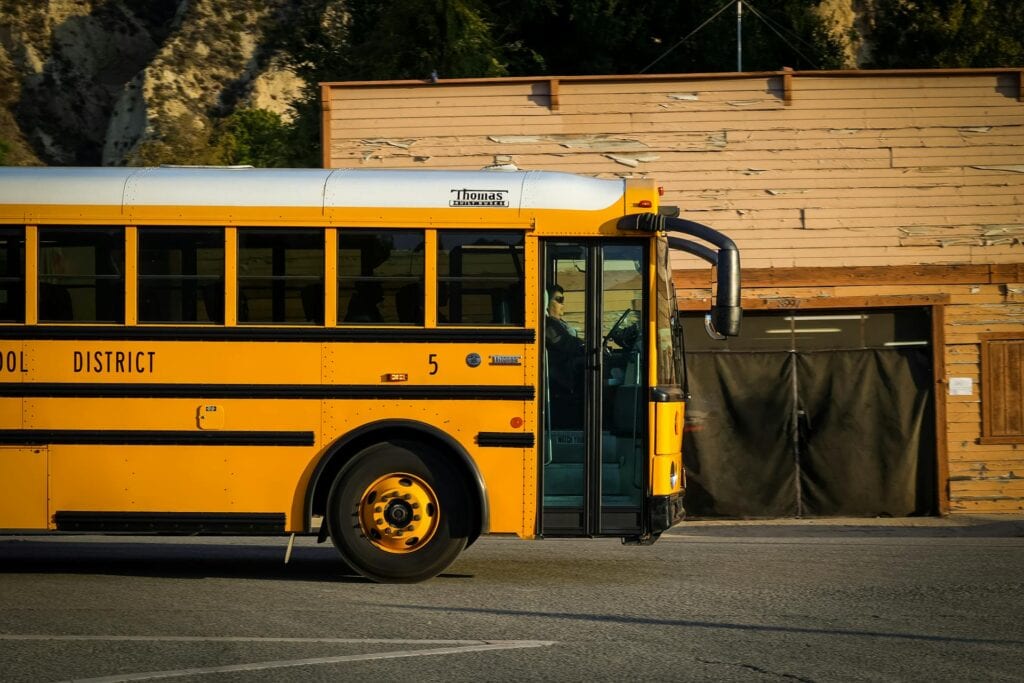
When we think of school buses, we picture the big yellow vehicles with stop signs that flip out from the side. But New York’s definition in Vehicle and Traffic Law Section 142 is broader than that. Under New York school bus laws, a school bus includes any motor vehicle owned by a public agency or private school that transports students, teachers, or supervisory staff to or from school or school activities. It also includes privately owned vehicles operated for compensation to transport these same people.
This means that a white van contracted by the district to transport a child with disabilities is legally a school bus. So is a smaller vehicle used for field trips or after-school programs. The definition matters because it determines which safety rules apply and what obligations other drivers have when they encounter these vehicles on the road.
If your child was injured in a vehicle you didn’t realize was classified as a school bus, it’s worth looking into whether all the required safety equipment was present and whether the driver had proper licensing and training.
What Training Must School Bus Drivers Complete?
School bus drivers in New York face some of the strictest requirements in the country, spelled out in 8 NYCRR Section 156.3. These rules exist because we entrust drivers with our most precious cargo, and any shortcut in training or qualification can lead to tragedy.
Every school bus driver must be at least 21 years old and hold a valid New York commercial driver’s license with both a passenger endorsement and a school bus endorsement. Before they can transport a single student, they must pass an annual physical exam and a physical performance test that checks whether they can climb bus steps, operate the brake pedal with adequate force, control the doors, and assist in emergency evacuations.
The training requirements are extensive. Before ever driving with children aboard, a new driver must complete at least four hours of school bus safety training. During their first year, they need a basic course of at least 30 hours covering safety procedures, child management, and emergency protocols. After that, every driver must complete at least two hours of refresher training twice a year, once between July and October and again between December and May. This refresher training must include instruction on transporting students with disabilities.
Districts are also required to conduct background checks, review driving records from every state where the driver has lived or held a license, and ensure compliance with federal drug and alcohol testing rules. When a driver causes an accident, one of the first questions in any injury case should be whether they had completed all required training and whether their record showed any red flags that the district ignored.
The Rules for School Bus Monitors and Attendants
Not every school bus has a monitor or attendant, but when they’re present, they serve critical safety functions. A monitor is employed to help children board and exit safely and to assist the driver in maintaining order. An attendant is specifically assigned to care for a child with disabilities as outlined in that child’s Individualized Education Program, including helping with boarding, exiting, and any special needs during the ride.
Monitors and attendants must be at least 19 years old and physically and mentally capable of performing their duties. Like drivers, they must pass a physical performance test before their first assignment and at least every two years after that. They need at least four hours of pre-service safety training before working with students, a basic course of at least ten hours during their first year, and two hours of refresher training twice per year.
For attendants working with students who have disabilities, additional certifications may be required. If a child’s IEP calls for CPR-trained staff on the bus, the attendant must have current CPR certification. Districts may also require first aid certification for monitors and attendants.
These requirements exist because monitors and attendants are often the first line of defense when something goes wrong on a bus. If a child is injured because a monitor was inadequately trained or because an attendant failed to properly secure a wheelchair, that failure to meet regulatory standards becomes central to any injury claim.
How Children Are Supposed to Be Kept Safe on the Bus
New York’s safety regulations spell out specific rules that govern what happens on a moving school bus. Students may not enter or leave while the bus is in motion, and they’re prohibited from sticking their heads or arms out of windows. These might sound like common sense, but they’re legally mandated, and a driver or monitor who allows this behavior is violating state regulations.
When a child needs to cross the street after getting off the bus, the driver must instruct them to walk at least 15 feet in front of the bus before crossing, ensuring they remain visible to the driver. The bus must stay stopped with red lights flashing until every crossing child has reached the other side and is at least 15 feet away or safely on the sidewalk. This rule exists because the area immediately around a stopped school bus is a danger zone where small children can disappear from the driver’s view.
Drivers are prohibited from filling fuel tanks while children are on board. They cannot leave the bus unattended with children inside except in an emergency, and even then they must turn off the engine, remove the key, and set the parking brake. Smoking and vaping are banned on school buses, as is any eating or drinking that could impair safe operation. The maximum speed limit for a school bus transporting students is 55 miles per hour on any road, even if the posted limit is higher.
Drivers must make complete stops at all railroad crossings and at state highways before crossing unless a traffic control device or police officer indicates otherwise. They must signal before making turns. They’re required to be familiar with not just traffic laws but also the specific education department regulations on pupil transportation.
When any of these rules is violated and a child is hurt, that violation can establish negligence in an injury case. A driver who was speeding, who failed to ensure a child crossed safely, or who left young children unattended has breached the duty of care owed to students.
Why School Bus Safety Drills Matter
Education Law Section 3623 and the accompanying regulations require every school bus to conduct at least three safety drills per school year. The first must happen during the first seven days of school, the second between November 1 and December 31, and the third between March 1 and April 30.
These drills aren’t optional or suggestions. They’re mandatory, and districts must certify annually to the State Education Department that they’ve been completed. During each drill, students learn the location and operation of emergency exits, fire extinguishers, first aid equipment, and how to use windows as escape routes. They practice safe boarding and exiting, including that critical rule about walking 15 feet in front of the bus before crossing. They learn about hazards in bad weather, from snow and ice to reduced visibility and hearing.
Before every sports trip or activity excursion, drivers must conduct a verbal mini-safety drill reviewing emergency procedures. These requirements exist because in an emergency, children need to know what to do instinctively. Panic is the enemy of safe evacuation.
When a school bus catches fire, rolls over, or is involved in any accident requiring emergency evacuation, whether the required drills took place can become crucial. If children were injured because they didn’t know where the emergency exits were or how to operate them, and the district failed to conduct the required drills, that failure contributed to the harm.
The Seat Belt Question on New York School Buses
Many parents are surprised to learn that seat belts are not required on all New York school buses. While districts must provide instruction on seat belt use at least three times per year to all students who ride buses, actually installing and requiring the use of seat belts is left to each district’s discretion.
The instruction must cover how to properly fasten and release seat belts, acceptable adjustment and placement, when to fasten and release them, and where to place them when not in use. Individual school boards may adopt resolutions requiring seat belts on some or all of their buses, but this isn’t a statewide mandate.
The rationale often cited is that school buses are designed with “compartmentalization,” a passive safety feature where high, padded seat backs protect children in frontal and rear impacts. However, this doesn’t help in side-impact collisions or rollovers, which is why the seat belt debate continues.
If a child is injured in a bus accident in a district that chose not to install seat belts, whether that decision constitutes negligence can be complex. However, if a district does have seat belts installed but drivers and monitors aren’t ensuring students use them, or if students weren’t properly instructed in their use as required by law, that failure to follow existing regulations is clearer evidence of negligence.
Why Standing Passengers Are Generally Prohibited
Education Law Section 3635-c makes it clear that standing passengers are not allowed on school buses owned by or contracted to school districts when transporting students under 21 and their teachers or supervisors. The rule is straightforward because standing passengers are at risk of falling when the bus stops, turns, or is involved in an accident.
There are only two narrow exceptions. During the first ten days of the school year, districts may permit a limited number of standing passengers while they sort out routes and capacity issues. Standing passengers may also be allowed in unlimited numbers when a breakdown, accident, or other unforeseen emergency makes it necessary to transport them.
Outside these exceptions, if your child was standing on a school bus and was injured when the bus stopped short or was involved in a collision, the district violated state law. This violation can be powerful evidence in an injury case, showing that the district failed to follow basic safety rules designed to prevent exactly what happened.
School Bus Idling Rules and Air Quality
New York has specific laws limiting how long school buses can idle on school grounds. Education Law Section 3637 requires districts to ensure that drivers turn off bus engines while waiting for students to load or unload on school grounds or while parked adjacent to schools.
The rule has exceptions for mechanical work, maintaining appropriate temperature for passenger comfort and safety, emergency evacuations, and operating wheelchair lifts. Districts are supposed to adopt policies promoting prompt loading and unloading rather than having buses sit and wait for entire fleets to arrive.
While idling rules primarily concern air quality and children’s respiratory health, they can become relevant in injury cases. If a child with asthma suffered a medical emergency on a bus where the driver violated idling rules, or if a child was injured running to catch a bus that pulled away early because of anti-idling concerns, these regulations provide context for what should have happened.
What Drivers Must Do When They See a Stopped School Bus
Vehicle and Traffic Law Section 1174 contains the rules that most adults in New York learned in driver’s education but that thousands violate every year. When a school bus stops to receive or discharge passengers and displays its red flashing lights and stop arm, every vehicle approaching from either direction must stop before reaching the bus and remain stopped until the bus moves again or until the driver or a police officer signals that it’s safe to proceed.
This applies on public highways, streets, and even private roads. It includes school driveways, parking areas, and access roads on school or BOCES grounds. The only exception would be a divided highway with a physical barrier, where traffic on the opposite side may proceed with caution.
The penalties for passing a stopped school bus are severe for good reason. Children are unpredictable, and the moments when they’re loading or unloading are when they’re most vulnerable. A first conviction carries a fine of $250 to $400 and up to 30 days in jail. A second conviction within three years increases the fine to $600 to $750 and up to 180 days in jail. A third or subsequent conviction within three years carries a fine of $750 to $1,500 and up to 180 days in jail.
Many school buses are now equipped with stop-arm cameras, and recent amendments to the law create a rebuttable presumption that a vehicle captured on camera passing a bus with red lights and stop arm extended has violated the law. This technology exists because the problem is so widespread and dangerous.
If your child was struck by a driver who passed a stopped school bus, that driver violated a clear safety law designed specifically to protect children. This makes establishing liability in an injury case relatively straightforward compared to accidents where negligence is more subtle. The challenge often becomes proving the extent of injuries and securing adequate compensation for medical bills, therapy, pain and suffering, and any long-term impacts on your child’s life.
Understanding Yellow Lights Versus Red Lights
Not all flashing lights on a school bus mean you must stop. When you see amber or yellow warning lights flashing, the bus is preparing to stop to load or unload passengers. Other drivers should slow down and prepare to stop, but they’re not yet required to come to a complete stop.
When the red lights begin flashing and the stop arm extends, that’s when the absolute duty to stop kicks in. The yellow lights serve as an advance warning, giving drivers time to react before children enter or exit the danger zone around the bus.
Confusion about when to stop can lead to accidents. Some drivers see yellow lights and think they can speed past the bus before it stops. Others see red lights too late and can’t stop in time. Still others are simply impatient or distracted and blow through a stopped bus even when they know they should stop.
In cases where a driver claims they didn’t realize they had to stop or didn’t see the lights, camera footage from the bus or from stop-arm cameras can be crucial evidence. So can the bus driver’s testimony about whether the lights and stop arm were functioning properly.
Where School Buses Stop and Why It Matters
School districts have authority to designate bus stops and pick-up points. They’re supposed to choose locations that maximize safety, considering factors like traffic patterns, sight lines, the need for children to cross streets, and the age of the students using each stop.
When districts make poor choices about bus stop locations, placing them in high-traffic areas, on blind curves, or requiring young children to cross dangerous roads, those decisions can contribute to accidents. If your child was injured at a bus stop, part of evaluating whether negligence occurred involves looking at whether the stop was reasonably safe and whether the district followed its own policies in designating that location.
Districts are also supposed to communicate clearly with parents about where stops are located and what time buses will arrive. When communication breaks down and children are in the wrong place at the wrong time, injuries can result.
What Happens When Someone Is Injured in a School Bus Accident
School bus accidents can take many forms. Children can be injured when buses crash into other vehicles or objects, when they roll over, when they’re struck while boarding or exiting, when they fall inside moving buses, or when other vehicles strike them near stopped buses. Drivers, monitors, and attendants can be injured in collisions. Pedestrians and other motorists can be hurt in crashes involving school buses.
New York law provides multiple potential sources of recovery depending on how the accident happened. If the bus driver’s negligence caused the crash, the school district or the private company that operates the bus may be liable. If another driver was at fault, that driver and their insurance company can be held responsible. If a defect in the bus itself caused the accident, the manufacturer might bear liability. If the district’s policies or training failures contributed to the accident, the district itself can be sued.
Claims against school districts and other government entities face special rules. Under New York’s Education Law and Court of Claims Act, you typically must file a notice of claim within 90 days of the accident before you can sue a school district. This is a much shorter deadline than the general statute of limitations for personal injury cases. Missing this deadline can destroy an otherwise valid claim, which is why it’s critical to consult with an attorney immediately after any accident involving a school bus.
For accidents involving school buses, preserving evidence is crucial. School districts have their own investigative procedures and often move quickly to secure statements and assess what happened. They may download data from the bus’s electronic systems, review camera footage, and interview drivers, monitors, and student witnesses. Families need to act just as quickly to protect their interests.
Important evidence includes photos of the accident scene, the bus, and any involved vehicles; contact information for witnesses; medical records documenting injuries; police reports; and any communications with school officials. If the bus had cameras inside or out, that footage needs to be preserved through a formal request before it’s routinely erased. If the accident happened at a bus stop, photographs of the location, sight lines, signage, and traffic patterns can be valuable.
The Human Cost Beyond the Legal Issues
Behind every school bus law in New York is a child who was hurt or killed when safety rules weren’t followed. These regulations exist because legislators, educators, and safety advocates learned the hard way that specific, detailed rules save lives. When districts cut corners on driver training, when drivers ignore safety procedures, when other motorists blow past stopped buses, children pay the price.
The injuries from school bus accidents range from minor cuts and bruises to traumatic brain injuries, spinal cord damage, broken bones, psychological trauma, and death. Young children are especially vulnerable because their bodies are still developing and because they lack the judgment to recognize and avoid danger.
For families dealing with the aftermath of a school bus accident, the legal process can feel overwhelming on top of the emotional and financial stress. Medical bills pile up, especially if a child needs surgery, rehabilitation, or ongoing therapy. Parents may need to take time off work to care for their injured child. Some injuries have lifelong consequences, affecting a child’s ability to learn, play, or eventually work.
New York law allows recovery for medical expenses, both past and future; pain and suffering; loss of enjoyment of life; and in cases of permanent injury, the impact on the child’s future earning capacity. For families who lost a child, wrongful death claims can include funeral expenses, loss of companionship, and the economic value of the child’s life.
Talk With a New York Personal Injury Lawyer at the Porter Law Group. Free, no-obligation, confidential.
Summing It Up
New York’s school bus laws represent some of the most comprehensive safety regulations in the nation, covering every aspect of how children should be transported to and from school. These laws set clear standards for who must be transported, what qualifications drivers and attendants must meet, how buses must be operated, what safety equipment must be present, and what other drivers must do when they encounter school buses.
When accidents happen, understanding these laws helps determine whether negligence occurred and who bears responsibility. A driver who wasn’t properly trained, a district that failed to conduct required safety drills, a motorist who passed a stopped bus, a district that designated an unreasonably dangerous bus stop – all of these can constitute negligence that supports an injury claim.
For families dealing with injuries from school bus accidents, the path forward starts with understanding what should have happened under the law and whether those responsible met their obligations. Every case is different, and the specific facts matter enormously. But knowing the legal framework helps families make informed decisions about whether to pursue a claim and what compensation might be available for their child’s injuries.
School buses should be the safest way for children to get to school. When they’re not, when the rules designed to protect children are ignored or violated, families have legal options to hold those responsible accountable and to secure the resources their children need to heal and move forward.