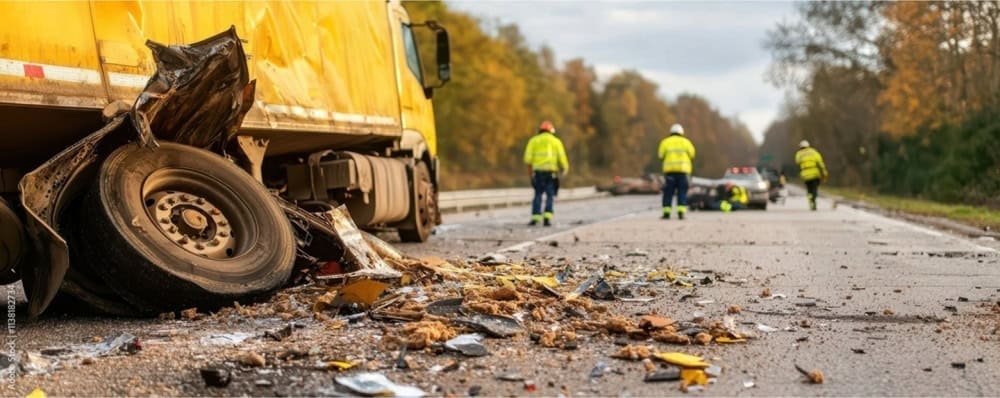

A squeeze play truck accident happens when a large commercial truck, usually during a wide turn, swings its trailer into an adjacent lane and traps a smaller vehicle, cyclist, pedestrian, or motorcyclist between the truck and something immovable. That immovable object could be a curb, a parked car, a light pole, a building, or a median. The victim gets pinned and crushed by the sheer weight and momentum of the truck.
These accidents most often occur at intersections or on narrow city streets where trucks need extra room to maneuver their long trailers around corners. The driver might fail to check mirrors, ignore blind spots, or forget to signal before starting the turn. Sometimes they simply misjudge the space available or the presence of someone in their path. The result is a violent compression that can cause devastating injuries or death.
Prior results do not guarantee a similar outcome.
The term “squeeze play” captures exactly what happens during these collisions. The truck essentially squeezes the victim against an object that won’t give way. Unlike a typical rear-end collision or side-swipe, squeeze play accidents involve crushing force from multiple directions. The truck doesn’t just hit someone. It traps them.
Why Do Squeeze Play Accidents Happen?
Most squeeze play accidents involve right turns. Trucks need to swing wide to navigate corners because of their length and limited turning radius. A tractor-trailer can be 70 feet long or more. To make a right turn from a single lane, the driver often has to start from the center or left lane, then arc the trailer through the intersection. As the trailer swings right, it can sweep into bike lanes, crosswalks, or the space where a car was sitting at the light.
The problem intensifies in cities like New York, where streets are narrow and intersections are crowded. A truck driver making a delivery might be under pressure to move quickly. They might rush the turn without properly checking their surroundings. Commercial trucks, garbage trucks, and delivery vehicles make frequent stops throughout the day, increasing the opportunities for these accidents to occur.
Garbage trucks present a particular risk. They operate on tight residential routes with constant stops and turns. Drivers work long shifts, often starting before dawn, and the repetitive nature of the work can lead to fatigue or complacency. When a sanitation truck swings wide to turn onto a narrow street, anyone in a bike lane or walking near the curb can be caught in the squeeze.
Driver error plays a central role in most of these crashes. Distraction is common. A driver checking a GPS, looking at a delivery manifest, or simply not paying full attention might not see a cyclist riding alongside. Fatigue makes reaction times slower and judgment worse. Some drivers speed through turns or fail to position their truck correctly before starting the maneuver. Others simply don’t understand how much space their trailer needs or where it will track during the turn.
Trucking companies sometimes contribute to these accidents through their policies and practices. Inadequate training means drivers might not fully understand how to execute safe turns in urban environments. Pressure to meet tight delivery schedules can push drivers to cut corners, literally and figuratively. Poor vehicle maintenance, like broken mirrors or malfunctioning turn signals, makes it harder for drivers to operate safely and communicate their intentions to others on the road.
What Are Blind Spots and No-Zones?
Every large truck has massive blind spots, sometimes called “no-zones,” where the driver cannot see other vehicles, cyclists, or pedestrians. These blind spots exist directly in front of the cab, behind the trailer, and along both sides, especially the right side. The area immediately next to and slightly behind the passenger door can hide an entire car from the driver’s view.
During a right turn, the right-side blind spot becomes especially dangerous. As the truck begins to turn, the trailer swings out and to the right. If a smaller vehicle, motorcycle, or bicycle is positioned in that blind spot, the driver has no way to see them. The trailer can sweep directly into them, pushing them toward the curb or trapping them against a fixed object.
Cyclists and motorcyclists are particularly vulnerable. They’re smaller and easier to miss in mirrors. They often travel in bike lanes or on the right side of traffic, exactly where a turning truck’s trailer will swing. Pedestrians crossing at intersections can also be caught if they’re in the crosswalk when a truck makes a turn without yielding.
The size and design of commercial trucks make these blind spots unavoidable to some extent. That’s why truck drivers need extensive training and must constantly check their mirrors and surroundings. When they fail to do so, the consequences can be catastrophic.
What Injuries Do Squeeze Play Accidents Cause?
The injuries from squeeze play accidents are often severe and life-altering. A fully loaded commercial truck can weigh up to 80,000 pounds. When that mass crushes someone against a curb, pole, or other vehicle, the human body cannot withstand the force.
Crush injuries are common. Bones break, organs rupture, and soft tissue is destroyed. Victims might suffer fractured ribs, collapsed lungs, internal bleeding, or damage to the liver, spleen, or kidneys. These injuries often require emergency surgery and extended hospital stays.
Traumatic brain injuries happen when the victim’s head strikes the ground, the truck, or another object during the collision. Even with a helmet, the force can cause concussions, skull fractures, or bleeding in the brain. Severe TBIs can result in permanent cognitive impairment, memory loss, personality changes, or the need for lifelong care.
Spinal cord injuries can leave victims paralyzed. Damage to the neck or back can sever or compress the spinal cord, affecting everything below the injury site. Paraplegia and quadriplegia are real possibilities in these accidents. Even incomplete spinal injuries can cause chronic pain, loss of sensation, and mobility challenges.
Amputations sometimes occur on the scene or become necessary afterward due to the severity of crush injuries. Limbs trapped and mangled by the truck’s weight might be unsalvageable. Victims face not only the physical loss but also the emotional trauma and the need for prosthetics and rehabilitation.
Many squeeze play accidents are fatal. Cyclists and pedestrians have no protection against the force of a commercial truck. Even occupants of smaller vehicles can be killed when the truck crushes their car. Families lose loved ones in an instant because a truck driver failed to check their mirrors or yield the right of way.
How Much Are Squeeze Play Accident Cases Worth?
The value of a squeeze play accident case depends on the severity of the injuries, the strength of the evidence, and the insurance coverage available. These cases often result in significant compensation because the injuries are so severe and the negligence is usually clear.
Cases involving traumatic brain injuries or spinal cord damage typically settle or result in verdicts ranging from $750,000 to over $5 million. The exact amount depends on factors like the victim’s age, their medical expenses, whether they can return to work, and how the injury affects their daily life. A young person left paralyzed will need decades of care, adaptive equipment, and lost income compensation.
Wrongful death cases also fall into the $500,000 to $5 million range or higher. These cases compensate the family for funeral expenses, the loss of financial support, and the loss of companionship and guidance. When the victim was the primary breadwinner or a parent to young children, the economic losses alone can be substantial.
Even cases with less severe injuries can result in significant settlements when broken bones, surgeries, and months of rehabilitation are involved. The key is documenting all medical treatment, lost wages, and the impact on quality of life.
Insurance limits matter. Commercial trucks are required to carry substantial liability insurance, often $1 million or more depending on the cargo and type of operation. Municipal vehicles like garbage trucks might be subject to different limits and rules. When insurance is insufficient to cover the full value of the case, victims might pursue claims against multiple parties or seek compensation from umbrella policies.
Who Is Responsible for a Squeeze Play Accident?
Determining liability in a squeeze play accident often involves looking at multiple parties.
The truck driver is usually the starting point, but they’re rarely the only one responsible. The driver’s negligence might include failing to check mirrors, not signaling, speeding through a turn, or misjudging the space available. If the driver was distracted, fatigued, or under the influence, that strengthens the case. Evidence like traffic camera footage, witness statements, and the truck’s electronic logging device data can prove what the driver did wrong.
The trucking company or employer typically shares responsibility under a legal principle called respondeat superior. This means employers are liable for the negligent acts their employees commit while working within the scope of their employment. If the driver was making a delivery or operating the truck as part of their job duties, the company is on the hook.
Companies can also face direct liability claims. If they failed to properly train the driver on safe turning procedures, that’s negligent hiring or training. If they pressured drivers to meet unrealistic schedules, leading to rushed and unsafe driving, that’s a systemic problem. If they skipped required vehicle maintenance and the truck had faulty mirrors or brakes, that’s negligent maintenance.
Maintenance companies and repair shops might be liable if they performed defective work on the truck. Cargo loading companies could share fault if improper loading caused the truck to handle unpredictably during the turn.
Government entities come into play when the truck is a municipal vehicle. Garbage trucks, sanitation vehicles, and public transit buses are operated by cities or contractors. Suing a government entity involves different rules and deadlines, which we’ll cover shortly.
Can You Sue After a Squeeze Play Accident?
Yes, you can sue after a squeeze play accident, but the process and timeline depend on who you’re suing and where the accident happened.
In New York, if the truck was privately owned and operated, you generally have three years from the date of the accident to file a personal injury lawsuit. Wrongful death cases have a two-year deadline from the date of death. These are called statutes of limitations, and missing them usually means losing your right to sue.
Suing a government entity is more complicated and time-sensitive. If a New York City sanitation truck, MTA bus, or other municipal vehicle caused your squeeze play accident, you must file a Notice of Claim within 90 days of the accident. This is a formal document that notifies the government of your intent to sue and provides basic information about the accident and your injuries.
After filing the Notice of Claim, you must wait for the government to investigate and respond. If they deny your claim or the waiting period expires, you can file a lawsuit. However, you only have one year and 90 days from the date of the accident to file that lawsuit against a government entity. This is much shorter than the three-year deadline for private defendants.
These strict deadlines exist because the law gives government entities special protections. The reasoning is that governments need time to investigate claims and budget for potential liabilities. The practical effect is that victims have far less time to pursue their cases.
Other states have their own rules. Michigan, for example, requires a 120-day notice before suing a municipality and caps damages at $500,000 per person in some cases. Colorado and other states use different notice periods and damage caps. If your accident happened outside New York or involved an out-of-state trucking company, the rules might be different.
Federal regulations also play a role. The Federal Motor Carrier Safety Administration (FMCSA) sets rules for commercial trucks operating across state lines. These rules cover driver hours, vehicle maintenance, and safety equipment. Violations of FMCSA regulations can strengthen your case by showing the driver or company broke the law.
What Is Comparative Negligence?
For personal injury cases covered by New York’s no-fault motor vehicle law and commenced on or after May 26, 2026, New York uses a modified comparative fault system under CPLR 1411(b). This means you can recover compensation even if you were partially at fault for the accident, but your recovery is reduced by your percentage of fault.
For example, if you were riding a bicycle in a truck’s blind spot and the truck turned into you, the trucking company might argue you should have been more aware of the danger. If a jury finds you 20% at fault and the truck driver 80% at fault, and your total damages are $1 million, the award would be reduced to $800,000.
This resembles the modified comparative negligence systems used in many other states, although New York compares your share of fault with the combined fault of everyone you sue, so an even split does not bar recovery. In modified systems, you can’t recover anything if you’re found to be 50% or 51% at fault, depending on the state.
New York now bars recovery if your fault is greater than the combined fault of the parties you are suing, and otherwise the more fault assigned to you, the less you receive.
Defense lawyers in squeeze play cases often try to shift blame to the victim. They’ll argue the cyclist should have stayed farther back, the pedestrian should have waited for the truck to complete its turn, or the driver of the smaller vehicle should have anticipated the truck’s movement. These arguments are designed to reduce the trucking company’s liability and payout.
Strong evidence is critical to countering these arguments. Video footage showing you had the right of way, witness testimony that the truck failed to signal, or expert analysis demonstrating the truck driver violated safety protocols all help establish the defendant’s primary responsibility.
What Evidence Do You Need?
Building a strong squeeze play accident case requires gathering evidence quickly before it disappears. The moments after the accident are critical.
Police reports provide an official record of the accident, including the officer’s observations, statements from drivers and witnesses, and any citations issued. Always call the police after a truck accident, even if injuries seem minor at first.
Photographs and video are invaluable. Take pictures of the vehicles, the intersection, skid marks, debris, traffic signals, and your injuries. Capture the truck’s position relative to where you were when the collision occurred. If nearby businesses or traffic cameras might have recorded the accident, note their locations so your lawyer can request footage before it’s deleted.
Witness statements can make or break a case. Bystanders who saw the truck turn without signaling or observed the driver not checking mirrors provide independent confirmation of negligence. Get names and contact information at the scene if possible.
Medical records document the extent of your injuries and connect them to the accident. Seek medical attention immediately, even if you don’t think you’re seriously hurt. Some injuries, like internal bleeding or concussions, might not be obvious right away. Delaying treatment gives the defense an argument that your injuries weren’t that serious or were caused by something else.
The truck’s electronic logging device (ELD) records the driver’s hours of service, speed, and other data. The truck might also have an event data recorder that captures information about braking, acceleration, and other factors in the seconds before the crash. Your lawyer can subpoena these devices and have experts analyze the data.
Driver logs, employment records, training materials, and maintenance records from the trucking company can reveal systemic problems. If the company has a history of hiring drivers with poor safety records, skipping required training, or deferring vehicle maintenance, that supports a claim for punitive damages.
Expert witnesses often play a crucial role. Accident reconstruction experts can analyze the physical evidence and explain how the accident happened and who was at fault. Trucking industry experts can testify about proper turning procedures and whether the driver followed them. Medical experts explain the nature and permanence of your injuries.
What Damages Can You Recover?
Squeeze play accident victims can pursue several types of damages, depending on the circumstances and the severity of the injuries.
Economic damages compensate for financial losses. Medical expenses are usually the largest component, including emergency room treatment, surgery, hospitalization, rehabilitation, prescription medications, medical equipment, and future medical care. If your injuries require ongoing treatment or long-term care, those future costs are included in your claim.
Lost wages cover the income you missed while recovering from your injuries. If you’re unable to return to your previous job or can only work part-time because of permanent disabilities, you can claim lost earning capacity. This calculates the difference between what you would have earned over your career and what you’ll actually be able to earn given your limitations.
Property damage covers repairs or replacement of your vehicle, bicycle, or other property damaged in the accident.
Non-economic damages compensate for intangible losses. Pain and suffering includes the physical pain from your injuries and the emotional distress of dealing with the accident and its aftermath. Loss of enjoyment of life compensates you for activities you can no longer participate in because of your injuries. Disfigurement and scarring, loss of consortium (the impact on your relationship with your spouse), and emotional trauma all fall into this category.
In wrongful death cases, the family can recover funeral and burial expenses, loss of financial support, loss of companionship and guidance, and the pain and suffering the deceased experienced before death if they survived for any period after the accident.
Punitive damages are available in cases involving gross negligence or intentional misconduct. If the trucking company knowingly put unsafe trucks on the road, falsified driver logs to hide hours-of-service violations, or ignored repeated safety complaints, a jury might award punitive damages to punish the company and deter similar conduct. These damages can significantly increase the total recovery.
How Do You Protect Your Rights?
Get medical attention immediately. Your health comes first, and prompt medical care creates a record linking your injuries to the accident. Follow your doctor’s treatment plan and attend all follow-up appointments. Gaps in treatment give the defense ammunition to argue your injuries weren’t serious.
Report the accident to the police and your insurance company. Be factual in your statements and avoid speculating about what happened or admitting fault. You might not have all the information yet about what the truck driver did wrong.
Document everything. Keep copies of medical bills, prescriptions, and records. Save pay stubs or tax returns showing your income before the accident. Take photos of your injuries as they heal. Keep a journal describing your pain levels, limitations, and how the injuries affect your daily life.
Don’t give recorded statements to the trucking company’s insurance adjuster without talking to a lawyer first. Adjusters are trained to ask questions designed to minimize your claim. They might ask if you feel okay, and if you say yes because you’re trying to be polite, they’ll use that against you later.
Don’t post about the accident on social media. Defense lawyers routinely search for and monitor victims’ social media accounts looking for posts they can twist to undermine your claim. A photo of you smiling at a family gathering becomes “evidence” you’re not really suffering, even though the photo doesn’t show the pain you were in before and after.
Consult with a lawyer who handles truck accident cases as soon as possible. These cases are complex, involving multiple parties, commercial insurance policies, federal regulations, and potentially government entities with special procedural requirements. An experienced lawyer can investigate the accident, identify all responsible parties, deal with insurance companies, and build a strong case while you focus on recovering.
Time is critical. Evidence disappears, witnesses forget details, and deadlines expire. The 90-day Notice of Claim requirement for government vehicles in New York is particularly unforgiving. Even for private defendants, starting the investigation early means better evidence and stronger claims.
How Can You Avoid Being in a Squeeze Play Accident?
While you can’t control what truck drivers do, you can reduce your risk of being caught in a squeeze play.
Stay out of blind spots. If you can’t see the truck driver in their mirror, they can’t see you. Avoid lingering alongside trucks, especially on the right side. Either drop back or move ahead so you’re visible.
Watch for turn signals, but don’t rely on them. Truck drivers sometimes forget to signal or leave their signal on from a previous turn. If a truck is positioned to turn, assume it will, even without a signal.
Give trucks extra space. Don’t squeeze between a truck and the curb, and don’t assume you can slip past a truck at a red light. Trucks need more room than you think to complete their turns.
Be especially careful at intersections. If you’re on a bicycle or motorcycle and a truck is next to you at a red light, consider waiting for the truck to complete its turn before proceeding. It’s better to arrive a few seconds later than to be trapped in a squeeze play.
For pedestrians, make eye contact with truck drivers before crossing, and never assume a truck will stop or yield just because you have the right of way. Trucks take longer to stop and have limited visibility.
Defensive awareness doesn’t mean you’re at fault if a truck hits you. Truck drivers have a legal duty to operate safely and check their surroundings. But being aware of the risks can help you avoid a life-changing accident.
Talk to our experienced truck accident lawyers, know your options, and then decide whether you want to work with us. No cost, no-obligation, confidential.
Summing It Up
Squeeze play truck accidents happen when large commercial vehicles trap smaller vehicles, cyclists, or pedestrians between the truck and an immovable object during wide turns. These accidents cause devastating injuries because of the crushing force involved. Victims suffer broken bones, traumatic brain injuries, spinal cord damage, amputations, and often lose their lives.
Liability typically involves the truck driver for failing to check blind spots or execute safe turns, and the trucking company for inadequate training, poor maintenance, or scheduling pressures. Government entities might be responsible when municipal vehicles like garbage trucks are involved, but suing them requires strict compliance with notice deadlines. In New York, you have just 90 days to file a Notice of Claim against a government entity and one year and 90 days to file the lawsuit.
These cases can result in substantial compensation, often ranging from hundreds of thousands to millions of dollars depending on the severity of the injuries and the strength of the evidence. New York’s comparative fault system allows recovery even if you share some fault, though your compensation is reduced proportionally and is barred if your fault is greater than the combined fault of the parties you are suing. This bar applies to personal injury cases covered by New York’s no-fault motor vehicle law and commenced on or after May 26, 2026.
Protecting your rights means getting immediate medical care, documenting everything, avoiding statements to insurance adjusters without legal advice, and consulting with a lawyer experienced in truck accident cases as soon as possible. The evidence you preserve and the actions you take in the days after the accident can make the difference between a strong case and a weak one.
If you or someone you care about was injured in a squeeze play truck accident, you don’t have to face the aftermath alone. These cases are complicated, and trucking companies have lawyers working to minimize what they pay. You deserve someone fighting just as hard for you. Reach out to the Porter Law Group for a free consultation, and know more about how you can recover the best compensation possible. Call 833-PORTER9 or email info@porterlawteam.com to get started.