
New York delivery room error claims must generally be filed before the child's 10th birthday under CPLR §214-a and CPLR §208. Public-hospital cases require a 90-day Notice of Claim under GML §50-e. Maternal claims arising from delivery room errors follow the adult 2.5-year statute with no infancy toll. Per Joint Commission Sentinel Event Alert No. 30 (2004), 47 cases of perinatal death or permanent disability were reported to the Joint Commission for review between 1996 and 2004 and the most common root cause was communication issues, identified in 72% of cases, followed by staff competency issues at 47%. Delivery room errors are a recognized category of medical malpractice in obstetric care because the standards for the delivery moment are well-established. Porter Law Group represents New York families whose newborns or mothers suffered preventable injuries from delivery room errors.
Settlement
Jury Verdict
Settlement
Settlement
Delivery room error cases are documented in the operative delivery note, the anesthesia record, the nursing flowsheet, and the resuscitation record. Did the team have the right people in the room when complications developed? Was communication between the obstetric team and the anesthesia team adequate? Was the appropriate level of neonatal resuscitation available? When the moment of delivery produced an unexpected complication, did the team respond per published standards? Each of these is documented in real time.
Porter Law Group has recovered more than $500 million for seriously injured clients since 2009, including multiple pediatric recoveries exceeding $8 million for children with permanent labor-and-delivery-related disabilities. Led by Harvard-educated attorney Michael S. Porter, a former U.S. Army JAG Corps Captain with over 20 years of trial experience, the firm retains maternal-fetal medicine specialists, obstetric anesthesiologists, neonatologists, pediatric neurologists, and life care planners on every case. Seven of eight partner-level attorneys are recognized by Super Lawyers, a distinction earned by fewer than 5% of New York attorneys. For more on the procedural framework that governs these cases, see Porter's published article on the Certificate of Merit and Expert Testimony in NY Medical Malpractice.
"Delivery room errors are typically failures of coordination, not technical failures. The obstetrician knew what to do. The anesthesiologist knew what to do. The nurse knew what to do. But communication broke down at a critical moment. The Joint Commission's own data identifies communication failures as the leading root cause of perinatal sentinel events — at 72%. When the chart shows that breakdown and the baby was injured, the case is generally strong."
— Michael S. Porter, J.D., Porter Law Group

REQUEST A NO-OBLIGATION CASE REVIEW
"Delivery room error" is a category of medical malpractice claim describing errors that occur during the immediate delivery period — typically the operative procedure (vaginal or cesarean), the moments immediately surrounding birth, and the immediate post-delivery period before mother and infant are stabilized. The legal claim follows New York's traditional four-element medical malpractice framework:
| Element | What Plaintiff Must Prove in a Delivery Room Error Case |
| Duty | The provider had a doctor-patient or hospital-patient relationship with the mother and the fetus during delivery |
| Breach (deviation from standard of care) | The team failed to perform the delivery procedure in accordance with accepted obstetric, anesthesia, and nursing standards |
| Causation | The failure was a substantial factor in causing the injury (NY's substantial factor causation standard) |
| Damages | Documented physical, cognitive, sensory, or developmental injury to the mother or infant flowing from the failure |
Delivery room errors are distinct from antepartum care failures (covered in our Failure to Act During Labor practice page) and from postpartum complications. The defining feature is that the error occurred at the delivery moment the operative procedure, the immediate transitional period from intrauterine to extrauterine life, and the team coordination during that critical window.
The Joint Commission and other patient-safety bodies have recognized several distinct categories of delivery room errors. Per Joint Commission Sentinel Event Alert No. 30 (2004), reviewable obstetric sentinel events include" any perinatal death or major permanent loss of function unrelated to a congenital condition in an infant having a birth weight greater than 2,500 grams." The recognized error categories include:
| Error Category | Examples | Mechanism |
| Communication / handoff failures | Failed escalation between nurse and physician; inadequate handoff at shift change; failure to communicate FHR concerns to anesthesia | 72% of perinatal sentinel events per Joint Commission SEA No. 30 |
| Staff competency / training failures | Inadequately trained provider performing operative delivery; unsupervised resident managing complication; absence of qualified provider when needed | 47% of perinatal sentinel events per Joint Commission SEA No. 30 |
| Operative vaginal delivery technical errors | Improper vacuum extraction or forceps technique; sequential vacuum-then-forceps use (against ACOG PB 219); applying instruments without meeting prerequisites | Direct injury to fetus and mother |
| Cesarean delivery surgical errors | Wrong-site procedure; retained surgical instruments or sponges; surgical injury to bladder, bowel, or ureter; uterine extension; hysterotomy injury to fetus | Direct surgical injury |
| Anesthesia errors | Failed intubation; aspiration; high spinal block; local anesthetic systemic toxicity; inadequate management of maternal hypotension affecting fetal oxygenation | Maternal and fetal injury |
| Resuscitation failures | Inadequate neonatal resuscitation; absent or inadequately trained resuscitation team; absence of NICU-level support when high-risk delivery anticipated | Failure to rescue compromised neonate |
| Multiple-instrument operative delivery | Sequential vacuum-then-forceps use (specifically called out by Joint Commission as preventable) | Cumulative trauma to fetus |
| Repetitive prolonged second-stage pushing | Repetitive coached pushing during nonreassuring FHR (specifically called out by Joint Commission) | Worsening fetal compromise |
| Wrong-patient / wrong-procedure events | Wrong-site surgery is one of the most commonly reported sentinel events generally per NIH StatPearls Sentinel Event review; applicable to obstetric procedures including operative deliveries | Catastrophic but rare |
Two of these categories multiple-instrument operative delivery and repetitive prolonged second-stage pushing during non reassuring FHR were specifically named by the Joint Commission as preventable causes of infant death and disability in obstetric sentinel events.
The Joint Commission has tracked perinatal sentinel events under formal reporting policies since 1996. Per Joint Commission Sentinel Event Alert No. 30 (July 2004), the analysis of 47 reported perinatal sentinel events revealed:
| Root Cause | Percentage of Cases |
| Communication issues | 72% |
| Staff competency / training issues | 47% |
| Organization culture as barrier to effective communication | Over half of organizations identified culture (hierarchy, intimidation, failure to function as a team) as a contributor |
The 72% communication-failure root cause is the most important data point in delivery room error litigation. It establishes that delivery room errors are typically NOT failures of medical knowledge or technical skill providers usually know what to do but failures of team coordination at critical moments.
Per Contemporary OB/GYN's Sentinel Events and Severe Maternal Morbidity review, the Joint Commission's January 2015 revised sentinel event definition is "any patient safety event (not primarily related to the natural course of the patient's illness or underlying condition) that reaches a patient and results in death, permanent harm, or severe temporary harm. "Severe maternal morbidity in obstetric cases is considered a sentinel event only if the outcome was unexpected in relation to the condition being treated, per the Joint Commission's clarification cited in the Contemporary OB/GYN review.
Six recurring failure patterns establish liability in delivery room error cases:
Failure 1 — Communication breakdown between obstetric team members. Per Joint Commission Sentinel Event Alert No. 30, communication failure is the most common root cause of perinatal sentinel events. When the chart shows a labor nurse identified concerning fetal heart rate features but did not adequately escalate to the attending physician, or shows the operating room team did not receive a complete handoff at shift change, or shows anesthesia was not adequately briefed on a developing maternal complication the resulting injury may be actionable on a communication-failure theory.
Failure 2 — Inadequate staff competency or training. Per the same Joint Commission analysis, staff competency issues contributed to 47% of perinatal sentinel events. When the chart shows the attending was inadequately trained for the level of complication that developed, or shows a resident performed a procedure without appropriate supervision, or shows a hospital allowed delivery in a setting that lacked appropriate clinical resources — the resulting injury may be actionable on an institutional-competency theory.
Failure 3 — Operative vaginal delivery technical errors. Per ACOG Practice Bulletin No. 219: Operative Vaginal Birth (April 2020, Reaffirmed 2022), forceps or vacuum extraction must meet specific prerequisites and procedural standards. Sequential vacuum-then-forceps use is specifically advised against. See our Vacuum Extraction practice page and Forceps Injury practice page for procedure-specific detail.
Failure 4 — Cesarean delivery surgical errors. Recognized cesarean errors include wrong-site procedure (rare but catastrophic), retained surgical sponges or instruments, surgical injury to maternal bladder/bowel/ureter, uterine extensions producing major hemorrhage, and hysterotomy injury to the fetus during the surgical opening of the uterus. Surgical errors during cesarean are often documented in the operative note, the surgical count documentation, and any subsequent imaging or operative repair notes.
Failure 5 — Anesthesia errors during delivery. Obstetric anesthesia is high-risk and time-pressured. Recognized errors include failed intubation in emergent cesarean, aspiration, high spinal block, local anesthetic systemic toxicity, and inadequate management of maternal hypotension that affects fetal oxygenation. See our Maternal Medical Negligence practice page for detail on anesthesia complications affecting the mother.
Failure 6 — Inadequate neonatal resuscitation. When a delivery is anticipated to produce a compromised neonate (preterm, fetal distress documented antenatally, meconium-stained fluid), the standard is to have qualified neonatal resuscitation team available at delivery. Failure to assemble the appropriate resuscitation team or failure to perform competent resuscitation when the neonate emerges compromised is a recognized basis for malpractice when the resulting injury is consistent with inadequate resuscitation.
FIND OUT WHAT YOUR DELIVERY ROOM ERROR CASE IS WORTH →
New York places no statutory cap on damages in medical malpractice cases. The pending NY S1608 (2025-2026) Borrello-sponsored bill proposing a $250,000 cap on noneconomic damages remains pending before the Senate Judiciary Committee and has not been enacted.
Delivery room error cases often involve dual claims the child's injury and the mother's injury arising from the same negligent care. Each claim runs on its own statute. Recoverable damages include:
Future medical and rehabilitation care for permanent injury. Children with HIE leading to cerebral palsy, brachial plexus injury, intracranial hemorrhage with sequelae, or other lasting injury typically require lifelong physical, occupational, and speech therapy, durable medical equipment, surgical interventions, special education support, and assistance with activities of daily living. The CDC estimates the lifetime cost of care for an individual with cerebral palsy at approximately $1 million in 2003 dollars, with medical care costs running roughly 10 times higher than for children without CP.
Past and future medical expenses.
Lost future earning capacity when permanent functional impairment results.
Pain and suffering damages are not capped in New York.
Maternal damages. Cesarean surgical complications, anesthesia complications, perineal lacerations, hemorrhage with hysterectomy, and other maternal injuries follow the mother's own 2.5-year statute under CPLR §214-a with no infancy toll.
Wrongful death. Catastrophic delivery room errors producing infant or maternal death support wrongful death claims under EPTL §5-4.1 within two years of death.
Parents' derivative claim. Parents can recover medical expenses they paid on the child's behalf and damages for loss of the child's services but under their own 2.5-year CPLR §214-a statute, which is not tolled by the child's infancy.
Porter Law Group's published catastrophic case results include three pediatric birth injury settlements that demonstrate the firm's track record in complex delivery-related injury cases. View all case results →
$8,300,000 Settlement: A premature infant suffered profound permanent disabilities, including cerebral palsy, after physicians failed to properly manage the mother's pre-gestational diabetes. The structured settlement provides lifetime care and therapy funding.
$8,250,000 Settlement: An infant sustained permanent physical and cognitive disabilities after delayed response to fetal distress during labor. Proceeds covered lifetime medical and educational needs.
$8,120,000 Settlement: An infant suffered permanent delivery-related injuries caused by mismanaged labor and delivery. The recovery funded a life-care plan built with the family's physicians and therapists.
Every case is different. Past results do not guarantee future outcomes.
| Category of Claim | Statute of Limitations | Infancy Toll | Effective Deadline | Primary Statute |
| Child's claim (private hospital/physician) | 2.5 years | Yes — capped at 10 years from malpractice | Child's 10th birthday in most cases | CPLR §214-a + CPLR §208 |
| Mother's claim (private hospital/physician) | 2.5 years | No — patient is adult mother | 2.5 years from malpractice | CPLR §214-a |
| Public hospital cases (NYC Health + Hospitals, SUNY Upstate, SUNY Downstate, Stony Brook, county hospitals) | 1 year and 90 days after Notice of Claim | No — 90-day Notice of Claim NOT tolled by infancy | 90 days from injury to file Notice of Claim | GML §50-e |
| Wrongful death of infant or mother | 2 years from date of death | N/A | 2 years from death | EPTL §5-4.1 |
| Parents' derivative claim | 2.5 years | No — not tolled by child's infancy | 2.5 years from malpractice | CPLR §214-a |
ACT NOW BEFORE YOUR DELIVERY ROOM ERROR CLAIM DEADLINE EXPIRES →

Did a Delivery Room Error Harm Your Baby or You in New York?
Find out if miscommunication, delayed response, or staff errors during delivery caused injury.
1. Request the complete labor-and-delivery records, including the operative delivery note, the anesthesia record, the labor nursing flowsheet, and the neonatal resuscitation record. Under Public Health Law §18, you are entitled to your and your child's complete medical records within a reasonable time of a written request. Each of these documents covers a different aspect of the delivery moment and they must be analyzed together.
2. Request the surgical count documentation if cesarean. Hospital cesarean delivery requires documented surgical counts (sponges, sharps, instruments) before, during, and after the procedure. Discrepant or undocumented counts can be evidence of retained surgical items.
3. Request the team composition and shift records. Identify which providers were physically present at delivery, which providers were on call, what the resident-supervision arrangements were, and what shift changes occurred during the relevant period.
4. Reconstruct the timeline with attention to handoffs. Communication failures at handoffs (shift change, shift handoff, handoff between obstetric and anesthesia teams, handoff to NICU) are the single largest root cause of perinatal sentinel events per the Joint Commission. Identify every handoff in the timeline.
5. Document any sentinel event reporting. Some delivery room errors trigger formal Joint Commission sentinel event review at the institution. Hospital incident reports, root cause analysis documentation, and any improvement plan documents while not always discoverable in litigation can be relevant evidence.
6. Preserve all imaging and pathology. Brain MRI between days 4 and 7 of life for any neurologic concerns; placental pathology; cord blood gas results; and any subsequent imaging documenting the injury.
7. Document developmental milestones over time. If the injury produces lasting deficit, the trajectory of recovery is core evidence.
8. Act immediately if your child or you were injured at a public hospital. The 90-day Notice of Claim deadline under GML §50-e is unforgiving and is NOT tolled by the child's infancy.
9. Consult a New York delivery room error attorney promptly. Porter Law Group offers free consultations on a contingency-fee basis and handles every stage of the case.
GET A FREE CASE REVIEW: CALL (833) PORTER-9 →
Porter Law Group represents families in delivery room error and related birth injury malpractice cases throughout New York State, with a statewide practice reaching every county and jurisdiction. Our Syracuse headquarters serves Central and Upstate New York, while attorneys travel regularly to downstate courthouses for cases in the five boroughs, Westchester, and Long Island.
Serving Clients statewide, including Delivery Room Error Attorney in Syracuse, New York City, Manhattan, Buffalo, Rochester, Albany, Yonkers, White Plains, Utica, Binghamton, Long Island (Nassau and Suffolk Counties), Saratoga Springs, Ithaca
Wherever you or your child were injured in New York, call (833) PORTER-9 for a free consultation with an experienced birth injury attorney.
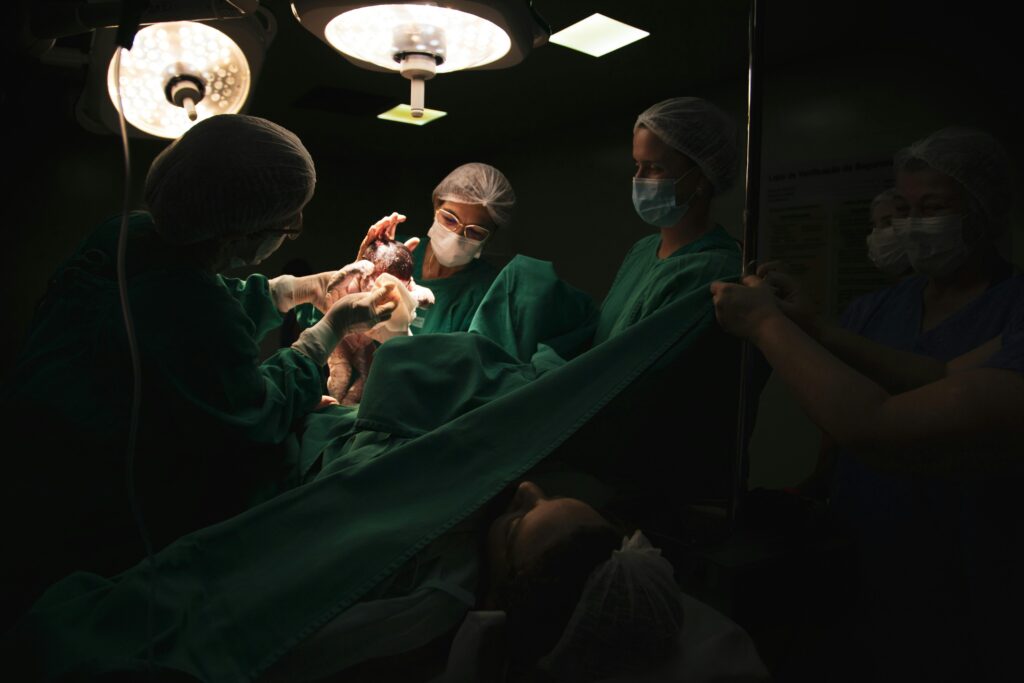
"Delivery room error" is a category of medical malpractice claim describing errors that occur during the immediate delivery period typically the operative procedure (vaginal or cesarean), the moments immediately surrounding birth, and the immediate post-delivery period before mother and infant are stabilized. The legal claim follows New York's traditional four-element medical malpractice framework: duty, breach, causation (NY's substantial factor causation standard), and damages. Delivery room errors are distinct from antepartum care failures (covered in our Failure to Act During Labor practice page) and from postpartum complications. The defining feature is that the error occurred at the delivery moment. Recognized error categories include communication and handoff failures, staff competency issues, operative vaginal delivery technical errors, cesarean surgical errors, anesthesia errors, resuscitation failures, and rare wrong-patient or wrong-procedure events.
Per the Joint Commission's published policy, a sentinel event is "any patient safety event (not primarily related to the natural course of the patient's illness or underlying condition) that reaches a patient and results in death, permanent harm, or severe temporary harm" (revised definition, January 2015). In obstetrics, reviewable sentinel events under the Joint Commission's policy include "any perinatal death or major permanent loss of function unrelated to a congenital condition in an infant having a birth weight greater than 2,500 grams" per Sentinel Event Alert No. 30 (2004), and any intrapartum maternal death or severe maternal morbidity per Contemporary OB/GYN's Sentinel Events review. When a delivery room event meets this threshold, the hospital is obligated to conduct a root cause analysis and implement corrective action. Sentinel event status does not automatically establish malpractice liability, but the underlying patient safety event often supports a malpractice claim.
Per Joint Commission Sentinel Event Alert No. 30 (2004) — the foundational study of perinatal sentinel events — communication issues were identified as the root cause in 72% of perinatal sentinel events reported to the Joint Commission. Staff competency issues contributed to 47% of cases. Over half of organizations identified organization culture (hierarchy, intimidation, failure to function as a team) as a barrier to effective communication and teamwork. The 72% communication-failure root cause is the most important data point in delivery room error litigation: it establishes that delivery room errors are typically not failures of medical knowledge or technical skill providers usually know what to do but failures of team coordination at critical moments.
The two categories overlap but are conceptually distinct. Failure to act during labor typically describes recognition or response failures during labor not interpreting fetal heart rate tracings correctly, not initiating intrauterine resuscitation when Category II tracings appeared, not expediting delivery when Category III tracings did not respond to resuscitation. Delivery room error typically describes errors at the moment of delivery the operative procedure, the immediate post-delivery transition, the team coordination during that window. Many catastrophic obstetric cases involve both failure to act during labor producing a compromised fetus, plus delivery room error in resuscitation or operative delivery. The legal analysis often charges multiple theories of negligence covering both phases. The two practice pages address the distinct phases of labor-and-delivery care and may both apply to a single case.
Yes — surgical errors during cesarean delivery are a recognized basis for malpractice. The recognized cesarean delivery surgical errors include wrong-site procedure (rare but catastrophic), retained surgical sponges or instruments, surgical injury to maternal organs (bladder, bowel, ureter), uterine extensions producing major hemorrhage, and hysterotomy injury to the fetus during the surgical opening of the uterus. Surgical errors are typically documented in the operative note, the surgical count documentation, and any subsequent imaging or operative repair notes. Per Joint Commission sentinel event guidance, foreign body retention is one of the most common general sentinel event categories. Cesarean surgical errors that produce permanent maternal or infant injury are recognized bases for medical malpractice claims in New York under CPLR §214-a.
Delivery room error claims pose timing challenges because the mother's claim and the child's claim run on separate statutes. The child's claim runs under CPLR §214-a (2.5 years), tolled during the child's minority but capped at 10 years from the malpractice under CPLR §208 — meaning most child claims must be filed before the child's 10th birthday. The mother's claim also runs under the 2.5-year CPLR §214-a statute but is not tolled because the mother is the adult patient. Public-hospital cases require a Notice of Claim within 90 days of the injury under GML §50-e for both mother's and child's claims, and the infancy toll does not extend the 90-day deadline. Wrongful death claims for infant or maternal death follow a separate 2-year deadline under EPTL §5-4.1.
Delivery room error settlement values vary based on the severity and permanence of the resulting injury. Cases involving full recovery resolve at modest values; moderate permanent injuries typically settle in the high six to low seven figures; catastrophic permanent injuries HIE leading to cerebral palsy, severe brain damage,wrongful death, or maternal hysterectomy/death routinely settle in the seven to eight figures. The CDC estimates the lifetime cost of care for an individual with cerebral palsy at approximately $1 million in 2003 dollars, with medical costs running roughly 10 times higher than for children without CP — meaning catastrophic case projections frequently exceed $10 million in 2026 dollars. New York places no statutory cap on damages in medical malpractice cases. Every settlement of a minor's claim must be approved by a judge at an infant compromise hearing under CPLR §1207, and attorney fees follow the sliding scale in Judiciary Law §474-a: 30% of the first $250,000, 25% of the next $250,000, 20% of the next $500,000, 15% of the next $250,000, and 10% of any amount over $1,250,000.
The most important evidence in a delivery room error case is the complete delivery record reconstructed minute by minute, with specific attention to handoffs and team communications. Critical documents include: (1) the operative delivery note documenting the type of delivery, indication, technique, and any complications; (2) the anesthesia record documenting medications, vital signs, and any anesthesia-related events; (3) the labor nursing flowsheet documenting communications with the attending and any escalations; (4) the neonatal resuscitation record if the infant required resuscitation; (5) the surgical count documentation if cesarean; (6) shift change documentation and team composition at delivery; (7) cord blood gas values and Apgar scores; and (8) any incident reports or root cause analysis documents related to the event (these are not always discoverable but their existence is sometimes determinative). Together, these documents create a precise timeline of who was in the room, what each provider did, what was communicated and when, and how any complication was managed. Communication breakdowns at handoffs are the single largest root cause of perinatal sentinel events per the Joint Commission and are a primary focus of expert review in delivery room error cases.

Michael S. Porter is the founder and managing partner of Porter Law Group, representing New York families in delivery room error, birth injury, medical malpractice, and catastrophic injury cases. A graduate of Harvard University (B.A., 1994) and Syracuse University College of Law (J.D., 1997), Porter served four years as a Captain in the U.S. Army Judge Advocate General's Corps. Selected to Super Lawyers for 14 consecutive years (2012–2025), he holds a 10.0 Superb rating on Avvo and a Distinguished rating from Martindale-Hubbell.
Bar Admissions: New York State Bar | U.S. District Court, Northern and Western Districts of New York
Memberships: New York State Bar Association, Onondaga County Bar Association, New York State Academy of Trial Lawyers, Multi-Million Dollar Advocates Forum
If your child or you suffered injury during a delivery in New York due to medical negligence, critical deadlines may run faster than you expect. The mother's claim runs on the adult 2.5-year statute with no infancy toll under CPLR §214-a; the child's claim follows the same 2.5-year statute but is tolled until the 10th birthday under CPLR §208. Public-hospital cases require Notice of Claim within 90 days for both claims.
Contact Porter Law Group today at (833) PORTER-9 for a free, no-obligation consultation. We operate on a contingency-fee basis under Judiciary Law §474-a, so you pay nothing unless you win.
Phone: +1 833-767-8379
Email: info@porterlawteam.com
Monday to Friday: 8 AM to 5 PM | Saturday and Sunday: Closed

Avoid sharing confidential information via contact form, text, or voicemail as they are not secure. Please be aware that using any of these communication methods does not establish an attorney-client relationship. *By appointment only.
The information contained on this site is proprietary and protected. Any unauthorized or illegal use, copying, or dissemination will be prosecuted to the fullest extent of the law. All content on this site is provided for informational purposes only. It is not, nor should it be taken as medical or legal advice. None of the content on this site is intended to substitute for medical advice, diagnosis, or treatment. Attorney Advertising.
We serve clients in every city and county in New York State. These include places like: The Adirondacks, Albany, Alexandria Bay, Amsterdam, Astoria, Auburn, Ballston Spa, Batavia, Beacon, Binghamton, Brooklyn, Buffalo, Canandaigua, Carthage, Cattaraugus, Catskill, Cayuga Lake, Cazenovia, Chelsea, Clayton, Clifton Park, Cobleskill, Colonie, Cooperstown, Corning, Cortland, Delhi, Delmar, Dunkirk, East Aurora, East Hampton, Elmira, Fayetteville, Finger Lakes, Flushing, Fredonia, Fulton, Garden City, Geneva, Glen Cove, Glens Falls, Gloversville, Gouverneur, Great Neck, Greenwich Village, Hamilton, Hammondsport, Harlem, Haverstraw, Hempstead, Herkimer, Hornell, Hudson, Huntington, Ilion, Ithaca, Jamaica, Jamestown, Johnstown, Kingston, Lake George, Lake Placid, Lewiston, Little Falls, Liverpool, Lockport, Long Island City, Lowville, Malone, Manhattan, Manlius, Massena, Medina, Middletown, Monticello, Montauk, Mount Vernon, New Paltz, New Rochelle, Newburgh, Niagara Falls, North Tonawanda, Norwich, Nyack, Ogdensburg, Old Forge, Olean, Oneida, Oneonta, Ossining, Oswego, Penn Yan, Peekskill, Plattsburgh, Port Chester, Potsdam, Poughkeepsie, Queens, Rhinebeck, Riverhead, Rochester, Rome, Rye, Sag Harbor, Saranac Lake, Saratoga Springs, Schenectady, Seneca Falls, Seneca Lake, Skaneateles, SoHo, Southampton, Spring Valley, Staten Island, Stony Brook, Suffern, Syracuse, Tarrytown, The Bronx, Thousand Islands, Ticonderoga, Troy, Tupper Lake, Utica, Warsaw, Waterloo, Watertown, Watkins Glen, Wellsville, White Plains, Williamsburg, Woodstock, Yonkers, and many more communities throughout New York State.
Copyright © 2026, Porter Law Group. Personal Injury Lawyers
Made with 💛 by Gold Penguin


