
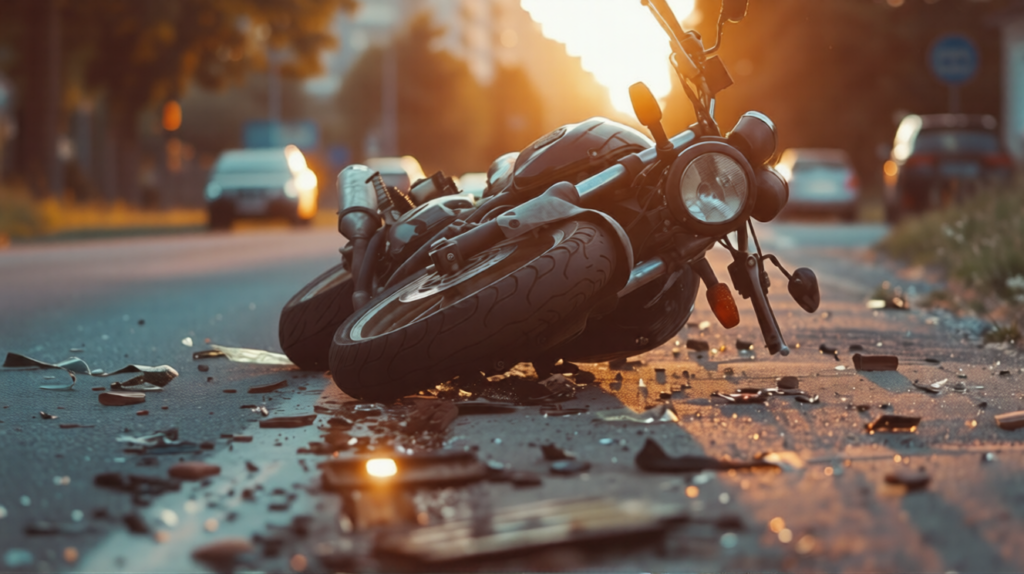

The most common fatal motorcycle accident in a multi-vehicle crash is a collision in which another vehicle strikes the motorcycle from the front; the crash configuration recorded in 79 percent of two-vehicle motorcycle fatalities in 2023, according to NHTSA. The most frequent mechanism behind that front-impact is another driver failing to yield while turning left across the motorcycle’s path. The major factors that consistently appear across all motorcycle crash types are speeding, alcohol impairment, and other drivers’ failure to detect motorcycles in traffic. Understanding which crash type you are most likely to face and what causes it is directly relevant to how you ride, and to the legal options you have for motorcycle accident if it happens anyway.
Prior results do not guarantee a similar outcome.
What Are the Two Main Types of Motorcycle Accidents?
Every motorcycle accident falls into one of two categories: multi-vehicle crashes involving at least one other vehicle, and single-vehicle crashes involving only the motorcycle.
According to NHTSA’s 2023 Motorcycles Traffic Safety Facts (DOT HS 813 732), collisions with another motor vehicle were the most harmful event for 60 percent of the motorcycles involved in fatal crashes in 2023. The remaining 40 percent were single-vehicle crashes crashes in which the motorcycle left the roadway, struck a fixed object, or went down without involving another vehicle.
| Crash Type | Share of Motorcycles in Fatal Crashes (2023) |
| Multi-vehicle collision | 60% |
| Single-vehicle crash | 40% |
Source: NHTSA Traffic Safety Facts, Motorcycles: 2023 Data (DOT HS 813 732)
The distinction matters legally as well as statistically. Multi-vehicle crashes typically involve at least one negligent driver whose actions caused or contributed to the collision creating a third-party liability claim. Single-vehicle crashes may involve road defects, fixed hazard visibility failures, or the rider’s own actions. Each category requires a different investigative approach and a different legal strategy.
What Is the Most Common Multi-Vehicle Motorcycle Accident?
In multi-vehicle motorcycle crashes, the dominant crash pattern is a motorcycle being struck from the front by another vehicle.
In 2023, 79 percent of motorcycles involved in two-vehicle fatal crashes were impacted on the front, according to NHTSA’s 2023 data. Only 6 percent were struck from the rear. A front impact on a motorcycle almost always means the other vehicle moved into the motorcycle’s path — not that the motorcycle moved into the vehicle.
The most common mechanism behind this pattern is another driver turning left across the path of a motorcycle proceeding straight. Under VTL §1141, the driver of a vehicle intending to turn left at an intersection must yield the right of way to any vehicle approaching from the opposite direction that is within the intersection or close enough to constitute an immediate hazard. When a driver fails to yield and turns left in front of an oncoming motorcycle, the motorcycle has no protective structure to absorb the collision — the rider takes the full force of the impact.
This crash type is particularly dangerous because it occurs where riders are most concentrated: 37 percent of motorcyclist fatal crashes in 2023 was due to intersection motorcycle accidents, according to NHTSA. The other driver frequently reports not seeing the motorcycle until impact. Motorcycles are narrower and present a smaller visual profile than passenger cars, and many drivers are not trained to scan specifically for motorcycles at intersections.
Why these crashes produce legal claims: A driver who fails to yield while turning left in violation of VTL §1141 has committed a statutory violation that directly establishes negligence. If the other driver was also distracted using a cell phone in violation of VTL §1225-d cell phone records subpoenaed through litigation can establish that distraction as a contributing cause. These cases involve a clear at-fault driver, a documented statutory violation, and a motorcycle rider with no protective structure absorbing a head-on impact exactly the combination that produces serious injury claims and serious verdicts.
What Are the Major Factors in Motorcycle Accidents?
NHTSA and IIHS data consistently identify the same behavioral and situational factors in fatal motorcycle crashes. These are not theoretical risk categories they are the specific conditions present in the majority of crashes that result in fatalities.
Speeding. In 2023, 36 percent of motorcycle riders involved in fatal crashes were speeding, compared to 22 percent of passenger car drivers, according to NHTSA’s 2023 Speeding Traffic Safety Facts (DOT HS 813 721). Speeding is a factor across both multi-vehicle and single-vehicle fatal crashes. At higher speeds, the time available to respond to a turning vehicle or road hazard is reduced, and the forces transmitted to the rider in a crash increase dramatically.
Alcohol impairment. Twenty-six percent of fatally injured motorcycle drivers in 2023 had blood alcohol concentrations at or above the legal limit of 0.08 g/dL, according to IIHS. Among riders killed at night, 44 percent had BACs at or above the legal limit. In single-vehicle crashes specifically, 40 percent of riders killed in 2024 were alcohol-impaired, according to NHTSA’s traffic safety data. Alcohol impairs the balance, throttle control, and split-second coordination that motorcycle operation demands at a level that exceeds its impairment of car driving.
No valid motorcycle license. In 2024, 35 percent of motorcycle operators involved in fatal crashes were riding without valid motorcycle licenses, according to NHTSA. A motorcycle license endorsement requires specific training in low-speed maneuvering, emergency braking, and hazard recognition skills that are not developed through car driving experience. Riders without that training are statistically overrepresented in fatal crashes.
Other drivers’ failure to detect motorcycles. In 2023, 37 percent of motorcyclist fatal crashes occurred at intersections, and 79 percent of motorcycles in two-vehicle fatal crashes were struck from the front. Both statistics point to a common thread: the other vehicle moved into the motorcycle’s space. Motorcycles are harder for other drivers to detect than cars because they occupy less visual space, are narrower in profile, and require a specific scan pattern that most drivers do not consistently apply. This is not a failure of the rider — it is a failure of driver awareness. Under New York’s negligence standard, every driver owes a duty of reasonable care to other road users, including motorcycle riders. A driver who turns left without seeing an approaching motorcycle, or who changes lanes without checking for a rider, has breached that duty.
| Major Factor | Data | Source |
| Speeding | 36% of riders in fatal crashes (2023) | NHTSA DOT HS 813 721 |
| Alcohol impairment | 26% of fatally injured riders BAC ≥ 0.08% (2023) | IIHS FARS data |
| Alcohol in single-vehicle crashes | 40% of riders killed (2024) | NHTSA trafficsafetymarketing.gov |
| Alcohol at night | 44% of riders killed at night (2023) | IIHS FARS data |
| No valid motorcycle license | 35% of operators in fatal crashes (2024) | NHTSA nhtsa.gov |
| Intersection location | 37% of fatal crashes (2023) | NHTSA DOT HS 813 732 |
| Front-impact in two-vehicle crashes | 79% of two-vehicle fatal crashes (2023) | NHTSA DOT HS 813 732 |
What Are the Most Common Single-Vehicle Motorcycle Accidents?
Single-vehicle crashes account for approximately 40 percent of motorcycle fatal crashes. They fall into three main patterns.
Fixed object collisions. In 2023, 24 percent of motorcycles involved in fatal crashes collided with fixed objects, according to NHTSA. This is a substantially higher rate than for any other vehicle type — 16 percent for passenger cars, 12 percent for light trucks, and 4 percent for large trucks. Fixed objects include guardrails, utility poles, trees, concrete barriers, and bridge abutments. A motorcycle that leaves the travel lane or loses control at speed has no structural protection when it contacts these objects.
Road hazard crashes. Potholes, uneven pavement, loose gravel, sand deposits, and raised utility covers create hazards that a car tire and suspension can absorb without incident but that can cause a motorcycle to lose traction, oscillate, or go down at speed. In New York, when a road defect caused or contributed to a single-vehicle motorcycle crash, the rider may have a claim against the government entity responsible for maintaining that roadway but only if a Notice of Claim is filed within 90 days of the crash under General Municipal Law §50-e. This deadline runs from the date of the crash, not the date an attorney is retained.
Overcorrection and loss of control. Emergency braking, sudden swerving to avoid a road hazard or an inattentive pedestrian, and misjudging a curve are the most common rider-input causes of single-vehicle crashes. These crashes are more prevalent at higher speeds, which is consistent with the speeding data showing 36 percent of fatal crash riders were traveling above the speed limit.
90-Day Deadline — Road Defect Claims: If a pothole, uneven pavement, or missing signage contributed to your crash, a Notice of Claim must be filed with the responsible government entity within 90 days under GML §50-e. Missing this deadline permanently bars the government liability claim regardless of how strong the underlying facts are.
How New York Law Applies to the Most Common Motorcycle Accident Types
Left-turn and intersection crashes (VTL §1141 and §1140). When a driver fails to yield while turning left in front of a motorcycle, that failure violates VTL §1141 — a statutory duty to yield to oncoming traffic at intersections. An attorney investigating this crash type subpoenas the at-fault driver’s cell phone records under CPLR Article 23 to determine if distracted driving contributed, retains an accident reconstruction expert to document speed and sight lines, and preserves surveillance footage from nearby businesses before it is overwritten.
Rear-end and lane-change crashes. When a driver strikes a motorcycle from behind or changes lanes without seeing the rider, the violation is typically VTL §1140 (failure to yield at an intersection) or a lane change violation.
These crashes also frequently involve distracted driving under VTL §1225-d, which prohibits use of a portable electronic device while operating a vehicle. Cell phone records that show the at-fault driver was texting or using an application at the time of the crash establish negligence per se.
Road defect single-vehicle crashes. When a road defect caused the crash, New York law allows a claim against the responsible government entity, but only after a Notice of Claim is filed within 90 days under GML §50-e.The attorney then conducts Freedom of Information Law (FOIL) requests for the entity’s prior inspection and maintenance records to establish that it had notice of the defect before the crash.
Comparative fault challenges in all crash types. In every motorcycle accident case, the at-fault driver’s insurer will attempt to assign a portion of fault to the rider — arguing the rider was speeding, not wearing appropriate gear, or failed to take evasive action. Under CPLR §1411, New York’s pure comparative negligence rule, partial fault reduces the recovery proportionally but does not eliminate it. An attorney presenting accident reconstruction evidence and physical crash data establishes the actual fault allocation rather than allowing the insurer’s characterization to stand unchallenged.
Porter Law Group has investigated and litigated every crash type described in this article intersection collisions, left-turn crashes, road defect claims, and single-vehicle crashes involving fixed objects across New York State.The firm has recovered more than $500 million for injured New Yorkers. All eight attorneys have been selected to Super Lawyers or Rising Stars, including founder Michael S. Porter, named to Super Lawyers for 14 consecutive years. For a full explanation of your legal rights after any type of motorcycle accident, see our New York Motorcycle Accident page.
Talk to our experienced New York motorcycle accident lawyers about your options for recovery in a free, no-obligation consultation.
Frequently Asked Questions
What is the most common type of motorcycle accident?
The most common fatal motorcycle accident in a multi-vehicle crash is a front-impact collision, recorded in 79 percent of two-vehicle motorcycle fatal crashes in 2023, according to NHTSA. The most frequent mechanism is another driver failing to yield while turning left across the motorcycle’s path at an intersection. Single-vehicle crashes involving fixed objects, road hazards, or loss of control account for approximately 40 percent of fatal motorcycle crashes.
What is a major factor in motorcycle accidents?
Speeding, alcohol impairment, riding without a valid motorcycle license, and other drivers’ failure to detect motorcycles at intersections are the major factors consistently identified in fatal motorcycle crash data. In 2023, 36 percent of motorcycle riders in fatal crashes were speeding (NHTSA), 26 percent of fatally injured riders had BACs at or above the legal limit (IIHS), and 35 percent of operators in fatal crashes in 2024 were riding without valid licenses (NHTSA). Separately, 37 percent of motorcyclist fatal crashes occurred at intersections in 2023.
Why do so many motorcycle accidents happen at intersections?
Because intersections require other drivers to make yielding decisions and motorcycles are harder for drivers to detect than cars. Motorcycles present a narrower visual profile and require a deliberate scan pattern that many drivers do not consistently apply. In 2023, 37 percent of motorcyclist fatal crashes occurred at intersections according to NHTSA, and 79 percent of motorcycles in two-vehicle fatal crashes were struck from the front consistent with another vehicle moving into the motorcycle’s path rather than the rider running into a stationary vehicle. Under New York law, a driver turning left must yield to oncoming traffic under VTL §1141.
Are most motorcycle accidents the rider’s fault?
No. In multi-vehicle motorcycle crashes, the data consistently shows the other vehicle moving into the motorcycle’s path. In 2023, 79 percent of motorcycles in two-vehicle fatal crashes were struck from the front, which indicates the other vehicle crossed into the motorcycle’s lane or turned in front of it. NHTSA and IIHS data show that rider behavior — speeding and alcohol impairment — is a more significant factor in single-vehicle crashes than in multi-vehicle ones. In New York, a finding of partial fault reduces but does not eliminate recovery under the comparative negligence rule at CPLR §1411.
What are the most common single-vehicle motorcycle accidents in New York?
Fixed object collisions, road hazard crashes, and loss of control due to overcorrection are the most common single-vehicle motorcycle crash patterns. In 2023, 24 percent of motorcycles in fatal crashes collided with fixed objects, according to NHTSA — a higher rate than any other vehicle type. Road hazards including potholes and uneven pavement are a specific concern in New York, where damaged road surfaces can cause a motorcycle to lose traction or go down without warning. If a road defect caused or contributed to a crash, a Notice of Claim must be filed against the responsible government entity within 90 days under GML §50-e.
How does alcohol affect motorcycle accident risk?
Alcohol impairs the specific physical skills that motorcycle riding depends on balance, fine motor control, and rapid coordination more severely than it impairs car driving. In 2023, 26 percent of fatally injured motorcycle drivers had BACs at or above the legal limit, according to IIHS. In single-vehicle crashes, that figure rises to 40 percent (2024, NHTSA). Among riders killed at night, 44 percent had BACs at or above 0.08 g/dL (2023, IIHS). These figures are consistently higher than the alcohol impairment rates for passenger car drivers in fatal crashes.
How does speeding contribute to motorcycle accidents?
Speeding reduces the time available to respond to a hazard and increases the force of impact in a crash. In 2023, 36 percent of motorcycle riders involved in fatal crashes were speeding well above the 22 percent rate for passenger car drivers according to NHTSA’s 2023 Speeding Traffic Safety Facts. For motorcycle riders, speeding is particularly dangerous because there is no protective vehicle structure to absorb excess collision energy. In a left-turn intersection crash at 45 mph, the outcome is categorically different from the same crash at 25 mph.
What should I do if another driver caused my motorcycle accident in New York?
Seek medical care immediately, preserve all evidence, and contact a motorcycle accident attorneybefore speaking to any insurance company. Because motorcycles are excluded from New York’s no-fault insurance system under Insurance Law §5103, your claim moves directly against the at-fault driver’s liability coverage. If a left-turn crash or intersection violation was the cause, an attorney can document the statutory violation, subpoena the at-fault driver’s cell phone records, and retain an accident reconstruction expert to establish how the crash occurred. The standard deadline to file suit is three years under CPLR §214, but government road defect claims require a Notice of Claim within 90 days under GML §50-e.For a full explanation of what to do after a motorcycle accident and the deadlines that apply, see our Motorcycle Accident Statute of Limitations guide.
Do road defects cause motorcycle accidents in New York?
Yes. Potholes, uneven pavement, loose gravel, and raised utility covers that a car tire absorbs without incident can cause a motorcycle to lose traction or go down at speed. When a road defect contributed to a crash, the government entity responsible for maintaining that road may bear liability under New York law. Filing a Notice of Claim under GML §50-e within 90 days of the crash is required before any lawsuit against a government entity can proceed. An attorney also conducts FOIL requests for the entity’s maintenance and inspection records to establish that it had notice of the defect before your crash.
Contact Porter Law Group
Porter Law Group represents motorcycle accident victims across New York State from offices in Syracuse, Albany, Buffalo, Rochester, and New York City. The firm works on a contingency-fee basis. No legal fees unless compensation is recovered. Call 833-PORTER9 or contact us online. Consultations are free.
Last reviewed by Michael S. Porter, J.D., Founder, Porter Law Group. Licensed in New York State.
Related pages on porterprotects.com: