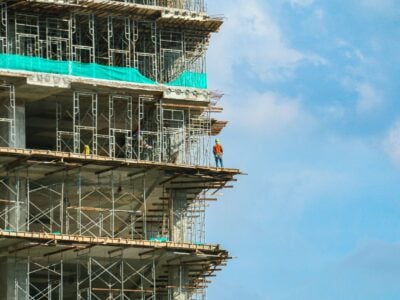


Most injured construction workers assume their only option after a jobsite accident is a workers’ compensation claim against their employer. In New York, that’s usually true, but it’s rarely the whole story.
State labor laws give injured workers a separate right to sue the property owner, general contractor, and other parties, sometimes without even having to prove they were careless.
Finding a lawyer who knows how to use both systems together often makes the difference between a modest workers’ comp payout and full compensation for what you actually lost.
Prior results do not guarantee a similar outcome.
What Makes New York Construction Accident Claims Different From a Typical Workplace Injury?
Under Workers’ Compensation Law Section 11, an employer’s workers’ compensation coverage is generally your exclusive remedy against that employer. In plain terms, you usually can’t sue your own employer for a jobsite injury, even if their carelessness caused it, and workers’ comp benefits don’t include compensation for pain and suffering.
What most injured workers don’t realize is that this bar only applies to your direct employer. New York’s Labor Law gives you a separate right to sue the property owner, the general contractor, and certain other parties who controlled the site, even though you can’t sue your own employer directly.
These are called third-party claims, and they’re often where the real compensation comes from, since they can include pain and suffering, full lost earning capacity, and future medical costs that workers’ comp doesn’t cover.
What Do Labor Law 240, 241(6), and 200 Actually Cover?
These three statutes work together, and a lawyer should know how to use all three depending on how your accident happened.
| Statute | Common Name | What It Covers | What You Must Prove |
|---|---|---|---|
| Labor Law 240(1) | Scaffold Law | Falls from height and being struck by falling objects | That proper safety equipment wasn’t provided; your own conduct generally isn’t a defense |
| Labor Law 241(6) | Industrial Code claims | Excavation, demolition, and other construction hazards | A specific violation of a New York Industrial Code safety regulation |
| Labor Law 200 | General duty statute | Any unsafe condition on a construction site | Ordinary negligence, and that the defendant had control over the work or the hazard |
Labor Law 240 is the most powerful of the three because it imposes what courts call absolute liability.
If you were injured because a ladder wasn’t secured, a scaffold collapsed, or you weren’t given adequate fall protection, the property owner and general contractor can be held responsible even if you made a mistake that contributed to the accident.
The main exception is for owners of one and two-family homes who didn’t direct or control the work being performed.
Labor Law 241(6) works differently. It requires showing that a specific, concrete provision of New York’s Industrial Code was violated, which is why a lawyer familiar with the Industrial Code’s actual regulations, not just the general concept of “safety violations,” matters here.
Why Doesn’t My Full Settlement Come Straight to Me?
This surprises a lot of injured workers, so it’s worth explaining upfront. If you’re receiving workers’ compensation benefits and you also win or settle a Labor Law claim against the property owner or general contractor, the workers’ compensation carrier generally has a right to be reimbursed out of that third-party recovery under Workers’ Compensation Law Section 29.
This is meant to prevent you from being paid twice for the same medical bills and lost wages, once through workers’ comp and again through the lawsuit.
In practice, this means part of your settlement or verdict goes toward reimbursing the amount the carrier already paid you in medical benefits and wage replacement, though the carrier’s share is generally reduced by its proportional share of the legal costs it took to win that recovery.
If you plan to settle a third-party claim, the carrier generally needs advance notice and, depending on the amount, its consent, since settling without it can create complications for your ongoing workers’ comp benefits.
A lawyer experienced in construction cases should walk you through what this lien will likely look like well before you’re deciding whether to accept a settlement, not after.
Who Can Be Held Liable Besides Your Employer?
Property owners, general contractors, and their site agents are the most common defendants in a Labor Law claim, but subcontractors with control over the specific work being performed can also be named, depending on the facts.
There’s an important wrinkle worth understanding. If a general contractor gets sued under Labor Law and wants your employer (often a subcontractor) to help cover the cost, Workers’ Compensation Law Section 11 generally blocks that unless your injury meets the statutory definition of a “grave injury,” a specific list that includes things like permanent loss of a limb, paraplegia, or a permanent brain injury.
This doesn’t affect your own right to recover from the owner or general contractor, but it does affect how the parties fight over who ultimately pays, and a lawyer who understands this dynamic can anticipate how the defense will approach your case.
What Should You Look for in a Construction Accident Lawyer?
Look for a lawyer who routinely handles Labor Law 240, 241, and 200 claims, not just general personal injury cases. These statutes involve technical proof requirements, particularly Industrial Code violations under 241(6), that a generalist may not catch.
Ask how quickly the attorney moves to preserve site evidence. Safety equipment gets repaired or removed, site logs get lost, and witnesses (often coworkers who may no longer be employed at the site) become harder to reach the longer a case sits.
A lawyer should also be comfortable coordinating your workers’ compensation claim and your third-party Labor Law lawsuit at the same time, since both can proceed together and the outcome of one can affect the other.
Finally, look for a firm that’s transparent about how contingency fees work. At Porter Law Group, you pay nothing unless we win your case.
What Questions Should You Ask During a Consultation?
| Question | Why It Matters |
|---|---|
| Do you handle Labor Law 240, 241, and 200 claims regularly? | These statutes require specific proof and site safety knowledge that general injury cases don’t involve |
| Can I pursue a Labor Law claim while also receiving workers’ compensation? | Both can generally proceed at the same time, and coordinating them affects your total recovery |
| How will my workers’ comp carrier’s lien affect my final settlement? | Under Workers’ Compensation Law 29, the carrier is generally entitled to reimbursement from a third-party recovery |
| Who do you believe may be liable in my case, beyond my employer? | Owners, general contractors, and certain subcontractors may share responsibility |
| How do you preserve site evidence like safety logs and equipment condition? | This evidence often disappears once a site is cleaned up or a project moves forward |
| Have you taken construction injury cases to trial? | Insurers and defense counsel negotiate differently with firms known to litigate |
| How do contingency fees and case costs work? | You should understand exactly what you owe and when, before you sign anything |
What Red Flags Should You Watch for When Hiring a Lawyer?
A few warning signs tend to separate firms that understand New York construction law from those that don’t.
- Treating your case as a workers’ compensation matter only, without mentioning a Labor Law claim against the owner or general contractor
- No familiarity with the difference between Labor Law 240, 241(6), and 200
- Guaranteeing a settlement amount before reviewing the accident report or site safety records
- Vague answers about which parties besides your employer might be liable
- Pressure to sign representation paperwork before you’ve had a chance to ask questions
What Are the Key Deadlines in a New York Construction Accident Case?
| Deadline | Rule | What It Means |
|---|---|---|
| 3 years | CPLR 214 | General statute of limitations for a personal injury lawsuit, including most Labor Law claims |
| 2 years | Workers’ Compensation Law | Deadline to file a workers’ compensation claim after a workplace injury |
| 90 days | General Municipal Law 50-e | Notice of claim deadline if a government agency owned or controlled the construction site |
| 2 years | EPTL 5-4.1 | Statute of limitations for a wrongful death claim following a fatal construction accident |
These deadlines can run separately from each other, which means missing the workers’ compensation filing window doesn’t necessarily bar a Labor Law lawsuit, and vice versa. A lawyer should confirm which deadlines apply to your situation early, rather than assuming only one clock is running.
Summing It Up
Choosing the right construction accident lawyer in New York means finding someone who understands that your workers’ compensation claim and your Labor Law claim are two different paths that often need to be pursued together. A lawyer who only files the workers’ comp paperwork may be leaving significant compensation unclaimed.
Porter Law Group has built its reputation on trial-tested representation for injured New Yorkers, and our attorneys work on a contingency fee basis, meaning you pay nothing unless we win.
If you or a loved one has been hurt in a construction accident, reach out to discuss what happened and what your legal options look like.
Call 833-PORTER9 or email info@porterlawteam.com to schedule a free consultation.
Prior results do not guarantee a similar outcome.
Frequently Asked Questions
Can I sue my employer for a construction site injury in New York?
Generally, no. Under Workers’ Compensation Law Section 11, your employer’s workers’ compensation coverage is usually your exclusive remedy against them. However, you may still be able to sue the property owner, general contractor, or other parties who controlled the site.
What is the Scaffold Law?
Labor Law 240(1) is commonly called the Scaffold Law. It holds property owners and general contractors responsible for injuries from falls or falling objects when proper safety equipment wasn’t provided, and generally does not allow your own conduct to be used as a full defense.
Do I have to choose between workers’ compensation and a lawsuit?
No. In most cases, you can receive workers’ compensation benefits from your employer while also pursuing a separate Labor Law lawsuit against the property owner or general contractor for the same accident.
Do I have to pay back my workers’ compensation benefits if I win a lawsuit?
Usually, at least in part. Under Workers’ Compensation Law Section 29, the carrier that paid your workers’ comp benefits generally has a lien on a third-party settlement or verdict, reduced by its proportional share of the legal costs involved. This prevents double recovery for the same medical bills and lost wages.
What counts as a “grave injury” under New York law?
Workers’ Compensation Law Section 11 defines grave injury narrowly, including things like death, permanent loss of a limb, paraplegia, quadriplegia, total blindness, or a permanent brain injury. This term mainly affects whether a general contractor can seek reimbursement from your employer, not your own right to recover.
How much does a construction accident lawyer cost in New York?
Most plaintiff-side personal injury attorneys, including Porter Law Group, work on a contingency fee basis. You pay nothing upfront, and there is no fee unless the firm recovers compensation on your behalf.
This article is for informational purposes only and does not constitute legal advice. Attorney advertising. Prior results do not guarantee similar outcomes.