

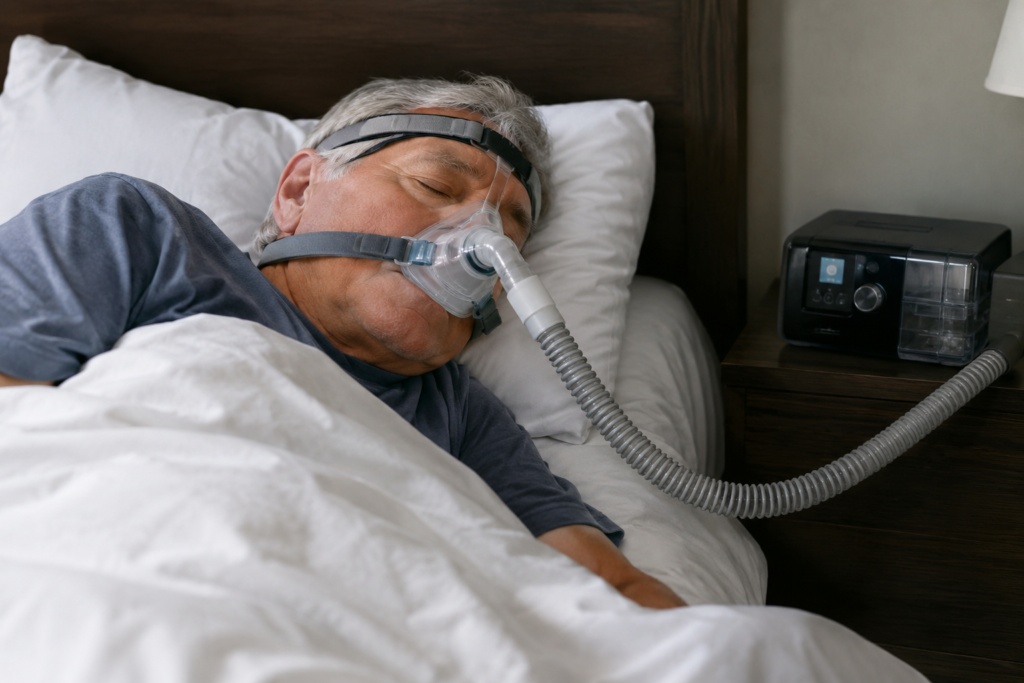

If you or someone you love used a Philips CPAP, BiPAP, or ventilator that was part of the 2021 recall, you’ve probably wondered whether the device that was supposed to help you breathe safely at night exposed you to something harmful.
The honest answer sits in the middle: the recall involved a real, FDA-confirmed potential exposure to foam particles and chemicals, but the best available human studies to date have not found that recalled devices independently increase cancer risk.
Understanding what’s actually been established, and what a legal claim would require, matters more than a simple yes or no.
Prior results do not guarantee a similar outcome.
Why Philips Recalled Certain CPAP Devices
On June 14, 2021, Philips Respironics recalled certain CPAP, BiPAP, and mechanical ventilator devices that used a polyester-based polyurethane sound-dampening foam known as PE-PUR.
The recall’s scale was substantial at approximately 15 million devices were affected worldwide, including roughly 10.8 million in the United States.
The FDA’s notification order classified this as an unreasonable risk of substantial harm to public health, warning that the foam could degrade and expose users to debris or chemicals capable of causing serious, life-threatening, or medically significant injury.
Two conditions drive the breakdown: hot and humid environments, and the use of ozone-based or other unapproved cleaning methods.
A machine having been part of the recall doesn’t automatically mean its foam actually degraded or that a particular user had meaningful exposure, but the FDA has treated the underlying risk as serious enough to warrant its most significant recall classification.
What Does the Cancer Risk Evidence Actually Show
Several of the largest and most recent human studies have specifically looked at this question, and they largely point in the same direction.
A registry study found an increased incidence of cancer, including lung cancer, in the PE-PUR CPAP group. It’s worth including for a complete picture, but the study’s own authors described their cancer findings as inconclusive, since the analysis couldn’t fully account for smoking history or geographic differences between groups, both major confounders in cancer research.
Question | Current Answer |
|---|---|
Could foam breakdown expose users to particles or chemicals? | Yes, this was the basis of the recall |
Could those particles or chemicals be toxic or carcinogenic? | FDA and Philips have both described this as a possible hazard |
Has a population-level cancer increase been proven in recalled-device users? | No. The largest, most recent studies found no statistically significant independent association |
Can an individual prove a recalled device caused their specific cancer? | Case-specific, and requires substantially more than a recall notice and a diagnosis |
Put plainly: the exposure pathway and hazard potential are real and FDA-confirmed, but the strongest available human evidence has not found that recalled devices independently raise cancer risk at the population level.
That doesn’t resolve every individual case, since observational studies have real limits around exposure measurement, cancer’s long latency, and rare or site-specific cancers.
Do FDA and Philips Agree on What the Evidence Shows
Not entirely, and that disagreement is itself informative. As of FDA’s January 2024 update, the agency stated that Philips’s then-submitted testing and analysis were not adequate to fully evaluate the risk to users and said it had requested additional testing.
Philips, for its part, maintains that its own testing and a review of 13 epidemiologic studies show no expected appreciable harm and no established cancer association. Both positions are documented and both are worth knowing, since patients are often told only one side.
What Do the 116,000 FDA Reports Actually Show
By January 31, 2024, the FDA had received more than 116,000 medical device reports, including 561 reports of death, associated with or suspected of being related to PE-PUR foam breakdown, with cancer among the reported conditions.
It’s important to be precise about what these reports are and aren’t. The FDA itself cautions that these reports can be incomplete, unverified, or duplicative, and that they don’t establish that a device caused any specific reported event or reliably indicate how common a given outcome actually is.
A report exists because someone flagged a possible connection, not because that connection was confirmed.
Are There Newer Recall Issues to Know About
Yes, and it’s a separate issue worth understanding on its own terms. In 2025, the FDA announced a Class I recall involving certain reworked Trilogy and Garbin ventilators, this time citing adhesive failure involving replacement silicone foam and residual PE-PUR foam debris left in some remediated units.
This is a distinct problem from the original 2021 foam-degradation recall and shouldn’t be assumed to apply to every repaired or replaced device, but it’s a reminder that remediation hasn’t fully closed the book on this issue.
How the Lawsuits Have Unfolded
Claims involving the recalled devices were consolidated into a federal multidistrict litigation, In re Philips Recalled CPAP, Bi-Level PAP, and Mechanical Ventilator Products Liability Litigation, MDL No. 3014, in the Western District of Pennsylvania before Judge Joy Flowers Conti. In April 2024, Philips reached a settlement covering personal injury and medical monitoring claims.
Settlement Component | Amount | Status |
|---|---|---|
Personal injury claims | $1.075 billion | Registration closed January 31, 2025 |
Medical monitoring | $25 million | Registration closed January 31, 2025 |
Economic loss (device replacement) | Approximately $479 million | Separate settlement, claims period closed |
Philips has not admitted fault or liability in these settlements. If you missed the registration deadline, you can’t access those specific funds, but litigation continues outside them.
As of August 3, 2026, the federal Judicial Panel on Multidistrict Litigation listed 624 pending actions and 1,033 total actions in MDL 3014, many involving cancer claims that didn’t join the settlement. A high case count reflects ongoing litigation volume, not proof of causation in any individual case.
What Would You Need to Prove in a Cancer Claim
What Would You Need to Prove in a Cancer Claim
A recall notice and a cancer diagnosis are rarely enough on their own. Building a viable claim generally requires evidence addressing several things together:
Confirmation that your specific device was within the recalled population
Documentation of how and how long you used it, and under what conditions
Your confirmed diagnosis and medical history
Scientific evidence connecting this type of exposure to your type of cancer generally
Expert analysis connecting your specific exposure to your specific illness
Consideration of other risk factors, like smoking or occupational exposures, that could explain the diagnosis instead
None of this is something you need to sort out alone before contacting an attorney, but it’s worth knowing that a diagnosis by itself isn’t the whole case.
How Long Do You Have to File a Claim in New York
New York’s timing rules here depend on several factors, including the claim type, when your diagnosis occurred, and whether your injury is treated as a latent toxic exposure injury, so it’s worth having an attorney confirm your specific deadline rather than assuming one applies.
Deadline | Applies To | Rule |
|---|---|---|
3 years from injury | Product liability where the injury was reasonably apparent | CPLR § 214(5) |
3 years from discovery | Injury from latent exposure effects, which the statute defines to include inhalation | |
2.5 years | A separate claim against a clinician for negligent advice about your therapy | CPLR § 214-a |
That last row matters because a claim against Philips as the device manufacturer is legally distinct from a claim that your own doctor gave negligent advice about continuing, stopping, or monitoring your CPAP therapy.
Most patients dealing with a recalled device don’t have a malpractice claim, since managing therapy through a recall involved real medical judgment about the risks of untreated sleep apnea, but it’s a distinct question worth separating from the device claim itself.
What You Should Do If You Used a Recalled Device
Confirm your exact device model and serial number against the official recall list, since not every Philips PAP device was included
Talk to your doctor before changing your therapy. The FDA specifically advises against stopping treatment without a provider’s guidance, since untreated sleep apnea carries its own serious risks
Avoid unapproved cleaning methods, particularly ozone-based cleaners
Document your usage history, any symptoms, and any diagnosis
Consult an attorney even if you missed the settlement deadlines, since individual claims, particularly cancer cases, remain active
Summing It Up
The clearest, most accurate answer right now is that the recalled devices created a real, FDA-confirmed exposure pathway, but the strongest available human studies haven’t shown that exposure independently increases cancer risk at the population level.
That’s not the same as saying no individual claim has merit, since case-specific factors, your particular device, your exposure history, your diagnosis, still matter.
If you used a recalled device and developed cancer or another serious illness, especially if you missed the settlement deadlines, it’s worth having your specific situation reviewed rather than relying on the general population data alone.
Porter Law Group offers free consultations to help you understand where your situation stands.
Frequently Asked Questions
Does this mean Philips CPAP machines don’t cause cancer?
Not exactly. It means the largest and most recent human studies haven’t found a statistically significant increase in cancer risk among recalled-device users as a group. That’s different from proving no individual case exists, and it’s different from FDA’s position, which continues to treat the underlying exposure as a potential hazard worth investigating further.
I missed the January 2025 settlement registration deadline. Do I have any options left?
Possibly. The settlement funds are closed to new registrants, but hundreds of individual lawsuits, including cancer claims, remain active in the federal MDL. Whether you have a viable path depends on your specific facts.
Does an FDA report about my device prove it caused my illness?
No. FDA reports document a possible association that someone flagged, not a confirmed cause. Proving causation in an individual case requires medical and expert evidence specific to your situation.
Should I stop using my CPAP if it was part of the recall?
Talk to your doctor first. The FDA specifically recommends against stopping therapy without medical guidance, since untreated sleep apnea carries its own serious risks.
What does it cost to have Porter Law Group review my case?
Nothing upfront. We work on a contingency fee basis, so you pay nothing unless we recover compensation for you.
Prior results do not guarantee a similar outcome.
This article is for informational purposes only and does not constitute legal advice. Attorney Advertising.