


Formaldehyde shows up in more New York workplaces than most people realize: the formalin used to preserve tissue in hospital pathology labs, embalming fluid at funeral homes, resins in particleboard and plywood, and chemical reactors at manufacturing plants.
It’s also a proven human carcinogen, linked most strongly to nasopharyngeal cancer and specific types of leukemia.
Whether your illness is legally connected to your job depends on how much you were exposed to, for how long, and whether your employer actually followed the safety rules designed to protect you.
Prior results do not guarantee a similar outcome.
Where Do Workers Encounter Formaldehyde
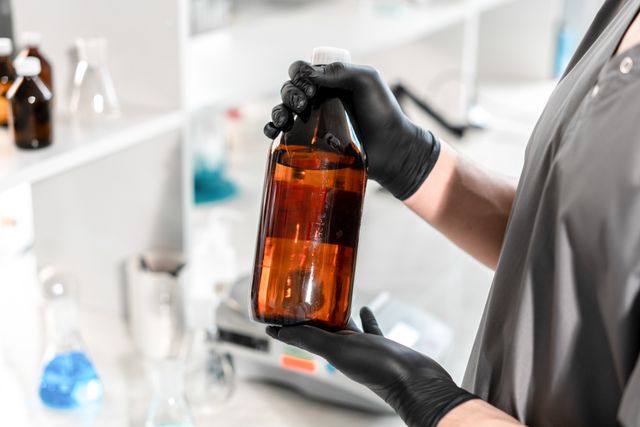
Hospital pathology labs, university research facilities, and clinical laboratories rely on formalin, formaldehyde dissolved in water, as the standard fixative for tissue specimens, exposing lab technicians and pathologists daily.
Funeral home embalmers face some of the highest occupational exposures of any profession, working with concentrated embalming fluid in small preparation rooms that often lack adequate ventilation.
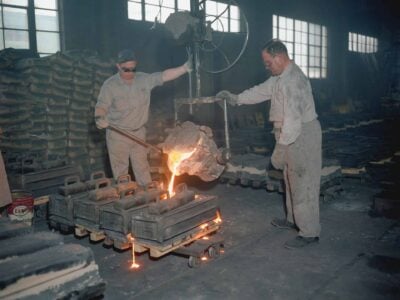
Manufacturing workers encounter formaldehyde as a feedstock for resins, plastics, and textiles, particularly near reactors and mixing tanks.
And formaldehyde-based resins used in particleboard, plywood, and medium-density fiberboard continue releasing formaldehyde gas long after manufacture, a process called off-gassing, which can expose carpenters, furniture makers, and even office workers in newly renovated spaces.
What Health Problems Formaldehyde Causes
Federal health authorities classify formaldehyde as a known human carcinogen, with the strongest evidence connecting it to nasopharyngeal cancer, a relatively rare cancer of the upper throat, which makes occupational clusters especially meaningful when they occur.
There’s also a documented, though more debated, association with myeloid leukemia in high-exposure industrial and funeral industry settings.
One funeral industry mortality study found that embalmers with more than 34 years of experience had roughly four times the risk of fatal myeloid leukemia compared to those with fewer than 500 lifetime embalming, and a separate industrial cohort study found a similar pattern tied specifically to high peak exposures rather than average daily levels.
Beyond cancer, formaldehyde is a powerful respiratory and skin irritant, and repeated exposure can cause workers to develop sensitized asthma where none existed before. Notably, irritation symptoms like eye and nasal irritation have been documented in multiple studies even at exposure levels below official occupational limits.
Why Formaldehyde Cases Involve a Real Regulatory Gap
OSHA’s formaldehyde standard, 29 C.F.R. § 1910.1048, sets a permissible exposure limit of 0.75 parts per million as an eight-hour average, a short-term limit of 2 ppm over any 15-minute period, and an action level of 0.5 ppm that triggers monitoring and medical surveillance requirements.
NIOSH, the federal research agency, recommends a far stricter limit: 0.016 ppm as a 10-hour average, nearly 50 times lower than OSHA’s legal ceiling.
That gap exists because OSHA’s limits, set in 1987, reflected a compromise between health protection and what regulators considered economically feasible at the time, while NIOSH’s recommendation is based purely on health science.
This gap matters directly in a legal case. An employer can be in full legal compliance with OSHA’s minimum standard while still exposing workers to levels health scientists consider dangerous, and expert testimony can establish that this kind of exposure was still negligent even though it was technically legal.
Courts have generally recognized in toxic exposure cases that meeting a bare regulatory minimum isn’t automatically a complete defense to negligence.
New York’s Specific Legal Recognition of Formaldehyde Poisoning
This is where New York law gets unusually direct. New York Workers’ Compensation Law § 3 explicitly lists “poisoning by formaldehyde and its preparations” by name as a compensable occupational disease when it results from a process involving formaldehyde or direct contact with it.
Most occupational chemicals don’t get this kind of specific statutory mention, which means the causal link, at least at the level of the statute recognizing the hazard, is already built into New York law rather than something you have to argue from scratch.
Timing works differently for formaldehyde-related cancer than for an acute injury, too.
New York Workers’ Compensation Law § 28 contains a special rule for latent or delayed malignancies tied to chemical exposure, allowing a claim within two years of disablement and after you knew or should have known the disease was connected to your job, even where more than two years passed since the original exposure itself.
This matters because formaldehyde-related cancers, like most occupational cancers, often don’t appear until years or decades after the exposure that caused them.
Can You Sue, or Is Workers’ Compensation Your Only Option
If you developed cancer or a respiratory illness from workplace formaldehyde exposure, workers’ compensation is typically your primary path against your own employer, since New York generally bars a direct negligence lawsuit against an employer covered by the workers’ comp system.
That doesn’t mean your options end there. If a chemical manufacturer sold formaldehyde-containing products without adequate warnings, or a property owner or contractor created unsafe conditions separate from your direct employment, a third-party lawsuit may be available, and this kind of claim can recover pain and suffering damages that workers’ compensation doesn’t provide.
Manufacturers of pressed-wood products face their own potential liability under product liability law when a product exceeds EPA’s formaldehyde emission standards under the Toxic Substances Control Act, which currently set limits of 0.05 ppm for hardwood plywood, 0.09 ppm for particleboard, 0.11 ppm for medium-density fiberboard, and 0.13 ppm for thin medium-density fiberboard.
A product that exceeds these limits, or that lacks adequate off-gassing warnings, may be considered defective.
How You Prove This Kind of Case
Building a formaldehyde claim starts with documenting your actual exposure: air monitoring records if your employer kept them, your specific job tasks, how often you handled formalin or embalming fluid, and the ventilation conditions where you worked.
If formal monitoring records don’t exist, which is common, your case may need to reconstruct exposure using job descriptions, facility layout, and comparisons to published exposure studies in similar workplaces.
Regulatory violations, like a missing Chemical Hygiene Plan, absent air monitoring, or no medical surveillance program, are strong evidence that your employer knew or should have known about the risk.
Medical causation for nasopharyngeal cancer and certain leukemias is comparatively well-supported by epidemiology, but a medical expert still needs to review your specific work history, diagnosis, and other risk factors like smoking to connect your particular illness to your particular exposure.
Summing It Up
Formaldehyde cases depend on connecting decades-old exposure conditions to a diagnosis that often arrives long after the job ended.
If you’ve worked around formaldehyde and developed cancer or a related illness, Porter Law Group can help you understand your options.
Call 833-PORTER9, email info@porterlawteam.com, or visit porterprotects.com/contact.
Frequently Asked Questions
My employer’s air monitoring showed formaldehyde levels below OSHA’s limit. Does that rule out a claim?
Not necessarily. OSHA’s legal limit is significantly higher than what NIOSH, the federal health research agency, recommends as actually safe, and irritation symptoms have been documented even below official limits in multiple studies. Legal compliance with OSHA’s minimum standard doesn’t automatically mean your employer met a reasonable standard of care, particularly if they knew or should have known a lower exposure level was necessary.
I worked in a wood products plant, not a lab or funeral home. Does formaldehyde still apply to me?
Yes, potentially, though it’s worth understanding that wood dust itself is also an independent carcinogen in these settings, particularly for a rare cancer called nasal adenocarcinoma. A thorough case evaluation for a wood-industry worker generally needs to consider both formaldehyde and wood dust exposure together, since a defense will likely point to wood dust as a competing explanation.
Does New York law specifically recognize formaldehyde as a workplace hazard?
Yes, unusually directly. New York’s Workers’ Compensation Law specifically names “poisoning by formaldehyde and its preparations” as a compensable occupational disease when connected to work involving the chemical. This doesn’t guarantee any particular case succeeds, since you still need medical and occupational proof connecting your specific illness to your exposure, but it means the underlying hazard is already recognized in the statute itself.
My cancer wasn’t diagnosed until years after I stopped working around formaldehyde. Is it too late to file?
Not necessarily. New York’s workers’ compensation law includes a special provision for latent or delayed malignancies caused by chemical exposure, generally allowing a claim within two years of disablement and after you knew or should have known the disease was work-related, even where the original exposure happened much earlier. Because the exact timing analysis is fact-specific, it’s worth having your situation reviewed rather than assuming you’ve missed your window.
Can I sue the manufacturer of a wood product instead of, or in addition to, filing a workers’ comp claim?
Potentially both. Workers’ compensation generally covers your own employer under a no-fault system, while a product liability claim against a manufacturer of a defective, excessive-emission wood product is a separate track with different requirements and the possibility of pain and suffering damages that workers’ comp doesn’t provide. Many formaldehyde cases involve pursuing both avenues at once.
This article is for informational and educational purposes only. It is not a substitute for medical advice from a qualified healthcare provider or legal advice based on your specific circumstances.