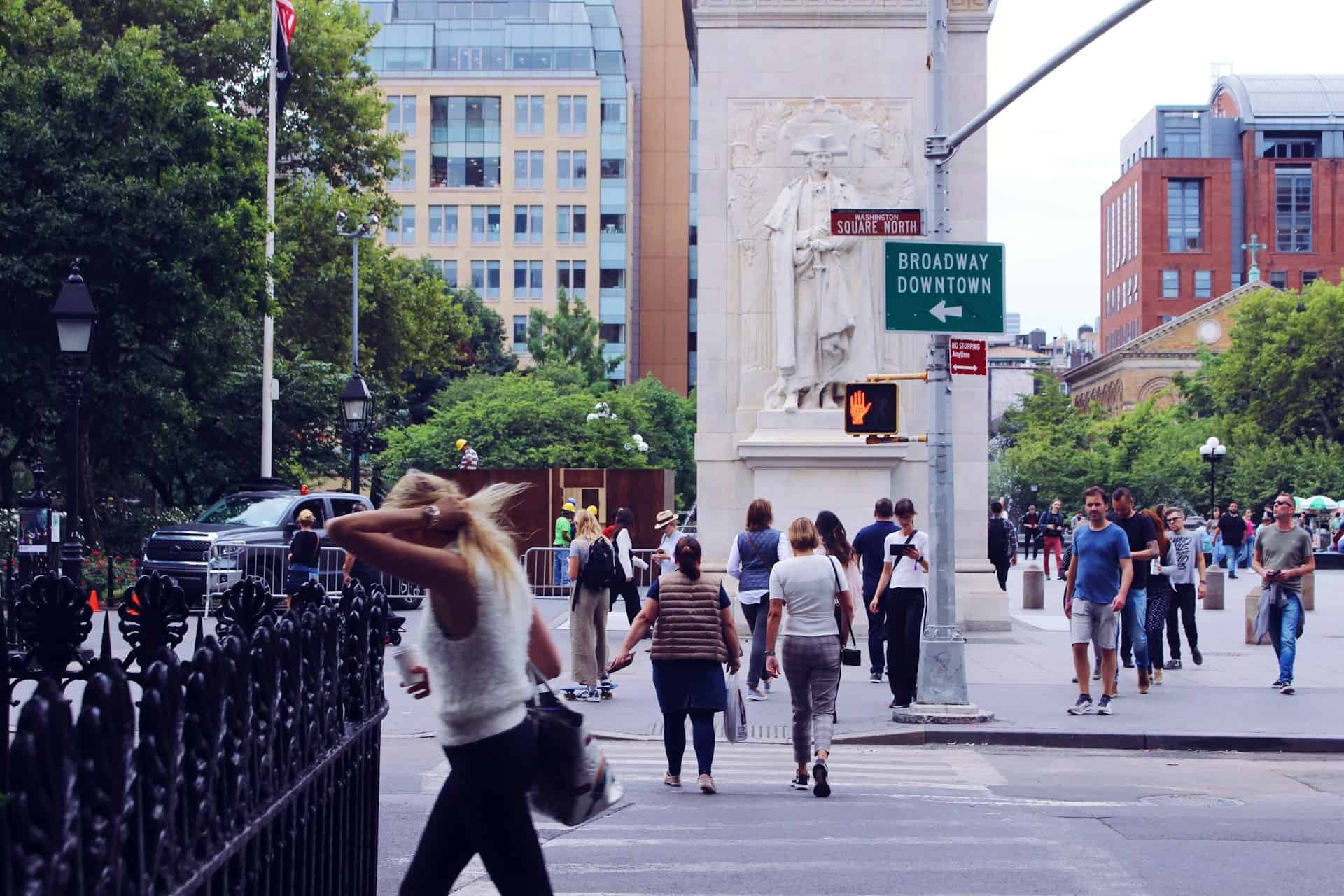


New York averages about 300 pedestrian deaths a year. In 2024 there were 14,878 crashes involving pedestrians statewide, of which 289 were fatal and 14,320 caused an injury, according to preliminary figures released by the New York State DMV.
Bus stops, crosswalks, and intersections put people on foot and on bikes close to turning cars, stopped buses, and drivers watching several things at once.
When a driver hits someone in one of these places, the question of who is responsible can reach past that driver. A transit agency, a municipality, a contractor, or a property owner may have played a part.
This guide explains how right of way works, who may be liable, how the new rules apply to pedestrians and cyclists, and which deadlines to watch.
Prior results do not guarantee a similar outcome.
What Do New York’s Right-of-Way Rules Require?
The Vehicle and Traffic Law sets duties for drivers, pedestrians, and cyclists. These are the rules that come up most often in these crashes:
Drivers must use due care. Under Vehicle and Traffic Law 1146, every driver must exercise due care to avoid hitting a pedestrian or bicyclist. This duty applies even when the driver has the right of way.
Drivers yield in crosswalks without a working signal. Vehicle and Traffic Law 1151 requires a driver to slow or stop for a pedestrian crossing in a crosswalk when no signal is in place or operating.
No passing a car stopped for a pedestrian. The same section bars a driver from overtaking a vehicle that has stopped at a crosswalk to let someone cross.
Turning drivers yield on a green light. Under Vehicle and Traffic Law 1111, a driver turning on green must yield to pedestrians lawfully in the adjacent crosswalk.
Pedestrians have duties too. Section 1151 says a pedestrian may not suddenly leave the curb into the path of a vehicle that is too close to yield. Section 1152 requires a pedestrian crossing outside a crosswalk to yield to vehicles.
Drivers must pass bicycles safely. Vehicle and Traffic Law 1122-a requires a driver overtaking a bicycle to pass on the left at a safe distance.
Doors stay closed until it is safe. Vehicle and Traffic Law 1214 bars opening a door on the traffic side until it is reasonably safe to do so.
Crosswalks don’t need paint to count. Vehicle and Traffic Law 110 defines a crosswalk to include the unmarked crossing at an intersection.
Our article on what an unmarked crosswalk is explains how the law treats intersections without markings. New York State also publishes a plain-language summary of pedestrian crossing laws.
Turning rules also differ by location. Section 1111 allows a right turn on red after a full stop in most of the state. That permission does not apply by default in a city of one million or more people, which means New York City. Where the turn is allowed, the driver must still yield to pedestrians in the crosswalk.
A traffic violation is evidence of negligence. It is not the final word on civil liability, which depends on everything that happened.
Who May Be Liable for a Pedestrian or Cyclist Crash?
The driver is the most common defendant, but responsibility can be shared. Our pedestrian accident practice page covers these claims in more depth. Depending on the facts, the parties may include:
The driver. Speeding, distraction, unsafe turns, and failure to yield are the usual issues.
The vehicle’s owner or the driver’s employer. Vehicle and Traffic Law 388 makes an owner responsible for the negligence of a person driving with the owner’s permission. An employer may be responsible when the driver was working at the time.
A transit agency or bus company. How a bus was operated or where it stopped may have contributed. Our page on bus accident claims in New York explains how those cases differ.
A city, county, town, village, or the State. A defective signal, a poorly maintained road, or a dangerous design may be involved.
A road contractor. Work zones can block lanes, sidewalks, and sightlines.
A property owner. Landscaping, structures, or parking on private land can hide people from drivers.
Naming a party here doesn’t mean that party was at fault. Each claim has to be proven with evidence.
How Does Shared Fault Work After the 2026 Change?
The answer depends on when the lawsuit is started and whom it is against. Drivers and insurers often argue that the injured person crossed outside a crosswalk, walked against the signal, rode against traffic, or rode without lights.
Lawsuits started before May 26, 2026. The earlier rule, now CPLR 1411(a), applies. Your share of fault reduces your damages by that percentage but doesn’t bar the claim.
Lawsuits started on or after May 26, 2026. CPLR 1411(b) applies to personal injury actions covered by the no-fault law, which includes a pedestrian or cyclist struck by a motor vehicle. Recovery is barred if your share of fault is greater than the combined fault of the people you are suing. If it is equal or less, your damages are reduced by your share.
Some claims stay under CPLR 1411(a) no matter when they are filed. These include claims against a municipality for a road defect, against a property owner, or against an equipment manufacturer. Wrongful death claims also remain under the earlier rule.
Fault percentages are decided on the evidence. A pedestrian’s or cyclist’s mistake is weighed against what the driver did, including speed, attention, and whether the driver used due care.
What Deadlines Apply to a Pedestrian or Cyclist Claim?
The deadline depends on who is being sued, and the shortest ones run 30 and 90 days. A claim against a private driver has years. A claim involving a public entity does not.
Step | Deadline | Source |
|---|---|---|
Police report in a hit-and-run | Within 24 hours | Insurance Law 5208 |
No-fault written notice | Within 30 days of the crash | 11 NYCRR 65-1.1 |
Notice to MVAIC, hit-and-run or unidentified vehicle | 90 days | Insurance Law 5208 |
Notice to MVAIC, identified uninsured vehicle | 180 days | Insurance Law 5208 |
Notice of claim to a city, county, town, village, or public authority | 90 days after the claim arises | General Municipal Law 50-e |
Claim or notice of intention against the State | 90 days after the claim accrues | Court of Claims Act 10 |
Lawsuit against a municipality or public authority | 1 year and 90 days from the crash | General Municipal Law 50-i and CPLR 217-a |
Lawsuit against a driver or other private party | 3 years from the crash | CPLR 214 |
Wrongful death lawsuit against a private party | 2 years from the date of death | EPTL 5-4.1 |
Under General Municipal Law 50-e, a court may allow a late notice of claim. It considers whether the entity already knew the essential facts and whether the person was a minor or was physically or mentally incapacitated. Permission is discretionary, and it can’t extend past the deadline for the lawsuit itself.
Three years can also be shorter than it sounds. Video is erased, witnesses move, and road conditions get repaired long before a filing deadline arrives.
Do No-Fault Benefits and the Serious Injury Threshold Apply?
Yes. A pedestrian or cyclist hit by a motor vehicle is covered by New York’s no-fault system even though they weren’t in a vehicle. Under Insurance Law 5103, benefits generally come from the insurer of the vehicle that struck you.
That holds when the vehicle is a bus. The rule that sends bus passengers to their own household policy first applies to people riding the bus, not to people it hits. Basic coverage pays up to $50,000 per person in combined economic loss under Insurance Law 5102.
That single limit covers medical bills, lost earnings counted up to $2,000 per month for up to three years and paid at 80 percent, and other necessary expenses up to $25 per day for one year.
The filing window is short. The New York Department of Financial Services says written notice must reach the no-fault insurer within 30 days of the accident unless there is a clear and reasonable justification for the delay.
What Extra Issues Do Cyclists Face?
Cyclists have the same rights and duties as drivers under Vehicle and Traffic Law 1231, plus rules written for bicycles. Our bicycle accident practice page covers these claims in detail. The questions that usually matter are:
Where you were riding. Vehicle and Traffic Law 1234 generally directs cyclists to a usable bike lane or the right side of the road. It allows moving left to avoid hazards, parked cars, and other unsafe conditions.
Whether the bike lane was blocked. A parked vehicle, construction barrier, or snow pile can force a rider into traffic. Whoever created the obstruction may share responsibility.
How the driver passed or turned. The safe passing and door rules described above apply.
Lights and equipment. State law requires lights after dark, and their absence may be raised as shared fault.
Sidewalk riding. Local rules vary by city and town.
Damage to the bicycle and gear is part of the claim. Keep the bike, helmet, and clothing as they are until they have been photographed.
What Injuries Do Pedestrians and Cyclists Suffer?
A person on foot or on a bike has nothing between their body and the vehicle or the pavement, so injuries are often severe. They include:
Head and brain injuries. Concussions, skull fractures, and bleeding in the brain. The CDC notes that symptoms of a brain injury may not appear until hours or days later, so a person who seems alert at the scene still needs to be checked.
Fractures and joint injuries. Legs, ankles, arms, wrists, ribs, and the pelvis are commonly broken. Ligament and tendon tears often need surgery.
Spinal injuries. Herniated discs, fractured vertebrae, and spinal cord damage that can cause paralysis.
Internal injuries. Bleeding and organ damage that may not be visible at first.
Scarring and facial or dental injuries.
Psychological harm. Anxiety, depression, and post-traumatic stress, including fear of crossing streets or riding again.
Frequently Asked Questions
What if the driver left the scene or had no insurance?
You may still have a source of coverage. An auto policy in your household may provide uninsured motorist coverage. If no policy applies, the Motor Vehicle Accident Indemnification Corporation, created under Insurance Law Article 52, may cover a qualified person. Under Insurance Law 5208, a hit-and-run must be reported to police within 24 hours and a notice filed within 90 days. The notice period is 180 days when the uninsured vehicle is identified. Which source applies depends on your household’s insurance.
Can I bring a claim if another cyclist hit me?
Yes, but different rules apply. A bicycle isn’t a motor vehicle under the no-fault law, so no-fault benefits and the serious injury requirement don’t apply. The claim is an ordinary negligence claim, and shared fault reduces damages under CPLR 1411(a) without barring recovery. Medical bills usually go through health insurance, and the rider’s homeowner’s or renter’s policy may come into play.
Does a traffic ticket to the driver prove my case?
No. A ticket is not proof by itself, and a civil case is decided separately on all the evidence. A guilty plea or a conviction for a traffic violation can be used as evidence of negligence, and the violation itself can support a claim. The driver can still argue that the pedestrian or cyclist shared fault. How much a ticket matters depends on the facts.
What if my child was hit while crossing the street?
A parent or guardian usually brings the claim on the child’s behalf. CPLR 208 can pause a child’s deadline to file a lawsuit, but it doesn’t automatically extend the 90-day notice of claim period for a public entity or the 30-day no-fault notice. A court may weigh the child’s age if late notice is requested. The right steps depend on who is involved.
Can I recover the cost of my damaged bicycle?
Yes. Property damage isn’t covered by no-fault benefits, so it is claimed from the at-fault driver’s liability insurer or in a lawsuit. The serious injury requirement applies to pain and suffering, not to property. Keep the bicycle and gear unrepaired until they are photographed, and save purchase records or a repair estimate from a bike shop to document the loss.
Summing It Up
Crashes at these locations rarely come down to one question. Right of way, the driver’s care, the injured person’s own conduct, and the condition of the road all bear on who is responsible.
The 2026 changes to shared fault and the serious injury definition make the filing date matter more than it used to. Medical care comes first, and the short insurance and public entity deadlines come right behind it.
If you or a family member was hit while walking or cycling in New York, Porter Law Group can review what happened and explain the deadlines that may apply. Call 833-PORTER9, email info@porterlawteam.com, or reach us through our contact page.
Contacting the firm does not create an attorney-client relationship.
This article is for informational and educational purposes only. It is not a substitute for medical advice from a qualified healthcare provider or legal advice based on your specific circumstances.
Attorney Advertising. Prior results do not guarantee a similar outcome.