
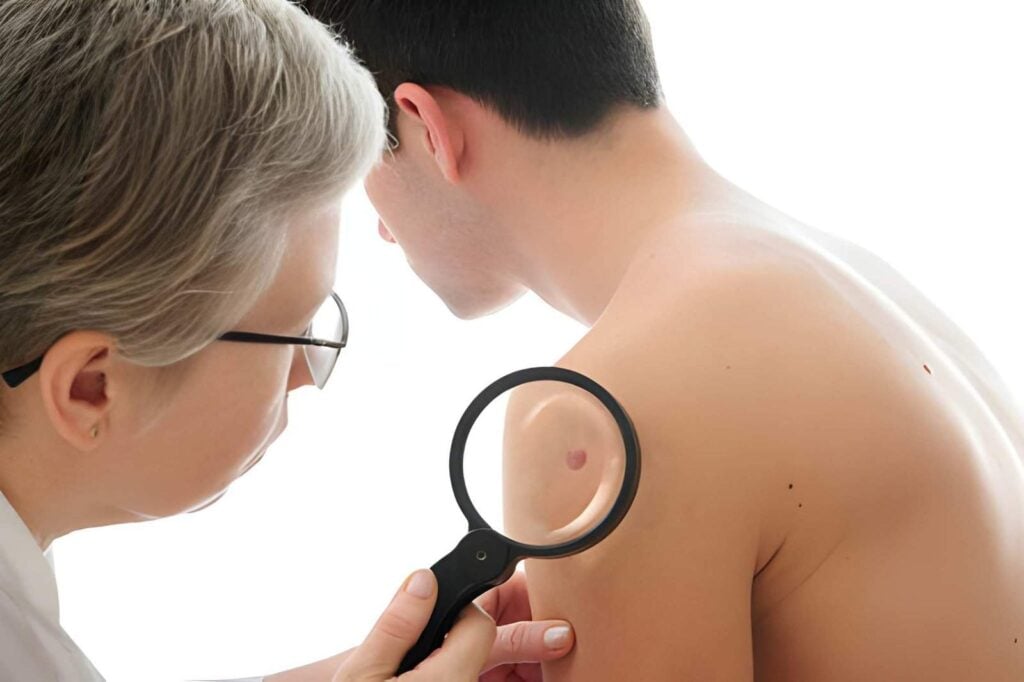

You noticed a mole on your back changing colors over several months. At your annual physical, you pointed it out to your doctor, who glanced at it and said to “keep an eye on it.” Two years later, a different physician insisted on an immediate biopsy. The results came back as stage III melanoma, now requiring lymph node removal and months of immunotherapy. You can’t stop thinking about that first appointment and wondering what might have happened if your doctor had taken action sooner.
This scenario plays out more often than it should. Melanoma, the most dangerous form of skin cancer, is highly treatable when caught early. But when doctors miss warning signs, dismiss concerning changes, or fail to refer patients for specialist evaluation, what should have been a simple excision can turn into aggressive, life-altering treatment. If you’re reading this because you or someone you love is now facing advanced melanoma after a doctor failed to act, you’re probably asking yourself whether this was truly negligence or just an unfortunate outcome.
Prior results do not guarantee a similar outcome.
Signs You Might Have a Melanoma Case
Before diving into the medical and legal details, here’s a practical checklist to help you evaluate whether your situation might warrant legal action, or at the very least, consultation with a cancer lawyer:
You may have grounds for a melanoma lawsuit if:
- A healthcare provider examined a mole or skin lesion that was changing in size, color, shape, or texture, but they chose to monitor it instead of performing a biopsy or referring you to a dermatologist. Months or years later, that same lesion was diagnosed as melanoma at a more advanced stage than it would have been if biopsied earlier.
- Your primary care doctor photographed or documented a suspicious lesion in your medical records but never followed up, never ordered a biopsy, and never mentioned dermatology, even though the lesion showed concerning features like irregular borders, multiple colors, or rapid growth.
- A dermatologist saw you for a full skin check but either missed an obvious melanoma or told you a clearly abnormal mole was “probably nothing” without performing any diagnostic test. You later discovered through another provider that it was melanoma that had progressed during the delay.
- You required extensive surgery, lymph node dissection, immunotherapy, targeted drug therapy, or radiation because the melanoma had spread, and medical records suggest that an earlier biopsy would have caught it at a localized stage with a far better prognosis.
- The timeline of your care shows gaps of six months, a year, or longer between when you first raised concerns about a changing mole and when someone finally took it seriously enough to biopsy it, during which time the melanoma grew deeper into your skin or spread to nearby tissue.
If several of these circumstances describe your experience, the delay in diagnosis may constitute medical negligence under New York law.
What Makes Melanoma Different From Other Skin Cancers
When most people hear “skin cancer,” they think of a single disease. In reality, there are several distinct types, and melanoma stands apart from the rest in both its behavior and its potential severity. Understanding this distinction matters because it affects how doctors should respond when they spot something suspicious on your skin.
Basal cell carcinoma and squamous cell carcinoma, the two most common forms of skin cancer, rarely spread beyond the skin. They grow slowly, and while they absolutely require treatment, they don’t typically threaten someone’s life if there’s a short delay in diagnosis. Doctors might reasonably adopt a “watch and wait” approach for certain low-risk lesions in these categories.
Melanoma operates differently. It develops in the pigment-producing cells of the skin and has the capacity to spread aggressively through the lymphatic system and bloodstream to distant organs. According to the American Cancer Society, melanoma accounts for only about 1% of skin cancers but causes the vast majority of skin cancer deaths. In the United States, roughly 100,000 new cases of melanoma are diagnosed each year, with approximately 8,000 deaths annually.
The survival statistics tell a stark story about timing. When melanoma is caught while still confined to the outermost layer of skin, the five-year survival rate exceeds 99%. Once it spreads to nearby lymph nodes, that rate drops to around 68%. If it reaches distant organs like the lungs, liver, or brain, the five-year survival rate plummets to approximately 30%. These aren’t just statistics. They represent the difference between a quick outpatient procedure and years of intensive treatment, between a full life and devastating prognosis.
This is why medical guidelines treat melanoma as a diagnosis that cannot wait. When a doctor sees a changing, irregular, or otherwise concerning pigmented lesion, standard practice calls for either immediate biopsy or urgent referral to dermatology, not casual monitoring over months or years. The difference in survival rates between early and late-stage melanoma means that a delay of even several months can fundamentally alter a patient’s outcome.
How Doctors Should Evaluate and Diagnose Suspicious Moles
Medical professionals use a straightforward framework to determine which skin lesions require immediate attention. The ABCDE rule has been the standard teaching tool in dermatology for decades: Asymmetry (one half of the mole doesn’t match the other), Border irregularity (edges are ragged or notched), Color variation (multiple shades of brown, black, red, or blue), Diameter larger than a pencil eraser, and Evolving (any change in size, shape, color, or symptoms like itching or bleeding).
When a patient presents with a lesion showing any of these features, accepted medical practice calls for action, not observation. A primary care physician should either perform a biopsy themselves if they’re trained and equipped to do so, or refer the patient to a dermatologist within a matter of weeks. Some doctors use dermatoscopes, specialized magnifying devices with lighting that help visualize structures beneath the skin’s surface, to better assess whether a lesion requires biopsy.
The biopsy itself matters too. There are different techniques, from shave biopsies that remove just the surface to excisional biopsies that remove the entire lesion with margins. For suspected melanoma, guidelines generally recommend excisional biopsy or at minimum a deep shave that captures the full depth of the lesion, because pathologists need to measure how deeply the melanoma has invaded the skin (called the Breslow depth) to determine staging and treatment.
Research published in medical journals consistently shows that delayed diagnosis of melanoma is one of the most common sources of dermatology-related malpractice claims. Studies examining missed melanoma cases typically find similar patterns: a patient reported a changing mole, a doctor noted it in the chart but recommended monitoring instead of biopsy, follow-up was inadequate or nonexistent, and by the time someone finally performed a biopsy, the melanoma had progressed to a more dangerous stage.
These delays don’t happen because melanoma is difficult to spot. The ABCDE criteria are taught to medical students in their first years of training. Rather, the breakdowns occur when doctors fail to take patient concerns seriously, when they assume a lesion is benign without performing appropriate testing, when they don’t document or follow up on concerning findings, or when they simply don’t refer patients to specialists who have more expertise in evaluating suspicious skin lesions.
What Has to Be Proven in a Medical Malpractice Case
Not every bad medical outcome gives rise to a lawsuit, and not every delayed cancer diagnosis constitutes malpractice. New York law requires plaintiffs to prove four specific elements to succeed in a medical malpractice claim, whether it involves melanoma or any other medical condition.
First, there must be a doctor-patient relationship. This is usually straightforward. If you saw the physician in their office, they examined you, and they documented that examination in your medical record, the relationship existed and they owed you a duty of care.
Second, you must show that the doctor breached the standard of care. This means proving that the physician’s actions fell below what a reasonably competent doctor would have done under similar circumstances. In melanoma cases, this often involves demonstrating that the doctor saw a lesion with clear warning signs (documented in their own notes or visible in photographs they took) but failed to biopsy it or refer you when guidelines and common practice called for immediate action. Medical malpractice cases in New York require expert testimony from qualified physicians who can explain what the standard of care required and how the defendant doctor’s conduct departed from that standard.
Third, you must prove causation. This is often the most complex element in delayed diagnosis cases. You need to show that the doctor’s breach of the standard of care actually caused you harm. In melanoma cases, this means demonstrating that if the doctor had biopsied the lesion when they should have, your melanoma would have been caught at an earlier stage, requiring less aggressive treatment and offering a better prognosis. Medical experts typically do this by reviewing pathology reports, examining the timeline of when the melanoma was first noted versus when it was biopsied, and explaining how melanoma progression correlates with delays in diagnosis.
Fourth, you must have suffered damages. In the context of melanoma, damages might include the need for more extensive surgery (like wide excisions or lymph node dissection), additional treatments such as immunotherapy or radiation that wouldn’t have been necessary with earlier diagnosis, ongoing medical monitoring, reduced life expectancy, pain and suffering, lost wages, and the emotional toll of living with advanced cancer that might have been prevented.
Medical malpractice cases also require something called a “certificate of merit.” Before filing a lawsuit in New York, your attorney must have a qualified medical expert review your records and provide a written statement that there appears to be a reasonable basis to believe malpractice occurred. This requirement exists to prevent frivolous lawsuits and ensure that claims have legitimate medical support before moving forward.
How Long You Have to File a Claim in New York
Medical malpractice claims in New York operate under strict time limits that can bar your case entirely if you miss them. Understanding these deadlines is crucial because even if you have clear evidence of negligence and significant harm, courts will dismiss your case if you file it too late.
Under New York Civil Practice Law and Rules Section 214-a, the standard statute of limitations for medical malpractice is two and a half years from the date of the negligent act or from the end of continuous treatment by the same physician for the same condition. This means if your doctor examined a suspicious mole in January 2023 and failed to biopsy it, you would generally need to file a lawsuit by July 2025.
However, cancer cases introduce complications because the harm often doesn’t become apparent until years after the negligent act occurred. A doctor might fail to biopsy a melanoma in 2020, but you might not discover that failure until 2023 when a different doctor finally diagnoses you with advanced disease. This is where discovery rules and cancer-related exceptions become relevant.
New York’s Lavern’s Law, enacted to address situations where patients didn’t discover their cancer or the negligence that allowed it to progress, modified the statute of limitations for cancer-related malpractice cases. While Lavern’s Law was written primarily with internal cancers in mind, courts have applied similar discovery-rule reasoning to delayed diagnosis of melanoma and other visible cancers in situations where the patient couldn’t reasonably have known about the malpractice until later.
The practical reality is that if you recently learned your melanoma diagnosis was delayed because of a doctor’s failure to act years ago, you should consult an attorney immediately. Don’t assume your case is barred simply because several years have passed. The analysis of when the statute of limitations started running in your specific situation requires detailed review of your medical records, documentation of when you learned certain information, and application of complex case law. These determinations are fact-specific and should be made by an experienced attorney, not through self-assessment.
One critical point: the statute of limitations is not something courts take lightly or extend based on sympathy for your situation. If you wait too long and the deadline passes, even the strongest case with the clearest evidence of negligence will be dismissed. This is why anyone who suspects their melanoma diagnosis was delayed should seek legal consultation as soon as that concern arises, rather than waiting months or years while trying to gather information on their own.
Real Scenarios That Might Support a Melanoma Lawsuit
Understanding the legal framework helps, but seeing how these principles apply to actual situations makes it clearer when you might have a viable case. Consider these scenarios that mirror patterns seen in melanoma malpractice litigation.
A 45-year-old woman visited her primary care doctor for an annual physical in March 2021. During the examination, she mentioned a mole on her upper back that her husband had noticed was getting darker and larger. The doctor looked at it briefly, noted in the chart “patient reports changing mole on back, appears benign,” and told her to mention it at her next annual visit if it continued to change. She returned in March 2022 for her next physical, but a different doctor in the same practice saw her and made no mention of the mole. In August 2023, she saw a dermatologist for an unrelated issue, who immediately became concerned about the lesion and performed a biopsy. The pathology revealed melanoma with a Breslow depth of 3.2 millimeters, requiring wide excision, sentinel lymph node biopsy (which came back positive), and months of immunotherapy. Her medical records from 2021 included a photograph the first doctor had taken, clearly showing the irregular borders and color variation. If biopsied in 2021, the melanoma would likely have been caught at a much thinner depth, possibly requiring only simple excision with no need for lymph node surgery or systemic therapy.
A 60-year-old man with a family history of melanoma and multiple atypical moles had been seeing the same dermatologist for annual full-body skin exams for years. At his 2019 exam, the dermatologist photographed several moles as part of routine documentation. At the 2020 exam, one of those previously photographed moles on his lower leg had noticeably changed, showing multiple colors and an irregular shape. The dermatologist’s note stated “continue to monitor” without explanation for why biopsy wasn’t performed. The patient returned in 2021, but due to COVID-19 disruptions, the office canceled and rescheduled multiple times, ultimately not seeing him until early 2022. By then, the lesion had ulcerated and was bleeding. Biopsy revealed melanoma that had spread to nearby lymph nodes. In this case, the dermatologist’s own documentation and photographs demonstrated that the lesion met biopsy criteria in 2020, yet the decision to monitor rather than biopsy, combined with inadequate follow-up, allowed the melanoma to progress.
A 35-year-old woman noticed a small dark spot on her shoulder that hadn’t been there before. She saw her family doctor, who referred her to dermatology. At the dermatology appointment, a physician assistant examined her, agreed the lesion looked “a little odd,” and scheduled her to return in four months for re-evaluation. When she returned, the PA noted it had grown slightly and now recommended biopsy. The pathology showed melanoma. In this situation, the initial decision to observe rather than biopsy a new, changing pigmented lesion in a young patient arguably fell below the standard of care, particularly given that even the PA acknowledged it looked unusual. The four-month delay may have allowed the melanoma to grow deeper, potentially affecting staging and treatment options.
These scenarios share common elements: a healthcare provider saw or documented a suspicious lesion, chose observation over biopsy, failed to provide adequate follow-up or explanation for the monitoring approach, and the patient later discovered they had melanoma at a more advanced stage than if the lesion had been biopsied promptly. Each would require expert review to determine whether the provider’s actions constituted a departure from accepted medical practice and whether the delay changed the patient’s prognosis, but all raise legitimate questions about the quality of care provided.
Gathering the Information You Need to Move Forward
If you believe you might have a melanoma lawsuit, the first practical step is assembling your medical records. You’ll need documentation from every provider who saw or should have evaluated the melanoma, including primary care physicians, dermatologists, urgent care visits, and any specialists involved in your treatment after diagnosis.
New York law gives you the right to obtain copies of your medical records. Request records from each provider’s office in writing, and be prepared to pay reasonable copying fees. Your records should include office visit notes, laboratory and pathology reports, imaging studies, photographs of the lesion if any were taken, and any correspondence between providers about your care.
Pay particular attention to dates and descriptions. When did you first mention the concerning mole? What did the provider’s notes say about it? Were photographs taken, and if so, what did they show? When was the first time biopsy was mentioned or recommended, versus when it was actually performed? What did the pathology report indicate about the melanoma’s depth, stage, and characteristics? These details form the foundation of any potential case.
Beyond medical records, think about your own documentation. Do you have emails or patient portal messages where you asked about the mole? Did you follow up with phone calls that might be documented in your chart? Did you see multiple providers about the same concern? This information can help establish that you raised the issue repeatedly and that delay wasn’t due to your own failure to seek care.
You’ll likely need medical expert review. In melanoma cases, this often involves a dermatologist or dermatopathologist who can evaluate whether the care provided met accepted standards and an oncologist who can speak to how the delay affected your prognosis and treatment needs. An experienced medical malpractice attorney will have relationships with qualified experts who regularly review these types of cases.
Understand that evaluating a potential melanoma lawsuit requires specialized knowledge of both medicine and law. Just because you feel something was missed doesn’t necessarily mean you have a viable legal case, and conversely, you might have a strong case even if you’re uncertain whether the care was truly negligent. The only way to know is to have qualified professionals review your complete medical history in detail.
Talk to our experienced medical malpractice lawyers, know your options, and then decide whether you want to work with us. No cost, no-obligation, confidential.
Summing It Up
Melanoma is not a cancer that can wait. When caught early, it’s one of the most curable forms of cancer, often requiring nothing more than a simple excision. When missed or dismissed by healthcare providers who should know better, it can transform into a devastating disease requiring aggressive treatment and carrying serious long-term consequences.
If you pointed out a changing mole to your doctor and they brushed off your concerns, if you saw a dermatologist who chose to “watch” an obviously abnormal lesion instead of biopsying it, if you’re now facing advanced melanoma that medical records suggest would have been caught much earlier with appropriate care, you’re not imagining a problem. These situations represent real departures from medical standards that can and do form the basis of successful malpractice claims.
The decision to pursue legal action is deeply personal and shouldn’t be made lightly. Medical malpractice litigation is complex, time-consuming, and emotionally demanding. But it also serves an important purpose beyond individual compensation. These cases hold providers accountable, create consequences that encourage better practices, and in some small way acknowledge the enormity of what you’ve been through because someone else didn’t do their job properly.
If this article resonates with your experience, don’t wait to seek legal guidance. New York’s statute of limitations rules mean that delay can permanently close the door on your case, regardless of how strong your claim might be. An experienced attorney who handles melanoma malpractice cases can review your medical records, consult with appropriate experts, evaluate the timeline of your care, and give you an honest assessment of whether you have grounds to move forward.
You don’t need to have all the answers before reaching out. You don’t need to be certain that malpractice occurred. You just need to take that first step of having someone knowledgeable look at what happened to you and tell you whether the law recognizes it as something that should never have occurred. That conversation costs you nothing and might give you clarity about options you didn’t know existed. Reach out to the Porter Law Group for a free consultation, and know more about how you can recover the best compensation possible. Call 833-PORTER9 or email info@porterlawteam.com to get started.