


There’s no clean answer to this question, and that’s exactly what makes asbestos so concerning. Medical and regulatory agencies agree on one fundamental point: there is no known safe level of asbestos exposure.
Even brief contact with asbestos fibers can, in some cases, lead to cancer decades later, though the risk climbs sharply with heavier and longer exposure.
If you’ve worked around asbestos, lived in an older building, or discovered asbestos materials in your home, understanding how exposure actually translates into risk can help you make informed decisions about your health and what to do next.
Prior results do not guarantee a similar outcome.
How Much Exposure to Asbestos Is Dangerous?
Every major regulatory and medical body that has studied this question, including OSHA and NIOSH, has reached the same conclusion: no exposure level has been shown to be completely safe.
This doesn’t mean everyone who encounters asbestos develops cancer. Most people exposed to asbestos never do. It means that any exposure, no matter how small, carries some measurable degree of risk, and there’s no dose below which that risk disappears entirely.
The relationship generally follows what’s called a dose-response pattern. More asbestos, inhaled over a longer period, produces higher risk.
But because there’s no proven safety threshold, even people with comparatively limited exposure have gone on to develop mesothelioma and other asbestos-related diseases.
How Much Asbestos Is Dangerous?
A widely used clinical benchmark, known as the Helsinki Criteria, holds that a cumulative lifetime exposure of about 25 fiber-years is associated with roughly a doubling of lung cancer risk, and this threshold is used internationally both in medical practice and in compensation determinations (National Institutes of Health, systematic review).
To put that in perspective, someone working for five years in an environment averaging five fibers per cubic centimeter, several times higher than today’s legal workplace limit, would reach that 25 fiber-year mark.
But cumulative dose is only part of the picture. Intensity matters too: a short but very high-concentration exposure, like unprotected work during the demolition of asbestos-containing material in an enclosed space, can be more dangerous than years of exposure to low background levels, because the body’s ability to clear fibers is easily overwhelmed by a sudden, heavy load.
Duration compounds the danger as well, since longer careers around asbestos consistently show higher disease rates than brief stints, even when average exposure intensity looks similar.
Can Asbestos Kill You?
Yes. Mesothelioma, the cancer most closely tied to asbestos exposure, is aggressive and, for most patients, ultimately fatal, with the CDC confirming that asbestos exposure causes most cases and that survival remains limited even with modern treatment.
Asbestos-related lung cancer carries a similarly serious prognosis, particularly when combined with a smoking history. Even asbestosis, which isn’t a cancer, can progress to respiratory failure in severe, advanced cases.
What makes asbestos especially dangerous is that these outcomes often aren’t apparent for decades. Someone can be exposed, feel completely fine for 20, 30, or 40 years, and then receive a diagnosis for a disease that was quietly set in motion long before any symptoms appeared.
Can a Single, One-Time Exposure Cause Cancer?
Technically, yes, a single significant exposure could deposit fibers deep in the lungs that eventually contribute to disease decades later. Any exposure adds some risk, and there’s no dose that’s guaranteed to be inconsequential.
That said, the probability of developing cancer from one brief exposure is considerably lower than from sustained exposure over months or years.
Most mesothelioma and asbestos-related lung cancer cases occur in people with substantial occupational exposure or significant secondary exposure from living with someone who worked with asbestos regularly.
What Does OSHA’s Exposure Limit Actually Mean?
It’s tempting to assume that staying under OSHA’s legal limit means exposure is safe, but that’s not quite right.
OSHA’s current permissible exposure limit is 0.1 fibers per cubic centimeter of air over an eight-hour workday, a standard reached only after decades of progressive tightening: the original 1972 limit was 5 fibers per cubic centimeter, reduced to 2 in 1976, then to 0.2 in 1986, and finally to today’s 0.1 in 1994 (OSHA).
Each reduction reflected growing evidence that the previous limit wasn’t protective enough. Even at today’s limit, sustained occupational exposure over decades can still cause mesothelioma, lung cancer, and asbestosis.
The permissible exposure limit represents a regulatory compromise, the lowest level practically achievable while still allowing certain kinds of work to continue, not a scientifically established point at which risk disappears. OSHA itself has acknowledged that meaningful risk remains even at the current limit.
Why Does Smoking Make Asbestos So Much More Dangerous?
The combination of asbestos exposure and cigarette smoking is one of the most studied and best-established interactions in occupational cancer research.
A landmark study by Dr. Irving S. found that, compared to someone with neither exposure, asbestos exposure alone raised lung cancer risk roughly fivefold, smoking alone raised it roughly tenfold, and the two together raised it by a factor of 50 to 90, far more than simply adding the two risks together.
More recent meta-analyses have found the interaction is at least strongly synergistic, even where the exact multiplier is debated, which is part of why quitting smoking is one of the single most effective things someone with a history of asbestos exposure can do to reduce their own risk.
Who Faces the Highest Risk?
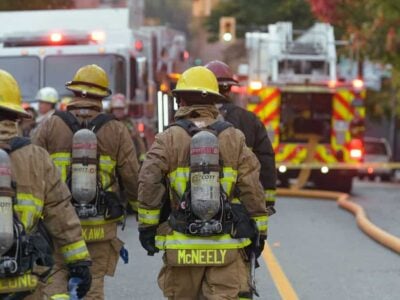
Certain occupations historically involved heavy, sustained asbestos exposure, and workers in these fields carry dramatically elevated risk. Construction workers involved in demolition or renovation, shipyard and Navy veterans, insulators, pipefitters, and auto mechanics who worked with brakes and clutches before asbestos was phased out all fall into this category, along with firefighters exposed during structural fires.
Secondary, or take-home, exposure has also caused mesothelioma in spouses and children of workers who never handled asbestos themselves, simply from fibers carried home on clothing, hair, or tools.
Environmental exposure near former mines, mills, or industrial sites can contribute to cumulative dose too, generally at lower intensity than occupational exposure but still adding to overall lifetime risk.
Why Does It Take Decades for Asbestos Cancer to Appear?
Mesothelioma typically appears 20 to 60 years after first exposure, asbestos-related lung cancer usually 15 to 35 years, and asbestosis 10 to 30 years.
This delay reflects how asbestos actually causes disease. Once inhaled, fibers become biopersistent, meaning the body can’t break them down or remove them.
They trigger chronic inflammation that continues year after year, gradually damaging cellular DNA and interfering with normal cell division, until enough accumulated damage allows some cells to begin growing uncontrollably.
This is also why there’s effectively no expiration date on asbestos risk from a medical standpoint.
Fibers inhaled decades ago remain in the body, continuing to cause low-level damage the entire time, which is exactly why people exposed in their 20s and 30s are still being diagnosed with these diseases well into their 60s, 70s, and beyond.
If you or a family member may have been harmed by a doctor's error in New York, the team at Porter Law Group can review the medical records and your options at no cost.
What Are the Legal Deadlines for an Asbestos Claim in New York?
Because these diseases can take decades to appear, New York starts the filing clock from the date of diagnosis, not the date of exposure.
Claim Type | Deadline | Legal Basis |
Personal injury (mesothelioma, lung cancer, asbestosis) | 3 years from the date the disease is discovered, or reasonably should have been discovered | CPLR § 214-c |
Wrongful death from an asbestos-related disease | 2 years from the date of death | EPTL § 5-4.1 |
Summing It Up
No amount of asbestos exposure is guaranteed safe, but risk isn’t uniform either. Brief, low-intensity encounters carry far lower risk than years of occupational exposure, especially at high concentrations, and the danger compounds with cumulative dose, exposure intensity, duration, and smoking history.
Porter Law Group represents New York individuals and families dealing with asbestos-related disease. Understanding your specific exposure history, how much, how intense, and for how long, is often central to both your medical care and any legal claim.
If you or someone you love has been diagnosed with mesothelioma, lung cancer, or another asbestos-related disease, we can review your exposure history and explain what your options actually look like.
Frequently Asked Questions
How much asbestos exposure is considered dangerous?
There’s no single safe threshold. Regulatory agencies agree that no level of asbestos exposure is guaranteed safe, though risk climbs with cumulative dose, exposure intensity, and duration. A commonly used clinical benchmark, 25 fiber-years of cumulative exposure, is associated with roughly a doubling of lung cancer risk.
Can asbestos actually kill you, or is it just a health risk?
Yes, asbestos can be fatal. Mesothelioma, the cancer most closely tied to asbestos, has a serious prognosis even with modern treatment, and asbestos significantly raises the risk of fatal lung cancer as well, especially in combination with smoking. Even non-cancerous asbestosis can progress to fatal respiratory failure in severe cases.
Is it true that there’s no safe level of asbestos exposure?
Yes, this is the consistent position of OSHA, NIOSH, and other major health authorities. It doesn’t mean every exposure causes disease, since most people exposed to asbestos never develop cancer, but no dose has been scientifically shown to carry zero risk.
Does a single brief exposure to asbestos put me at serious risk of cancer?
The risk from one brief exposure is real but considerably lower than from repeated or prolonged exposure. Most mesothelioma and asbestos-related lung cancer cases occur in people with substantial occupational or secondary exposure, though the actual risk from a single incident depends heavily on how concentrated the exposure was and how long it lasted.
If my workplace complies with OSHA’s asbestos exposure limit, does that mean I’m not at risk?
Not entirely. OSHA’s current limit of 0.1 fibers per cubic centimeter represents the lowest level considered practically achievable in workplaces, not a level proven to be risk-free. Even compliant, long-term occupational exposure at or near this limit has still been associated with mesothelioma, lung cancer, and asbestosis in some workers.
Prior results do not guarantee a similar outcome.
Contact Porter Law Group
Phone: 833-PORTER9
Email: info@porterlawteam.com