

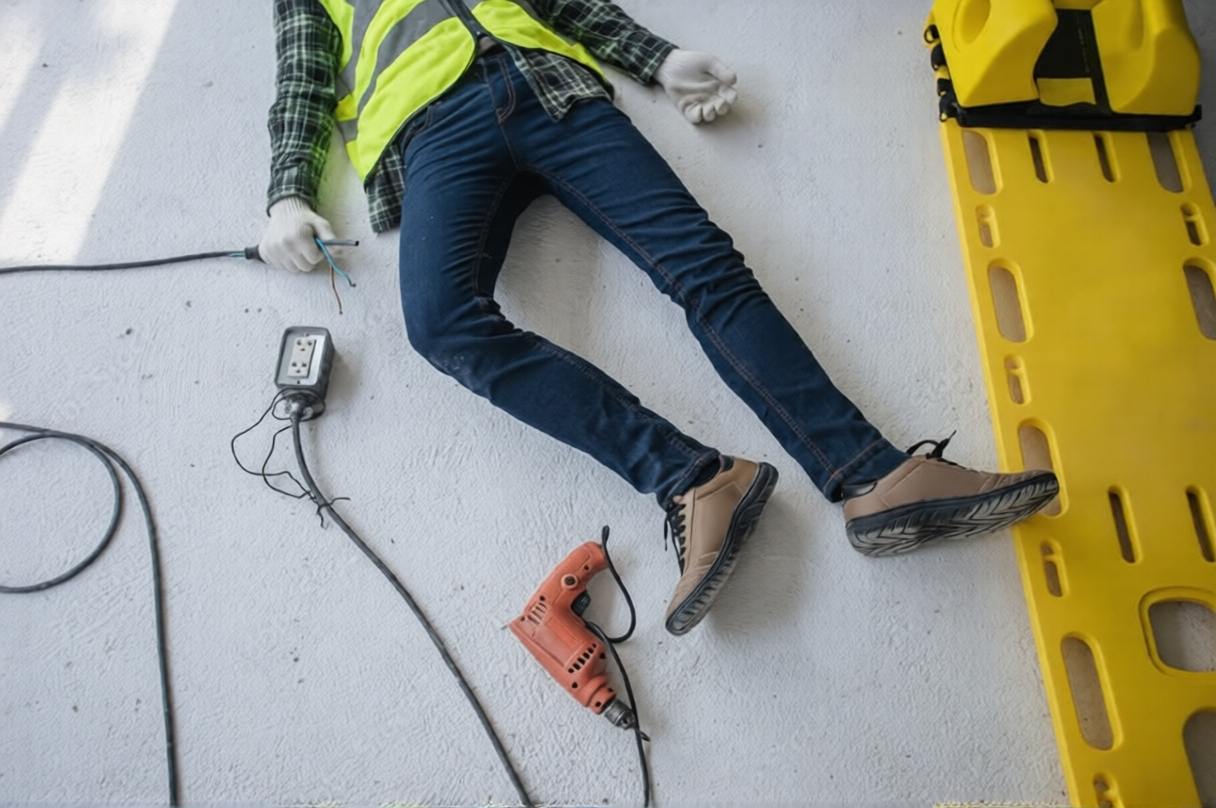
Electrocution is one of OSHA’s Fatal Four, the four leading causes of construction worker deaths in the United States, and it is one of the most underestimated hazards on New York job sites. Unlike a fall or a collapse, electrical injuries are often invisible until it is too late. A worker can contact an energized line without seeing it, suffer injuries that appear minor at the scene and become catastrophic over the following days, or survive a shock only to face months of neurological complications that no one anticipated.
If you or a family member was electrocuted or seriously injured by an electrical hazard on a New York construction site, you may have powerful legal rights under New York Labor Law that go far beyond what workers’ compensation covers. At Porter Law Group, attorney Michael S. Porter and his team represent construction workers and the families of those killed in electrocution accidents throughout New York State. Call us at (833) 767-8379 or email info@porterlawteam.com for a free consultation. You pay nothing unless we recover for you.
Prior results do not guarantee a similar outcome.
What Makes Construction Site Electrocution Cases Different
Electrical injuries on construction sites are distinct from electrocution injuries in other settings, and that distinction shapes every aspect of the legal case.
When a worker is electrocuted on a construction site, New York’s Labor Law framework applies. That means property owners and general contractors face liability not only under ordinary negligence principles but under statutes that impose specific, non-delegable duties to protect workers from electrical hazards. Industrial Code Section 23-1.13 sets out precise requirements that every construction site must meet. When those requirements are violated and a worker is hurt, Labor Law Section 241(6) creates a basis for liability against the property owner and general contractor that does not require the injured worker to prove those parties were careless in the traditional sense.
This matters because construction site electrocution cases often involve parties who were not present when the injury occurred, who had no direct role in the electrical work being done, and who would argue in any other context that they bear no responsibility. New York’s Labor Law removes that argument. The duty to protect workers from electrical hazards on a construction site belongs to the owner and general contractor, and it cannot be delegated away to an electrical subcontractor or to anyone else.
A second distinction is scale. According to data from the CDC’s National Institute for Occupational Safety and Health, roughly half of all fatal electrical injuries in the United States, and nearly a quarter of all non-fatal electrical injuries, occur in the construction industry. Specialty trade contractors account for 71 percent of fatal electrical injuries in construction. These are workers in the electrical trades, HVAC, plumbing, and telecommunications who work daily around energized systems, often in conditions where they have little control over how the site is managed.

New York Labor Law and Construction Site Electrocutions
Three statutes govern construction site electrocution claims in New York, and understanding how each one applies to your situation is the foundation of a well-built case.
Labor Law Section 241(6) and Industrial Code Section 23-1.13. This is the primary legal framework for construction site electrocution cases. Labor Law Section 241(6) requires property owners and general contractors to comply with the specific safety rules of the New York State Industrial Code. For electrical hazards, the controlling provision is 12 NYCRR Section 23-1.13, which sets out mandatory requirements that every construction, excavation, and demolition site in New York must follow.
Under Section 23-1.13, employers must determine the voltage of all power lines before any work begins. All power lines must be assumed to be energized until the utility owner confirms otherwise in writing. Warning signs must be posted, and all workers must be informed of every electrical hazard on the site. A minimum clearance of 10 feet must be maintained from any overhead high-voltage power line, and any work closer than that distance requires coordination with the utility owner and written guidance on how to proceed safely. All electric equipment must be grounded, and all circuits must be locked out and tagged before any work on them begins, consistent with OSHA’s requirements under 29 CFR 1926.417.
When any of these requirements are violated and a worker is injured, Section 241(6) creates liability for the property owner and general contractor, even if they did not personally perform the electrical work, were not present on the site, and did not know the specific hazard existed. New York courts have upheld this liability standard in electrocution cases involving live BX cable contacted during renovation work, overhead power line contact during crane operations, and energized equipment that was not properly locked out before maintenance began.
Labor Law Section 240(1). The Scaffold Law is most closely associated with fall injuries, but it also applies to electrocution cases where the shock causes a secondary fall. When a worker contacts an energized line and the resulting muscle contractions throw them from a scaffold, a ladder, or an elevated platform, the fall itself is covered under Section 240(1) as a gravity-related injury. In these cases, the injured worker may have claims under both Section 240(1) and Section 241(6) simultaneously, significantly strengthening the overall case.
Labor Law Section 200. This statute addresses general negligence and applies when the manner in which the work was being performed, or a dangerous condition on the site, caused the injury. Section 200 claims in electrocution cases often reach parties like electrical subcontractors who had direct control over the hazardous work, and site owners or general contractors who knew about an energized hazard but failed to address it. Unlike Section 241(6), Section 200 requires proof that the defendant knew about or exercised control over the dangerous condition.
One limitation applies across all three statutes: the residential owner exception. A homeowner who owns and occupies a one- or two-family home and does not direct or control the work being done may not face liability under these statutes. For all other property owners, including commercial developers, landlords, and corporate entities, the full force of New York’s Labor Laws applies.
To learn more about how these statutes apply across construction accident types, visit our construction accident practice area page.
Common Causes of Construction Site Electrocution in New York
Electrical injuries on construction sites do not happen randomly. Behind nearly every serious electrocution is a specific failure to meet a legal requirement, and identifying that failure is the foundation of the legal claim.
Overhead power line contact. Workers on scaffolding, cranes, aerial lifts, and elevated platforms can contact overhead energized lines when required clearances under 12 NYCRR Section 23-1.13 are not maintained. Under federal OSHA standards at 29 CFR 1926.416, employers must protect workers from contact with energized lines by deenergizing and grounding them, by maintaining safe distances, or by installing physical barriers. When those requirements are not met and a worker is injured, liability attaches to the owner and general contractor under Section 241(6).
Failure to lock out and de-energize circuits. Under both 12 NYCRR Section 23-1.13 and OSHA’s lockout/tagout standard at 29 CFR 1926.417, circuits and equipment must be de-energized and locked out before any work begins on or near them. When contractors allow workers to perform maintenance, repairs, or modifications on energized systems without proper lockout procedures in place, the resulting injuries are foreseeable and the liability is direct.
Exposed and unguarded wiring. Active construction sites are dynamic environments where temporary electrical systems are constantly being installed, modified, and extended. Exposed conductors, damaged insulation, improperly spliced connections, and unguarded electrical boxes create hidden hazards that can injure workers who have no reason to suspect the danger. Temporary wiring on construction sites is governed by 29 CFR 1926.405, which requires specific protections for wiring methods, components, and equipment used on jobsites.
Ground faults and lack of GFCI protection. OSHA requires ground-fault circuit interrupter protection for all 120-volt, single-phase, 15- and 20-ampere outlets used during construction under 29 CFR 1926.404. GFCIs cut power in milliseconds when a ground fault is detected, preventing electrocution. When contractors bypass or fail to install required GFCI protection, the consequences for workers who contact energized equipment can be fatal.
Defective electrical equipment and tools. Power tools, extension cords, generators, and temporary lighting that are improperly maintained, damaged, or defective can deliver fatal current to workers who have no indication the equipment is unsafe. Under 29 CFR 1926.431, employers are required to maintain electrical equipment in safe working condition. When defective equipment is provided by a manufacturer, a product liability claim can run alongside the Labor Law claims.
Inadequate training and safety communication. Under both federal and New York State law, employers must train workers to recognize electrical hazards, understand safe work distances, and follow lockout procedures. When workers are not informed of the electrical hazards present on the site, as required by Section 23-1.13, any resulting injury falls squarely within the liability framework those rules were designed to create.
Who Can Be Held Liable for a Construction Site Electrocution
Multiple parties often share responsibility for a construction site electrocution, and identifying all of them is critical to a full recovery.
Property owners. Under Labor Law Section 241(6), property owners are liable for violations of Industrial Code Section 23-1.13 that result in worker injuries, regardless of whether they were present on the site or had any direct role in the electrical work. The duty is non-delegable.
General contractors. The general contractor is responsible for site-wide safety, for ensuring that electrical subcontractors comply with the Industrial Code, and for enforcing lockout procedures and clearance requirements across the entire site. A general contractor who knew or should have known that an electrical hazard existed and failed to address it faces liability under all three Labor Law statutes.
Electrical subcontractors. The subcontractor performing electrical work has its own independent duty under Labor Law Section 200 and common law negligence when it created the hazardous condition or had supervisory control over the work that caused the injury. An electrical subcontractor that left an energized circuit unlabeled, failed to lock out a system before allowing other trades to work near it, or installed defective temporary wiring can bear significant liability.
Equipment and tool manufacturers. When a power tool, extension cord, generator, or piece of electrical equipment was defectively designed or manufactured and the defect caused the electrocution, the manufacturer and distributor can be held strictly liable under New York products liability law alongside the Labor Law defendants.
Utility companies. When overhead or underground utility lines contacted during construction work were inadequately maintained, improperly marked, or not de-energized when required, the utility company may bear liability alongside the property owner and general contractor.
Our attorneys investigate site plans, electrical permits, utility records, OSHA citations, inspection logs, and equipment documentation to identify every party who bears responsibility for what happened. We also handle third-party construction claims as a dedicated practice area.
How Electrical Injuries Affect the Body
Understanding the medical reality of electrical injuries matters for two reasons: it shapes the medical care a victim needs, and it shapes the full value of the legal claim. Electrical injuries are consistently underestimated at the scene because the visible damage often does not reflect the true extent of internal harm.
Cardiac arrest and arrhythmia. Electrical current can disrupt the heart’s natural rhythm, triggering ventricular fibrillation or full cardiac arrest even at relatively low voltages. A worker who survives a cardiac event caused by electrical contact may face long-term cardiac monitoring requirements and permanent heart function changes.
Nerve damage and chronic pain. Current traveling through the body destroys nerve tissue along its path, producing chronic pain, numbness, loss of sensation, weakness, or complete loss of function in affected limbs. Nerve injuries may not reach their full severity until weeks after the incident, and many are permanent.
Internal and external burns. Electrical burns appear at the entry and exit points of the current and along the internal path it travels. The visible wound at the surface may be small while the underlying tissue damage is extensive. Arc flash events can also cause severe external burns across large portions of the body simultaneously.
Traumatic brain injury and neurological complications. High-voltage electrocution is associated with loss of consciousness, seizures, cognitive impairment, and lasting neurological effects. Additionally, the violent muscle contractions that electrical current causes can throw a worker from a height or against a surface, producing a secondary traumatic brain injury entirely separate from the electrical contact itself. Our firm has extensive experience handling catastrophic injury cases involving TBI resulting from construction accidents.
Spinal cord injuries from secondary falls. When an electrical shock causes a worker to fall from a scaffold, ladder, or elevated platform, the spinal cord injuries that result can cause partial or complete paralysis. These cases involve overlapping claims under both Section 240(1) and Section 241(6).
Wrongful death. Electrocution remains one of the four leading causes of construction worker fatalities in the United States. When a worker is killed, surviving family members may have a wrongful death claim against the property owner, general contractor, electrical subcontractor, and other responsible parties. Recoverable damages include funeral costs, the financial support the deceased would have provided over a lifetime, and compensation for the loss of companionship and parental guidance. For more on how these claims work, visit our page on wrongful death in New York.
A full medical evaluation immediately after any electrical contact is critical, because delayed symptoms are common and because a medical record created the same day establishes the connection between the injury and the incident. Our attorneys work with medical specialists and economic analysts to document the true scope of losses before any settlement is considered.
Steps to Take After a Construction Site Electrocution
The actions taken in the hours and days after a construction site electrocution can significantly affect both your medical outcome and your legal claim.
- Seek emergency medical care immediately, even if you feel okay. Cardiac arrhythmias, nerve damage, and internal burns can develop or worsen hours after the initial contact. Tell the treating physician exactly what happened, including the likely voltage involved, the duration of contact, and whether you lost consciousness. A medical record created the same day is essential evidence.
- Report the accident in writing. Notify your employer or the site supervisor in writing as soon as you are physically able. Under New York workers’ compensation law, you must report a workplace injury to your employer within 30 days. Delays can jeopardize your benefits.
- Do not allow the hazard to be repaired or removed before documentation. The energized wire, the unlocked circuit, the missing GFCI, or the downed power line is the primary evidence in your case. Photograph it if you can. Do not allow contractors or site supervisors to repair or alter the condition before an attorney can arrange an independent inspection.
- Preserve your equipment and clothing. The tools, protective equipment, and clothing you were wearing at the time of the accident can show the entry and exit points of the current and help an electrical engineer reconstruct what happened. Do not wash or discard them.
- Do not give recorded statements to insurers. Insurance adjusters for the property owner and general contractor will contact you quickly. You are not required to give a recorded statement. Do not sign any documents or accept any offer before speaking with an attorney.
- File for workers’ compensation promptly. Workers’ comp covers your medical bills and a portion of lost wages regardless of fault. Filing on time protects those benefits. Note that filing a workers’ comp claim does not extend or pause the deadline for your personal injury lawsuit. Those two deadlines run on completely separate tracks.
- Contact Porter Law Group. Call (833) 767-8379 or email info@porterlawteam.com. We will review your case at no cost and explain every legal option available to you.
What Compensation Can You Recover
Workers’ compensation provides medical benefits and a portion of lost wages, but it does not cover pain and suffering, full lost wages, or the long-term financial consequences of a permanent disability. A successful third-party claim under Labor Law Section 241(6), Section 240(1), or Section 200 opens access to the full range of compensation that serious electrocution injuries warrant.
- Past and future medical expenses, including emergency care, hospitalization, surgery, rehabilitation, cardiac monitoring, neurological care, and long-term treatment
- Lost wages from the time of the accident through the resolution of your case
- Reduced future earning capacity if your injuries prevent you from returning to your trade or any comparable work
- Pain and suffering, both physical and emotional
- Loss of enjoyment of life
- Permanent disfigurement from electrical burns
- Loss of consortium for the injured worker’s spouse or family members
How Much Is a Construction Electrocution Case Worth in New York?
The value of an electrocution claim depends on the severity of the injuries, the specific violations that occurred, and the parties involved. The table below reflects general outcome ranges for New York construction accident cases involving electrical injuries.
| Injury severity | Typical range |
| Moderate injuries, full or significant recovery | $75,000 to $300,000 |
| Serious injuries with permanent effects, nerve damage, or extended recovery | $300,000 to $1,000,000 |
| Catastrophic injuries including severe burns, TBI, paralysis, or cardiac damage | $1,000,000 to $5,000,000 or more |
| Wrongful death | $1,000,000 to $5,000,000 or more |
These ranges are general guidance only. Cases involving a clear violation of Industrial Code Section 23-1.13, strong evidence of the defendant’s knowledge of the hazard, or catastrophic and permanent injuries tend to produce the strongest recoveries. For more context on construction accident compensation in New York, visit our construction accident settlement amounts page.
Deadlines for Filing a Construction Electrocution Claim in New York
New York’s filing deadlines are strict and unforgiving. Missing any one of them can permanently end your right to recover compensation, regardless of how strong your case is.
Personal injury lawsuits: Three years from the date of the accident, under CPLR Section 214(5). This applies to all claims under Labor Law Sections 241(6), 240(1), and 200 against private property owners, developers, and general contractors.
Wrongful death claims: Two years from the date of death, under New York Estates, Powers and Trusts Law Section 5-4.1.
Claims involving a government entity: If the construction site was owned or controlled by New York City, the MTA, NYCHA, a city agency, a public authority, or any other government body, you must file a Notice of Claim within 90 days of the accident under General Municipal Law Section 50-e. You then have one year and 90 days to file your lawsuit. This shorter window is easy to miss, particularly for workers on public infrastructure projects, public housing construction, and government-managed development sites.
Workers’ compensation: You must notify your employer of the injury within 30 days of the accident.
One critical point: filing a workers’ compensation claim does not toll or extend the statute of limitations for your personal injury lawsuit. Many workers lose their right to sue because they assumed the workers’ comp filing covered both. It does not.For a full breakdown of how these deadlines apply to different construction accident scenarios, visit our statute of limitations page.
Talk to our experienced New York construction accident lawyers about your rights under Labor Law in a free, no-obligation consultation.
Why Work With Porter Law Group
Construction site electrocution cases require a legal team that understands the interplay between Labor Law, the Industrial Code, and OSHA regulations, and that can move quickly to preserve evidence before the electrical hazard is repaired and the site is returned to service.
Michael S. Porter founded Porter Law Group to represent New York workers and families in serious injury cases. A graduate of Harvard University and Syracuse University College of Law, he served as a Captain in the U.S. Army Judge Advocate General’s Corps before entering private practice. He has been selected to Super Lawyers for 14 consecutive years, from 2012 through 2025, and holds a 10.0 Superb rating on Avvo and a Distinguished rating from Martindale-Hubbell.
No fee unless we win. All electrocution accident cases are handled on a contingency basis. You pay nothing unless we recover compensation for you.
Free consultations, available 24/7. You can reach our team any time to discuss your case at no cost and with no obligation to retain us.
Direct attorney access. You will speak with the attorney handling your case throughout the process, not only with a case manager or paralegal.
You can review our case outcomes on our Results page, read client experiences on our Testimonials page, and meet our team on the Attorneys and Staff page.
Serving Construction Electrocution Victims Across New York State
Porter Law Group represents injured workers and their families throughout New York State wherever construction site electrocution accidents occur.
- New York City. Electrocution hazards are constant across all five boroughs, where older building stock, dense overhead utility infrastructure, and the pace of active development create daily electrical risks for construction workers. We handle cases involving NYCHA, MTA, and NYC Department of Design and Construction projects, each of which requires a Notice of Claim within 90 days of the accident. We represent workers injured on projects across Manhattan, Brooklyn, Queens, the Bronx, and Staten Island.
- Long Island. We represent construction electrocution victims across Nassau and Suffolk Counties, including residential construction, commercial development, and utility infrastructure projects.
- Westchester and the Hudson Valley. Workers injured by electrical hazards on construction projects in White Plains, Yonkers, and across Westchester County are served by our team.
- Syracuse and Central New York. We handle construction electrocution cases throughout Onondaga County and the surrounding region. New York State Industrial Code requirements apply statewide, and violations of Section 23-1.13 carry the same legal weight on a Syracuse job site as on a Manhattan high-rise.
- Buffalo and Western New York. Workers injured by electrical hazards on construction sites across Erie and Niagara Counties can reach our team for a free consultation at any time.
- Upstate New York. We handle construction electrocution cases in Albany, Rochester, Utica, Binghamton, and communities throughout New York State.
Frequently Asked Questions
What is Industrial Code Section 23-1.13, and why does it matter for my case?
Section 23-1.13 of the New York Industrial Code is the specific regulation that governs protection from electrical hazards on construction, excavation, and demolition sites. It requires employers and contractors to determine voltage levels before work begins, to treat all power lines as energized unless confirmed otherwise in writing by the utility owner, to maintain a minimum 10-foot clearance from overhead high-voltage lines, to post warnings of all electrical hazards, and to ensure all circuits are locked out before work begins on or near them. When a violation of Section 23-1.13 causes a worker’s injury, Labor Law Section 241(6) creates liability for the property owner and general contractor, even if they did not personally perform the electrical work. This provision has been the basis for successful summary judgment motions in New York courts and is one of the strongest legal tools available in construction electrocution cases.
Can I sue for a construction electrocution if I am receiving workers’ compensation?
Yes. Workers’ compensation covers your medical bills and a portion of lost wages, but it does not compensate you for pain and suffering, full lost wages, or the long-term financial impact of a permanent disability. Workers’ comp only bars you from suing your direct employer. You can file a separate personal injury lawsuit against the property owner, general contractor, electrical subcontractor, equipment manufacturer, or utility company whose negligence contributed to the accident, all while receiving workers’ comp benefits from your employer. Coordinating both claims correctly can significantly increase your total recovery.
Does Section 240(1) apply to electrocution cases?
It can, when the electrocution causes a secondary fall from height. When electrical current causes the violent muscle contractions that throw a worker from a scaffold, ladder, or elevated platform, that fall is covered under Labor Law Section 240(1) as a gravity-related injury. In those cases, the injured worker can bring claims under both Section 240(1) and Section 241(6), which strengthens the overall case and increases the available recovery.
How long do I have to file a construction electrocution lawsuit in New York?
For most cases involving private property owners, developers, and general contractors, you have three years from the date of the accident under CPLR Section 214(5). For wrongful death claims, the deadline is two years from the date of death under EPT Section 5-4.1. If the construction site was owned or controlled by a government entity such as New York City, the MTA, or NYCHA, you must file a Notice of Claim within 90 days of the accident under General Municipal Law Section 50-e, followed by your lawsuit within one year and 90 days. Filing a workers’ comp claim does not extend these deadlines. Contact an attorney as soon as possible.
What if I am an undocumented worker injured by an electrical hazard?
Undocumented workers in New York have the same rights under Labor Law Section 241(6) and the workers’ compensation system as any other worker on a construction site. Immigration status does not affect your right to file a claim or recover full compensation for your injuries. Our attorneys handle these cases with complete confidentiality.
What should I do if I was shocked but feel fine now?
Go to an emergency room the same day, regardless of how you feel. Cardiac arrhythmias, internal burns, and neurological complications from electrical contact can develop or worsen hours after the incident. Delayed symptoms are common in electrical injury cases, and a medical record created the same day of the accident is one of the most important pieces of evidence in your legal claim. Do not wait to see how you feel over the coming days before getting evaluated.
What Clients Say About Porter Law Group
Meet the Attorney

Michael S. Porter, J.D.
Founder and managing partner of Porter Law Group. Harvard University (B.A., 1994), Syracuse University College of Law (J.D., 1997). Former U.S. Army JAG Corps Captain, Airborne Training School graduate. Super Lawyers 14 consecutive years, 10.0 Superb on Avvo, Distinguished rating from Martindale-Hubbell. Over 20 years of trial experience and $500 million in recoveries.
Reviewed by Michael S. Porter, J.D. | Last updated: [April, 2026]
Get Help from a New York Construction Electrocution Lawyer Today
A construction site electrocution can change a life instantly, and the injuries it causes often continue to develop long after the initial incident. The legal process that follows is complex, the deadlines are strict, and the parties responsible will have experienced legal teams protecting their interests from the moment the accident is reported.
Call 833-PORTER9 | Available 24/7 | No fee unless we win

