

If you or someone you love was hurt in a dump truck accident in New York, you may be entitled to financial compensation for your injuries, lost income, and everything else the crash has cost you. Dump truck accidents are some of the most serious on New York roads and job sites. These trucks are heavy, carry loose materials, and often work in tight construction zones near people on foot. When something goes wrong, the injuries can be life-changing. Settlements in New York dump truck cases typically range from $100,000 for moderate injuries to over $5 million for the most severe, with fatal accidents often resulting in wrongful death claims exceeding $2 million. Porter Law Group has recovered more than $500 million for injured New Yorkers since 2009. Contact us today for a free, no-obligation consultation.
Prior results do not guarantee a similar outcome.
Why Choose Porter Law Group for Dump Truck Accident Cases?
Dump truck accidents can involve multiple parties, including the driver, the trucking company, and sometimes a construction contractor or property owner. That means multiple insurance policies and more than one avenue for compensation. Porter Law Group knows how to pursue every responsible party so you are not left with less than you deserve.
Our firm has recovered more than $500 million for injured clients, including a $17.8 million settlement and a $13.5 million jury verdict. Seven of our eight attorneys have been recognized by Super Lawyers. Our founding attorney, Michael S. Porter, is a Harvard-educated lawyer and former U.S. Army JAG Corps Captain with over 20 years of trial experience. We handle both the vehicle claim against the trucking company and any applicable construction-site claims against contractors and property owners when the accident happened at a job site.
Meet our attorneys and staff and see our results to learn more about how we fight for our clients.

FIND OUT WHO IS LIABLE FOR YOUR DUMP TRUCK ACCIDENT
What Makes Dump Trucks Uniquely Dangerous?
Dump trucks are not like other large vehicles on the road. They carry loose material that can spill, their beds move up and down, and they frequently operate in active construction zones where workers and pedestrians are nearby. These features create hazards that simply do not exist with other trucks.
| Hazard | How It Causes Accidents | Who Gets Hurt |
| Raised bed while driving | Driver forgets to lower the bed after unloading, hitting overpasses, power lines, or tipping over on turns | Other drivers, pedestrians, utility workers |
| Loose material spills | Gravel, sand, or debris falls from the bed onto the road or into following vehicles | Drivers behind the truck, motorcyclists |
| Overloading | Too much weight increases stopping distance, causes tire failure, and makes the truck harder to control | Anyone in the path of the truck |
| Construction zone operation | Backing and turning near workers, open ground, and foot traffic | Construction workers, flaggers, pedestrians |
| Hydraulic failure | The bed drops unexpectedly during unloading, crushing anyone nearby | Workers standing near the truck |
FIND OUT WHO IS LIABLE FOR YOUR DUMP TRUCK ACCIDENT
How Do Dump Truck Accidents Happen in New York?
Driving With The Bed Raised
After unloading at a job site, a driver may forget to lower the hydraulic bed before pulling back onto the road. A raised bed can strike overpasses, power lines, and traffic signals. On turns, it makes the truck far more likely to tip over. New York has many low-clearance bridges, particularly on Long Island and older upstate routes, which makes this a recurring problem.
Loose Material Falling From The Truck
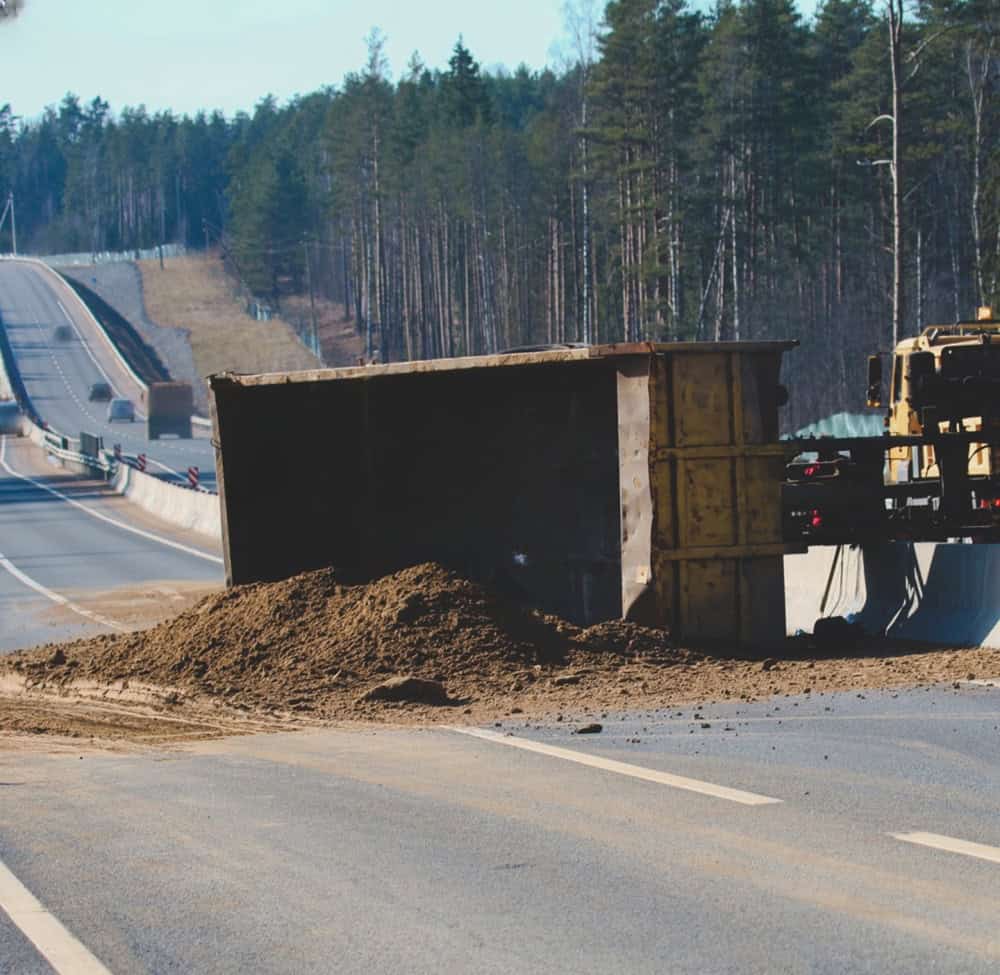
Gravel, sand, broken concrete, and debris can spill from an uncovered or overfilled dump truck. This material can crack windshields, puncture tires, and cause drivers to swerve suddenly. New York law requires loads to be covered or properly secured. When a driver or company ignores this, they are responsible for any crashes that result.
Construction Zone Accidents
Dump trucks working at active job sites have to back up, turn, and maneuver in tight spaces near workers and pedestrians. These trucks have significant blind spots, and construction noise can drown out backup alarms. When a driver backs up without a spotter or fails to check mirrors, workers and bystanders can be struck before they even know the truck is moving.
Overloaded Trucks
Drivers in the construction industry are often paid by the load, which creates financial pressure to carry as much as possible. An overloaded truck takes longer to stop, is more prone to tire blowouts, and is harder to handle on hills. New York’s hilly terrain in the Hudson Valley, Catskills, and Southern Tier makes this especially dangerous on downhill roads.
Who Is Responsible For A Dump Truck Accident In New York?
More than one party can be responsible for your injuries, which means more than one source of potential compensation.
The dump truck driver may be responsible for traffic violations or operating errors, such as driving with the bed raised, failing to cover the load, speeding in a construction zone, or backing up without checking for people nearby.
The trucking company is responsible for maintaining the truck, making sure loads are properly covered, and training drivers on safe operation. Companies that pay drivers by the load may be creating the very conditions that lead to overloading accidents. That pay structure can itself be used as evidence in a case.
The general contractor or property owner may share responsibility when the accident happens at a construction site and injures a worker. New York has specific laws that can hold contractors and property owners accountable for worker safety on job sites, in addition to standard negligence.
The loading company may be responsible if they improperly loaded the truck, caused it to be overloaded, or failed to secure the material before the truck left.
New York law allows injured people to recover from each party that contributed to the accident, which means you are not limited to one defendant or one insurance policy.
What Compensation Can You Recover After A Dump Truck Accident?
The compensation available in a dump truck accident case covers both what the accident cost you financially and what it has cost you personally.
Medical expenses and future care cover everything from emergency treatment and surgery to physical therapy, follow-up visits, assistive devices, and any ongoing care your injuries require. Serious injuries like traumatic brain injuries, spinal cord damage, or amputations can require years of treatment, and that full future cost should be part of your claim, not just what you have already paid.
Lost income and earning capacity covers the wages you missed during recovery and, if your injuries have reduced your ability to work long-term, the income you will lose going forward. Construction workers, tradespeople, and anyone who does physical work can be deeply affected when injuries prevent them from returning to their field.
Pain and suffering covers the physical pain, emotional distress, anxiety, disrupted sleep, and overall reduction in your quality of life caused by the accident and the recovery that follows. New York generally does not cap compensation for pain and suffering.
A narrow exception can limit recovery to $100,000 for certain at-fault drivers. Under Insurance Law 5104(d), in motor vehicle lawsuits commenced on or after May 26, 2026, that limit on non-economic damages applies only when the injured person was operating a motor vehicle, was partly at fault but not barred from recovery by CPLR 1411, had a serious injury, and was either driving an uninsured vehicle they were responsible for insuring (a coverage lapse of less than thirty days does not count), driving while impaired and convicted of it, or committing a felony or fleeing from one while driving and convicted of that felony. The limit does not apply to claims for injuries resulting in death.
Wrongful death claims are available to the surviving family of someone killed in a dump truck accident. These claims can cover funeral and burial costs, the financial support the person would have provided to their family, and the loss of their companionship and guidance. Wrongful death settlements in New York dump truck cases typically range from $1 million to $10 million.
Punitive damages may apply in cases where the at-fault party’s behavior was particularly reckless, such as a company that sent out a truck it knew was unsafe, or a driver with a documented history of dangerous practices that the company ignored.
FIND OUT WHAT YOUR DUMP TRUCK ACCIDENT CASE IS WORTH
Case Results
Porter Law Group’s published results include more than 50 cases at or above $1 million, anchored by a $17.8 million settlement and a $13.5 million jury verdict.
$5,700,000 Settlement: 52-year-old man suffered a lower extremity amputation in a commercial trucking accident. Porter Law Group established liability through driver logbook violations and secured a settlement covering lifetime prosthetic costs and lost earning capacity.
$1,027,000 Jury Verdict: Construction accident resulting in severe injuries. The insurer offered $50,000. Porter Law Group secured over $1 million, a 20x increase demonstrating why insurance companies settle when they know the firm will go to trial.
Every case is different. Past results do not guarantee future outcomes.
We Fight for What You Deserve — Free consultation, no fee unless we win. Call (833) PORTER-9.
How Long Do I Have to File a Dump Truck Accident Claim in New York?
Timing is one of the most critical factors in a dump truck accident case. Miss a deadline and you may lose your right to compensation entirely, regardless of how strong your case is.
Most private truck cases: 3 years. If the dump truck was owned by a private company, you generally have three years from the accident date to file a claim. Even so, you should not wait. Key evidence like the truck’s maintenance records, load tickets, and driver history can be lost or destroyed quickly if a lawyer does not act early to preserve it.
Government-owned trucks: 90 days. Many dump trucks in New York belong to city or county agencies, or work under government contracts. If a government vehicle was involved in your accident, you must file a formal legal notice within just 90 days. This is the shortest and most dangerous deadline in dump truck cases, and it almost never can be extended. Identifying whether the truck is government or privately owned should happen as soon as possible after the accident.
Wrongful death: 2 years. If someone was killed, the surviving family has two years from the date of death to file a wrongful death claim.
Workers’ compensation does not end your options. Receiving workers’ comp from your employer does not prevent you from filing a separate personal injury claim against the dump truck driver, the trucking company, or the general contractor. Workers’ comp covers only a portion of your losses. A personal injury claim can recover the rest, including full lost wages and pain and suffering that workers’ comp does not pay.
ACT NOW BEFORE YOUR DEADLINE EXPIRES
What Should You Do After a Dump Truck Accident in New York?
1. Call 911 and stay at the scene
Ask the responding officer to document whether the truck’s bed was raised, whether the load was covered, whether any material spilled onto the road, and whether the truck was operating in or near a construction zone. Ask them to record the company name on the truck and note whether it appears to be a government or private vehicle.
2. Take photos and video right away
Before anything is moved or cleaned up, photograph the bed position, the cargo type and whether it was covered, any spilled material on the road, all company markings and license plates on the truck, and the full extent of damage to your vehicle and any others involved.
3. Get medical attention within 24 hours
Dump truck impacts can cause serious internal injuries, brain injuries, and spinal damage that are not immediately obvious. Getting evaluated right away protects your health and creates a medical record that connects your injuries to the accident from day one, which matters significantly for your claim.
4. Find out if the truck is government or privately owned
This single fact determines which deadline applies to your case. If it is a government vehicle, you may have only 90 days. Do not assume one way or the other. Find out and call a lawyer immediately.
5. Contact a dump truck accident lawyer as soon as possible
An attorney can send preservation notices to the trucking company requiring that the truck’s maintenance records, load weight tickets, driver files, and any onboard camera footage are not deleted or destroyed. Porter Law Group offers free consultations with no upfront costs. Reach us here.
Dump Truck Accident Lawyer Near You in New York
Porter Law Group represents dump truck accident victims across all of New York State. Whether your accident happened on a city street, a state highway, or at an active construction site, our team handles claims in every county and region. We are headquartered in Syracuse and serve clients statewide.
Syracuse | New York City | Buffalo | Rochester | Albany | Yonkers | White Plains | Utica | Binghamton | Long Island
No matter where you are in New York, we can help. See all our service locations.
Call (833) PORTER-9 to speak with a dump truck accident attorney today.
Frequently Asked Questions About Dump Truck Accidents in New York
How much is a dump truck accident settlement worth in New York?
Every case is different, but settlements generally range from $100,000 for moderate injuries to over $5 million for catastrophic ones. Fatal accidents often produce wrongful death claims above $2 million. The key factors are the severity of your injuries, how many parties share responsibility, and whether a construction site was involved, since that can bring in additional defendants and additional insurance coverage.
Who can be held responsible for a dump truck accident?
The driver, the trucking company, the general contractor at a job site, the property owner, and the company that loaded the truck can all share responsibility depending on what happened. Each may carry separate insurance, which can increase the total compensation available to you.
Can a construction worker sue after being hit by a dump truck on a job site?
Yes. Receiving workers’ compensation from your employer does not prevent you from filing a personal injury claim against the dump truck driver, the trucking company, or the general contractor. Workers’ comp covers only a portion of your losses. A separate personal injury claim can recover full lost wages, pain and suffering, and other damages that workers’ comp does not pay.
What if a dump truck spilled debris that caused my accident?
The driver and the trucking company can be held responsible. New York law requires all loads to be covered or secured before the truck moves. When that rule is not followed and someone gets hurt, the company is liable. Dashcam footage and witnesses who can identify the truck are the most valuable evidence in spill cases.
How much does it cost to hire Porter Law Group for a dump truck accident case?
Nothing upfront. Porter Law Group works on a contingency-fee basis, meaning you pay nothing unless we recover compensation for you. We cover all costs for investigation, expert witnesses, and litigation. If we do not win, you owe us nothing.
Can a construction worker sue after being hit by a dump truck on a job site?
Yes. An injured construction worker can file a personal injury claim against the dump truck driver, the trucking company, the general contractor, and the property owner, even while receiving workers’ compensation benefits from their direct employer. Workers’ compensation covers medical bills and partial lost wages from the direct employer, but a third-party personal injury claim against the dump truck operator and the general contractor can recover full lost wages, pain and suffering, and other damages that workers’ comp does not cover.
Do dump trucks require a 90-day Notice of Claim?
Only if the dump truck is owned or operated by a government entity. Municipal highway departments, county DPW agencies, and government contractors performing public works projects may all be subject to the 90-day Notice of Claim requirement under General Municipal Law §50-e. Private dump truck companies follow the standard 3-year statute of limitations. Identifying whether the truck is government or private must happen immediately after the crash because the 90-day deadline cannot be extended in most circumstances.
How long do I have to file a dump truck accident claim in New York?
For private dump trucks: 3 years under CPLR §214. For government-owned dump trucks: 90-day Notice of Claim under General Municipal Law §50-e, followed by a lawsuit within 1 year and 90 days. Workers’ compensation claims have separate filing deadlines. Wrongful death claims carry a 2-year deadline under EPTL §5-4.1. The 90-day deadline is the shortest and most dangerous trap in dump truck cases.
How much does a dump truck accident lawyer cost?
Porter Law Group works on a contingency-fee basis, meaning you pay nothing unless the firm recovers compensation for you. There are no upfront costs, retainers, or hourly fees. The firm covers all expenses for construction site investigation, engineering experts, Labor Law analysis, and litigation against multiple defendants. If the case does not result in a recovery, you owe nothing.
What Clients Say About Porter Law Group
Meet the Attorney

Michael S. Porter, J.D.
Founder and managing partner of Porter Law Group. Harvard University (B.A., 1994), Syracuse University College of Law (J.D., 1997). Former U.S. Army JAG Corps Captain, Airborne Training School graduate. Super Lawyers 14 consecutive years, 10.0 Superb on Avvo, Distinguished rating from Martindale-Hubbell. Over 20 years of trial experience and $500 million in recoveries.
Reviewed by Michael S. Porter, J.D. | Last updated: [April, 2026]
Contact Porter Law Group Today
Dump truck accidents cause serious, life-altering injuries, and the clock starts running the day the crash happens. If a government vehicle was involved, you may have as little as 90 days to act. The sooner you call, the better positioned we are to protect your rights and preserve the evidence that wins cases.
Phone: +1 833-767-8379
Email: info@porterlawteam.com
Monday to Friday: 8 AM to 5 PM | Saturday and Sunday: Closed