
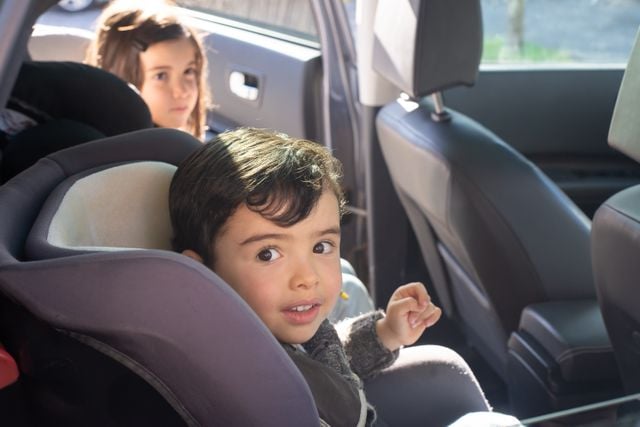

Yes, you can bring and use a booster seat in an Uber, Lyft, taxi, or livery vehicle in New York, and for most kids who’ve outgrown a harnessed car seat, you should.
But the legal picture here is genuinely messier than a yes-or-no answer suggests, because the state statute and New York City’s own transportation agency don’t actually say the same thing.
The statute itself, specifically VTL 1229-c(3-c), requires seat belts for taxi and livery drivers and passengers age 8 and older, but it does not impose the same child-restraint requirement on taxi and livery passengers younger than 8 that applies in an ordinary private car.
That’s a real, current statutory exception, and New York’s own DMV materials describe it as one.
But the NYC Taxi and Limousine Commission’s own passenger guidance says something different: children under 4 must ride in child safety seats, and all children must ride in a child restraint system, a harness, vest, or booster seat, until their 8th birthday, not a seat belt alone.
The TLC also explicitly tells passengers they’re allowed to bring and use their own car seat or booster in a TLC-licensed vehicle.
So you have a state statute that technically exempts taxi and livery passengers under 8, and the city agency that actually regulates those vehicles telling riders the opposite.
Prior results do not guarantee a similar outcome.
What New York Law Actually Requires
New York’s child restraint law, Vehicle and Traffic Law 1229-c, sets requirements by age and size for a typical private vehicle.
Child’s Age or Size | What’s Required |
|---|---|
Under 2 | Rear-facing car seat, until age 2 or the seat’s height/weight limit |
Under 4 | Federally approved child safety seat |
Age 4 through 7 | An appropriate child restraint, in practice a booster once the child has outgrown a harnessed seat |
Under 8 | Some form of federally approved restraint system |
8 and older | Seat belt, though a booster remains safest until the belt actually fits correctly |
That last point matters more than the age cutoff does. New York’s own guidance is explicit that proper belt fit, not a birthday, is what actually determines when a booster is no longer needed.
Why the Legal Minimum Isn’t the Safe Number
Whatever the statute technically allows, the safety numbers aren’t ambiguous. In 2023, 1,019 child passengers age 14 and under died in motor vehicle crashes nationwide, and more than 142,000 were injured, with 43 percent of the children killed not buckled up at all.
For kids ages 4 to 8 specifically, booster seats reduce the risk of serious injury by 45 percent compared to a seat belt alone. And it’s not just about whether a child is restrained at all: a CDC analysis found that while most children were restrained in some way, only about 60 percent were actually in the age-appropriate restraint for their size, meaning plenty of buckled-in kids are still riding in the wrong seat for their body.
None of that changes because the vehicle happens to be a yellow cab instead of a family sedan. A crash at 30 miles per hour applies the same force to a small body regardless of what’s printed on the vehicle’s TLC medallion.
How to Actually Use a Booster in a Rideshare
A booster only works with a lap-and-shoulder belt, never a lap belt alone. If the seating position you’re given only has a lap belt, a standard belt-positioning booster isn’t appropriate there, and it’s worth asking to move seats or requesting a different vehicle rather than using it incorrectly.
Done right, the lap belt sits low across the upper thighs, not the stomach, and the shoulder belt crosses the center of the chest and shoulder, not the neck or face, with the child sitting all the way back and knees bending comfortably at the edge of the seat.
Drivers aren’t obligated to help install it. Plan to do it yourself, and budget a few extra minutes before the ride starts.
Do Uber and Lyft’s Car Seat Options Actually Cover This?
Both companies offer optional car seat rides in New York City, but neither is really a booster-seat service, and it’s worth knowing the gap before you rely on one.
Uber’s Car Seat option uses a Nuna RAVA convertible seat for children between 5 and 65 pounds and up to 49 inches tall, usable rear-facing or forward-facing. Lyft’s Car Seat mode uses an IMMI Go forward-facing seat, for children at least 2 years old, between 22 and 48 pounds, and 31 to 52 inches tall.
Both are genuinely useful for younger kids, but a child who’s aged out of a harnessed seat and specifically needs a belt-positioning booster generally isn’t what either service is built for. If your child falls in that gap, bring your own.
If Your Child Is Hurt in a Rideshare or Taxi Crash
Get medical evaluation promptly, especially after any head impact, abdominal pain, vomiting, unusual sleepiness, or behavior change, even if your child seems okay at first.
Don’t reuse a car seat or booster involved in a crash if the manufacturer says it should be replaced.
Photograph the restraint, how it was installed, the belt path, and the vehicle seating position, and hold onto the restraint itself along with the ride receipt, trip record, and any crash report rather than discarding or returning anything before it’s documented.
What Actually Determines Liability
A child’s injury in a rideshare or taxi crash doesn’t automatically point to one party. Whether the child was correctly restrained for their size, whether a compatible lap-and-shoulder belt was even available, and which driver actually caused the collision all factor into a real investigation.
It’s worth being precise about how fault works here, because New York’s rule for motor vehicle cases changed in 2026 and a taxi or rideshare crash falls squarely under that change.
Under the current fault-bar rule, if a jury finds your fault, including a parent’s failure to properly restrain a child, exceeds the combined fault of everyone else involved, recovery can be barred entirely rather than just reduced.
That’s a meaningfully different and stricter standard than the old comparative negligence rule that a lot of older guidance still describes.
That said, a taxi/livery statutory exception for a child under 8 doesn’t establish a parent’s fault on its own, and lack of a booster doesn’t automatically prove liability either. These are fact-specific questions that depend on the full picture of what happened.
Summing It Up
You can, and generally should, bring your own booster into any Uber, Lyft, taxi, or livery ride in New York. The statute contains a genuine exception for taxi and livery passengers under 8, but NYC’s own TLC guidance tells families to use a restraint anyway and explicitly allows bringing your own, and a pending bill would close the statutory gap outright.
Whatever the legal minimum technically allows, the safety numbers point in exactly one direction: use the appropriate restraint every time, not just when the law happens to require it.
If your child was injured in a rideshare, taxi, or livery crash in New York, Porter Law Group can help you understand what happened and what your options are.
Call 833-PORTER9 or email info@porterlawteam.com to schedule a free consultation.
Prior results do not guarantee a similar outcome.
Frequently Asked Questions
Is it actually legal to skip a booster seat in an NYC taxi?
The state statute contains a technical exception for taxi and livery passengers under 8. But NYC’s Taxi and Limousine Commission, which actually regulates these vehicles, instructs families to use a restraint for children under 8 regardless, and permits bringing your own. The safest approach is to use one either way.
Does Uber or Lyft provide a booster seat automatically?
No. Their optional car seat services use convertible or forward-facing seats designed for younger, smaller children, not belt-positioning boosters. If your child has outgrown a harnessed seat, bring your own booster.
Can I use a booster seat with just a lap belt in a taxi?
No. A booster seat requires a lap-and-shoulder belt together. If the only available seating position has a lap belt alone, that position isn’t appropriate for a standard booster.
If my child wasn’t in a booster during a rideshare crash, does that automatically hurt my case?
Not automatically, but it can be a factor. New York’s current fault rule for motor vehicle crashes can bar recovery if a jury finds your fault exceeds everyone else’s combined, so restraint use can matter, though a taxi’s statutory exception for children under 8 doesn’t establish fault on its own.
How much does a rideshare accident lawyer cost in New York?
Porter Law Group works on a contingency fee basis. There’s no upfront cost, and no fee unless we recover compensation on your behalf.
This article is for informational purposes only and does not constitute legal advice. Attorney advertising. Prior results do not guarantee similar outcomes.