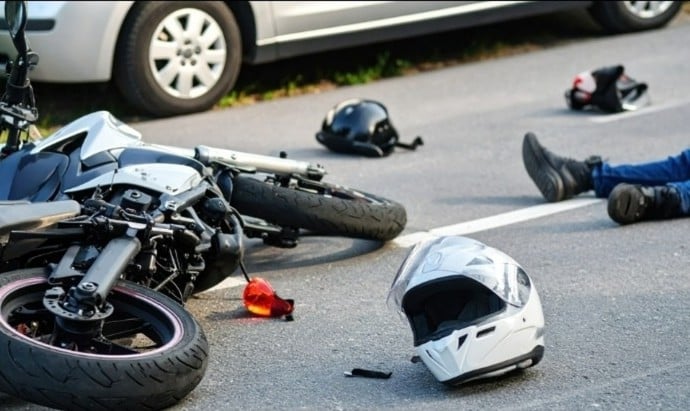


Per mile traveled in 2024, motorcyclists were 27 times more likely to die in a crash than passenger car occupants, according to NHTSA. That same year, 6,228 motorcyclists were killed on American roads — 15 percent of all traffic fatalities — despite motorcycles representing only 3.5 percent of all registered vehicles. The gap between those two numbers defines the risk of motorcycling, and understanding what drives it is the first step toward managing it.
Prior results do not guarantee a similar outcome.
How Much More Likely Is a Motorcycle Accident Than a Car Accident?
The statistical gap between motorcycle and passenger car risk is not a matter of degree — it is a matter of order of magnitude.
In 2024, motorcyclists were almost 27 times more likely to die per vehicle mile traveled than passenger car occupants, and almost 5 times more likely to be injured, according to NHTSA’s motorcycle safety page. In 2023, NHTSA recorded 31.39 motorcyclist fatalities per 100 million vehicle miles traveled, compared to 1.13 for passenger car occupants — a disparity approaching 28 to 1 for that year.
The overrepresentation in fatalities is equally stark. Motorcycles make up 3.5 percent of all registered motor vehicles in the United States. In 2024, motorcyclists accounted for 15 percent of all traffic fatalities. That means motorcyclists are killed at more than four times the rate their share of the vehicle fleet would predict.
In 2023, an estimated 82,564 motorcyclists were injured in traffic crashes nationally, according to NHTSA.
| Metric | Motorcycle | Passenger Car |
| Fatalities per 100M VMT (2023) | 31.39 | 1.13 |
| Death rate relative to passenger cars | ~28x higher | — |
| Injury risk per VMT (2024) | ~5x higher | — |
| Share of traffic fatalities (2024) | 15% | — |
| Share of registered vehicles | 3.5% | — |
Source: NHTSA, 2024 and 2023 data
The reason for this disparity is structural. A passenger car driver who is struck in a crash is surrounded by a metal frame, seat belts, airbags, and crumple zones designed to absorb and redirect impact forces. A motorcycle rider has none of those protections. The rider absorbs the crash directly.
What Are the Odds of a Motorcycle Accident in New York?
New York’s motorcycle accident numbers reflect the national pattern, compounded by the volume of traffic in the state’s urban areas.
In 2023, New York State recorded 4,525 fatal and personal injury motorcycle crashes and 187 motorcycle fatalities — representing 17 percent of all traffic deaths in the state, according to the New York State DMV Institute for Traffic Safety Management and Research (ITSMR). New York City alone saw more than 2,000 motorcycle crashes in 2023, an increase of nearly 50 percent over the prior year, according to the NY Department of Motor Vehicles.
One factor that significantly reduces risk in New York compared to most other states is the universal helmet law. Under VTL § 381(6), all motorcycle riders in New York are required to wear DOT-compliant helmets. NHTSA data shows that in states with universal helmet laws, approximately 10 percent of riders killed in crashes in 2023 were not wearing helmets, compared to 51 percent in states without such laws. The helmet law does not eliminate crash risk, but it substantially reduces the severity of injury when crashes occur.
What Factors Raise the Odds of a Motorcycle Accident?
While crashes can happen even to careful, experienced riders, the data from NHTSA and the Insurance Institute for Highway Safety (IIHS) consistently identifies the same risk factors in fatal motorcycle crashes.
Speeding. In 2024, 37 percent of motorcycle riders involved in fatal crashes were speeding, compared to 22 percent of passenger car drivers, according to NHTSA’s Traffic Safety Marketing data. Speeding reduces the rider’s reaction time and eliminates the margin of error needed to respond to hazards.
Alcohol impairment. Twenty-six percent of fatally injured motorcycle drivers in 2023 had a blood alcohol concentration of 0.08 g/dL or higher, according to IIHS. In single-vehicle crashes, that figure rises to 40 percent. Among riders killed at night, 44 percent had BACs at or above 0.08 percent. Alcohol impairs the balance, coordination, and fine motor control that motorcycle operation requires to a greater degree than it impairs automobile driving.
Riding without a valid motorcycle license. In 2024, 35 percent of motorcycle operators involved in fatal crashes were riding without valid motorcycle licenses, according to NHTSA. A motorcycle endorsement requires both written and skills testing specifically for motorcycle operation — skills that differ substantially from automobile driving.
Intersections and turning vehicles. Thirty-five percent of motorcyclist fatal crashes in 2021 occurred at intersections, according to NHTSA’s 2021 Motorcycles Traffic Safety Facts. In two-vehicle fatal crashes, 75 percent of the motorcycles involved were struck from the front. A significant portion of these crashes involve another vehicle turning across the motorcycle’s path at an intersection — a crash type that occurs because other drivers misjudge a motorcycle’s speed and proximity or simply fail to see it.
Night riding. Nighttime riding increases the risk from both alcohol-impaired riders and impaired or inattentive drivers. IIHS data shows that 44 percent of motorcycle drivers killed at night in 2023 had BACs at or above the legal limit, and visibility of the motorcycle itself is reduced in low-light conditions.
| Risk Factor | Data | Source |
| Speeding | 37% of riders in fatal crashes were speeding | NHTSA 2024 |
| Alcohol impairment | 26% of fatally injured riders had BAC ≥ 0.08% | IIHS 2023 |
| Alcohol at night | 44% of riders killed at night had BAC ≥ 0.08% | IIHS 2023 |
| No valid motorcycle license | 35% of operators in fatal crashes | NHTSA 2024 |
| Intersection crashes | 35% of fatal crashes at intersections | NHTSA 2021 |
| Front-impact in two-vehicle crashes | 75% of motorcycles struck from front | NHTSA 2021 |
What Reduces the Risk of a Motorcycle Accident?
The data that identifies what raises crash risk also points directly to what reduces it.
Wearing a DOT-compliant helmet. Helmets are approximately 37 percent effective in preventing motorcycle deaths and approximately 67 percent effective in preventing brain injuries, according to IIHS. In New York, the universal helmet law under VTL § 381(6) ensures that virtually all riders on the road are helmeted — and the state’s fatality data reflects that protection.
Getting and maintaining a valid motorcycle license. The 35 percent of fatal crash operators riding without a valid motorcycle license in 2024 represents a substantial preventable risk factor. Formal motorcycle training programs teach the specific balance, braking, low-speed maneuvering, and hazard recognition skills that motorcycle riding requires and that automobile driving experience does not develop.
Sober riding. Given that 40 percent of riders in single-vehicle fatal crashes were alcohol-impaired, riding sober eliminates what the data identifies as the single most common behavioral factor in fatal motorcycle crashes.
Defensive riding at intersections. Since 35 percent of fatal crashes occur at intersections and the majority of multi-vehicle fatal crashes involve a motorcycle being struck from the front, approaching every intersection with the assumption that crossing traffic may not see you — and positioning and slowing accordingly — addresses the crash scenario most likely to be fatal.
Proper gear beyond the helmet. Protective gear — leather or reinforced jackets, gloves, over-the-ankle boots, and armored pants — does not prevent a crash, but it dramatically reduces the severity of road rash and orthopedic injuries when a crash occurs.
If You Are Injured in a Motorcycle Accident in New York
The statistics make clear that motorcycle accidents happen even to experienced, careful, properly equipped riders. The rider who is struck from the front by a driver who failed to yield at an intersection did nothing wrong. The overrepresentation of motorcyclists in traffic fatalities and injuries is largely a function of the vehicle’s structural vulnerability, not of rider behavior.
When a crash does happen, New York law gives motorcycle accident victims a meaningful legal advantage over car accident victims. Because motorcycles are excluded from the no-fault insurance system under Insurance Law § 5103, riders can sue for any injury — including pain and suffering — without meeting the “serious injury” threshold that limits car accident claims. The standard deadline to pursue a claim is three years under CPLR § 214, but if a road defect contributed to the crash, a Notice of Claim against the responsible government entity must be filed within 90 days under General Municipal Law § 50-e.
90-Day Deadline — Government Road Defect Claims: If a pothole, missing sign, or dangerous road condition contributed to your crash, the Notice of Claim deadline under GML §50-e runs from the date of the crash. Missing it permanently bars the government liability claim.
Porter Law Group has recovered more than $500 million for injured New Yorkers. All eight attorneys have been selected to Super Lawyers or Rising Stars, including founder Michael S. Porter, named to Super Lawyers for 14 consecutive years. The firm works on a contingency-fee basis. There are no upfront costs and no legal fees unless compensation is recovered. For a full explanation of your legal rights as an injured motorcycle rider in New York, see our New York Motorcycle Accident page.
If you were injured in a motorcycle accident in New York and want to understand your options, the first step is a free consultation with an experienced New York motorcycle accident attorney. The deadlines that govern your claim begin running from the day of the crash.
Talk to our experienced New York motorcycle accident lawyers about your options for recovery in a free, no-obligation consultation.
Frequently Asked Questions
What are the chances of getting in a motorcycle accident?
Per mile traveled in 2024, motorcyclists were 27 times more likely to die in a crash than passenger car occupants and 5 times more likely to be injured, according to NHTSA. In 2024, 6,228 motorcyclists were killed nationally, representing 15 percent of all traffic fatalities despite motorcycles making up only 3.5 percent of registered vehicles. In New York State alone, 4,525 fatal and personal injury motorcycle crashes occurred in 2023, according to ITSMR.
How much more dangerous is riding a motorcycle than driving a car?
The fatality rate per vehicle mile traveled for motorcyclists was approximately 28 times higher than for passenger car occupants in 2023, based on NHTSA data. In 2023, there were 31.39 motorcyclist fatalities per 100 million vehicle miles traveled, compared to 1.13 for passenger car occupants. The disparity is structural: motorcycles provide no protective frame, airbags, or crumple zones, meaning the rider absorbs crash forces directly.
What are the most common causes of motorcycle accidents?
The most consistently documented risk factors in fatal motorcycle crashes are speeding, alcohol impairment, riding without a valid motorcycle license, and intersection crashes. According to NHTSA and IIHS data: 37 percent of riders in fatal crashes in 2024 were speeding; 26 percent of fatally injured riders in 2023 had blood alcohol levels above the legal limit; 35 percent of fatal crash operators in 2024 lacked valid motorcycle licenses; and 35 percent of motorcyclist fatal crashes in 2021 occurred at intersections.
What percentage of motorcycle accidents are fatal?
Motorcycle crashes result in fatalities at a significantly higher rate than car crashes because of the absence of protective vehicle structure. NHTSA data for 2024 shows that motorcyclists represent 15 percent of all traffic fatalities while making up only 3.5 percent of registered vehicles. For context, in 2023 approximately 82,564 motorcyclists were injured in crashes nationally, in addition to 6,335 fatalities — indicating that most crashes produce injury rather than death, but the fatality rate relative to miles traveled is nearly 28 times that of passenger cars.
Are motorcycle accidents usually the rider’s fault?
Not according to the crash data. NHTSA’s analysis of multi-vehicle motorcycle crashes shows that in two-vehicle fatal crashes, 75 percent of the motorcycles involved were struck from the front, which typically indicates another vehicle turned across or into the motorcycle’s path. While rider behavior — speeding and alcohol impairment — is a factor in a significant portion of single-vehicle crashes, multi-vehicle crashes frequently involve the other driver’s failure to see or yield to the motorcycle.
How do you reduce the risk of a motorcycle accident?
The behavioral factors that appear most consistently in fatal motorcycle crash data point directly to the risk reduction measures with the most impact: wearing a DOT-compliant helmet, holding a valid motorcycle license, riding sober, and riding defensively at intersections. According to IIHS, helmets are approximately 37 percent effective in preventing deaths and 67 percent effective in preventing brain injuries. In New York, the universal helmet law under VTL § 381(6) means all riders are required to meet this standard. The 35 percent of fatal-crash operators riding without valid licenses in 2024 highlights licensure as a separate, preventable risk factor.
Is riding a motorcycle more dangerous in cities or on highways?
NHTSA data shows that 65 percent of motorcyclist fatal crashes in 2021 occurred at locations other than intersections — meaning many occur on open roads, not just at city intersections. However, 35 percent did occur at intersections, which are concentrated in urban and suburban areas. New York City’s 2023 motorcycle crash count of more than 2,000 — nearly 50 percent higher than the prior year — reflects the volume-driven risk of dense urban riding. Neither environment is safe; the risk factors simply differ.
What should I do if I am injured in a motorcycle accident in New York?
Seek medical care immediately, preserve all evidence, and contact a motorcycle accident attorney before speaking to any insurance company. Because motorcycles are excluded from New York’s no-fault insurance system under Insurance Law § 5103, your claim moves directly against the at-fault driver’s liability coverage. The standard deadline to file a lawsuit is three years under CPLR § 214. If a road defect was involved, a Notice of Claim against the government entity must be filed within 90 days under GML § 50-e — a deadline that cannot be extended in most circumstances. For a full explanation of what to do and what rights you have, see our Motorcycle Accident Statute of Limitations guide.
Does wearing a helmet significantly reduce motorcycle accident risk?
A helmet does not reduce the probability of a crash, but it substantially reduces the probability of dying or suffering a traumatic brain injury if a crash occurs. According to IIHS, helmets are approximately 37 percent effective in preventing motorcycle deaths and approximately 67 percent effective in preventing brain injuries. New York’s universal helmet law under VTL § 381(6) requires all riders to wear DOT-compliant helmets. NHTSA data shows that in states with universal helmet laws, only about 10 percent of riders killed in 2023 were not wearing helmets, compared to 51 percent in states without such laws.
Contact Porter Law Group
Porter Law Group represents motorcycle accident victims across New York State from offices in Syracuse, Albany, Buffalo, Rochester, and New York City. The firm works on a contingency-fee basis. No legal fees unless compensation is recovered. Call 833-PORTER9 or contact us online. Consultations are free.
Related pages on porterprotects.com: