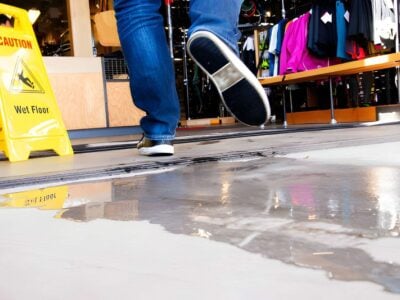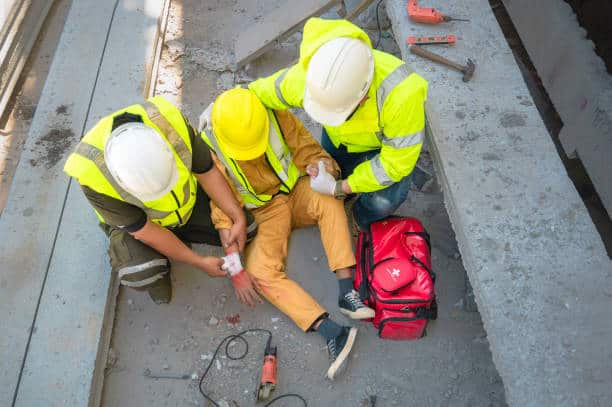
If you slipped and fell at work, you can almost certainly get benefits through workers’ compensation. Whether you can also sue depends entirely on who was responsible for the hazard that caused your fall. In most cases, you cannot sue your employer directly.
But if a property owner, contractor, cleaning company, or any other third party contributed to the dangerous condition, a personal injury lawsuit may be available alongside your workers’ compensation claim, and the financial difference between the two can be substantial.
You may not be able to sue your boss, but you can often sue another company that helped create the dangerous condition while still receiving workers’ comp benefits.
Understanding which path applies to your situation matters because the two systems cover very different losses.
Prior results do not guarantee a similar outcome.
Can You Sue Your Employer for a Slip and Fall at Work?
In most situations, no. Under New York Workers’ Compensation Law § 11, the employer’s liability is exclusive and in place of any other liability. This is called the exclusive remedy rule.
When an employer carries required workers’ compensation insurance, an injured employee’s remedy against that employer runs through the workers’ comp system, not a civil negligence suit, even if the employer’s negligence directly contributed to the fall.
This applies whether the employer failed to enforce safety rules, ignored a known spill, or created a hazardous condition themselves. The exclusive remedy rule covers it all.
There are narrow exceptions:
Your employer failed to carry the workers’ compensation insurance required by New York law. In that case you can file a claim through the state or sue in court, and the employer loses several standard defenses including the ability to argue you were partly at fault
Your employer intentionally injured you through actual assault or conduct specifically designed to cause harm, not merely by ignoring a known hazard
You are genuinely an independent contractor rather than an employee, though New York courts look closely at the actual working relationship and not just what a contract says
These exceptions are narrow and rarely apply to ordinary slip and fall cases.
If your employer has proper workers’ comp coverage, your claim for medical bills and lost wages goes through that system, not a direct lawsuit, even when they were clearly at fault.
What Does Workers’ Compensation Actually Cover After a Workplace Fall?
New York requires almost all employers to carry workers’ compensation insurance for their employees. The system is no-fault, meaning you don’t need to prove your employer was negligent. You simply need to show the injury arose out of and occurred in the course of your employment.
Benefit | What you receive |
|---|---|
Medical treatment | Full coverage for doctor visits, hospital stays, surgery, physical therapy, and medications |
Lost wage replacement | Two-thirds of your average weekly wage, subject to the state maximum |
Permanent disability | Additional compensation based on severity and type of permanent impairment |
Death benefits | Two-thirds of the deceased worker’s average weekly wage to surviving dependents |
On lost wages specifically, the New York Workers’ Compensation Board sets the maximum weekly benefit at two-thirds of the New York State Average Weekly Wage for the prior year.
For injuries occurring between July 1, 2025 and June 30, 2026, that maximum is $1,222.42 per week.
A worker earning $2,500 per week receives only $1,222.42, losing more than $440 weekly compared to actual pre-injury earnings.
What workers’ compensation does not cover is equally important to understand:
Pain and suffering
Full wage replacement beyond the statutory formula
Future lost earning capacity
Emotional distress
Workers’ comp is your safety net, but a third-party lawsuit is often the only way to recover for pain and suffering and to replace all of your lost income.
For serious, long-term injuries, the gap between what workers’ comp pays and what a full personal injury recovery would provide can be financially devastating.
When Can You Sue for a Slip and Fall at Work?
While you generally cannot sue your employer, New York law allows you to receive workers’ compensation benefits and pursue a separate personal injury lawsuit against a negligent third party at the same time.
A third party is anyone other than your employer or co-workers.
Common third-party defendants in workplace slip and fall cases include:
Property owners and landlords. If you work in a building your employer leases or rents, the building owner or property management company is typically responsible for maintaining common areas, stairways, hallways, parking lots, and entry points.
Maintenance and cleaning companies. If an outside janitorial service leaves floors dangerously wet without posting warning signs, or a maintenance contractor fails to repair a known defect in an area where employees work, they can be held liable for the resulting injuries even though they have no employment relationship with you.
General contractors and subcontractors. On construction and industrial sites, multiple contractors often work alongside each other. If another contractor created the hazardous condition that caused your fall, they may be liable even though they don’t employ you.
Product manufacturers. Defective ladders, faulty flooring materials, malfunctioning mats, or defective safety equipment that contributed to the fall can support a product liability claim against the manufacturer separately from both the workers’ comp claim and any premises liability claim.
In third-party cases, fault matters. You have to prove the defendant owed you a duty of care, breached it by failing to act reasonably, and caused your injuries. That’s different from workers’ comp, where fault is irrelevant.
One important consideration: if you receive workers’ compensation benefits and then recover money from a third-party lawsuit, your workers’ compensation carrier typically has a right to reimbursement for what it paid out.
This is called subrogation. An attorney can help navigate these calculations to maximize what you ultimately keep.
Are There Special Protections for Construction Workers?
Yes. Workplace falls on construction sites carry additional legal protections under New York law that don’t apply to most other workplaces.
New York Labor Law Sections 200, 240, and 241 provide extra protections for workers injured in construction and related work.
Labor Law § 240, known as the Scaffold Law, imposes strict liability on property owners and general contractors for elevation-related injuries to construction workers, including falls from ladders, scaffolds, and other heights.
Strict liability means the owner or contractor is responsible regardless of whether they were traditionally negligent.
Labor Law § 241(6) can apply to certain unsafe worksite conditions including some slip and fall situations at construction sites.
These claims are brought against property owners or general contractors, not the construction worker’s own employer when workers’ comp applies.
For construction workers, the combination of workers’ compensation benefits and a Labor Law claim against the site owner or general contractor is often the path to full compensation.
What Counts as a Workplace Fall for Workers’ Comp Purposes?
New York workers’ compensation applies to injuries arising out of and in the course of employment, and many slip and fall scenarios satisfy that definition.
Falls in work areas, offices, stockrooms, break rooms, and other spaces where employees are expected to be are almost always covered. Some ingress and egress slips, including falls while arriving at or leaving an employer-controlled property, may also qualify as work-related.
If your job requires travel, a slip and fall while performing work duties off-site at a client’s location or another worksite can still be work-related for workers’ comp purposes.
It may also give rise to a third-party claim against the property owner where you fell. That combination, workers’ comp plus a third-party lawsuit, is one of the most common and valuable situations in workplace injury law.
A general principle worth knowing: if you’re hurt somewhere you’re supposed to be for your job, workers’ comp likely applies. The next question is whether another company besides your employer also bears responsibility.
What Are the Most Common Causes of Workplace Slip and Falls?
The Centers for Disease Control and Prevention consistently identifies falls as a leading cause of nonfatal workplace injuries across industries.
Common causes include wet or recently mopped floors without adequate warning signs, spilled liquids, grease, or debris that weren’t cleaned promptly, icy or snowy outdoor walkways and parking lots that weren’t properly treated, uneven surfaces or damaged flooring, poor lighting in stairwells or walkways, and clutter or materials left in pathways.
Most of these hazards are preventable. When the party responsible for maintaining the area failed to take reasonable steps, that failure is the foundation of a negligence claim, whether against a property owner, a contractor, or a cleaning company.
What Can You Actually Recover From Each Path?
The distinction between workers’ comp and a third-party lawsuit is most visible when you look at what each system actually pays.
Type of compensation | Workers’ comp | Third-party lawsuit |
|---|---|---|
Medical expenses | Yes, fully covered | Yes, past and future |
Lost wages | Partial, two-thirds up to state maximum | Full replacement |
Future lost earning capacity | Limited | Yes |
Pain and suffering | No | Yes |
Emotional distress | No | Yes |
Loss of enjoyment of life | No | Yes |
For catastrophic injuries involving traumatic brain damage, spinal cord injuries, or fractures requiring multiple surgeries, the gap between workers’ compensation and a full third-party recovery can reach hundreds of thousands of dollars or more.
Workers’ comp is the safety net. A lawsuit is the only path to everything else.
What Are the Deadlines After a Workplace Slip and Fall?
Missing a deadline in a workplace fall case can eliminate your rights entirely. You are dealing with two separate systems, each with its own timeline.
Claim type | Deadline | Legal basis |
|---|---|---|
Notice to employer | Within 30 days of the injury | |
Formal workers’ comp claim | Generally within 2 years | NY Workers’ Compensation Board |
Third-party personal injury lawsuit | 3 years from the accident date | |
Fall on government property (Notice of Claim) | 90 days from the accident | |
Lawsuit against government entity | 1 year and 90 days |
As the NYC Bar Association confirms, missing these deadlines can turn a strong case into no case at all. If you fell on government property while performing your job duties, the 90-day Notice of Claim window under GML § 50-e is the most urgent deadline you face.
What Should You Do If You Slip and Fall at Work?
The steps you take immediately after a workplace fall protect both your workers’ comp claim and any potential third-party lawsuit.
Report the incident to your supervisor immediately. Notify your employer in writing and make sure an incident report is created. Get a copy. If the report is inaccurate, provide your own written account of what happened.
Seek medical attention the same day. Prompt medical evaluation creates the documentation that connects your injury to the fall. Some serious injuries including concussions and spinal damage don’t produce obvious symptoms right away.
Document the scene. Photograph the hazard, surrounding area, lighting conditions, any warning signs or their absence, and your footwear. If you can’t do this yourself, ask someone nearby to do it.
Collect witness information. Names and contact details for anyone who saw the fall or was nearby.
Preserve physical evidence. Keep the shoes and clothing you were wearing. Don’t clean or repair anything that might show how the fall occurred.
Track everything. Keep all medical records, bills, and communications with your employer and insurer. Write down how the injury affects your daily life, sleep, and ability to do your job.
Find out who owns and maintains the area where you fell. This is the question that determines whether a third-party claim exists. If your employer leases the space, if a contractor maintains it, or if another company was responsible for that specific area, you may have options beyond workers’ compensation that are worth pursuing.
Porter Law Group finds out before it's too late.
Summing It Up
Workers’ compensation covers the basics after a workplace fall, but it doesn’t cover pain and suffering, doesn’t fully replace your income, and doesn’t account for the long-term financial impact of a serious injury.
If a property owner, contractor, or cleaning company created or ignored the hazard that brought you down, a personal injury claim against that third party may be available on top of your workers’ comp benefits, and that combination is often where real compensation lives.
Both clocks start running the moment you fall. Workers’ comp notice goes to your employer within 30 days. A third-party lawsuit must be filed within three years under CPLR § 214.
Falls on government property require a Notice of Claim within 90 days under General Municipal Law § 50-e.
Most injured workers don’t know they have a third-party claim until someone actually looks for one. That’s what Porter Law Group does first. No upfront cost, no fee unless we win.
Contact us before that window closes.
Frequently Asked Questions
Can I sue my employer for a slip and fall at work in New York?
In most cases, no. Under New York Workers’ Compensation Law § 11, workers’ compensation is the exclusive remedy against your employer for workplace injuries, even when the employer was clearly negligent. Limited exceptions apply when an employer fails to carry required workers’ comp insurance or intentionally injures an employee.
What does workers’ compensation cover after a workplace slip and fall?
Workers’ compensation covers full medical treatment and two-thirds of your average weekly wage up to the state maximum, which is $1,222.42 per week for injuries occurring between July 1, 2025 and June 30, 2026 per the New York Workers’ Compensation Board. It does not cover pain and suffering, full wage replacement, or future lost earning capacity.
Can I sue someone else if I can’t sue my employer?
Yes. New York law allows you to receive workers’ compensation benefits and pursue a separate personal injury lawsuit against a negligent third party at the same time. Common third-party defendants include property owners, building managers, cleaning contractors, and equipment manufacturers.
Are construction workers treated differently after a workplace fall?
Yes. New York Labor Law Sections 240 and 241 provide additional protections for construction workers injured in falls, including strict liability claims against property owners and general contractors that are not available in standard premises liability cases.
What should I do if I slip and fall at work?
Report it to your supervisor immediately in writing, seek medical attention the same day, photograph the hazard and surrounding area, collect witness information, and find out who owns and maintains the area where you fell. That last question determines whether a third-party claim exists alongside your workers’ comp claim.
How long do I have to file a claim after a workplace slip and fall?
You must notify your employer within 30 days. A formal workers’ compensation claim must generally be filed within two years. A third-party personal injury lawsuit must be filed within three years under CPLR § 214. Falls on government property require a Notice of Claim within 90 days under General Municipal Law § 50-e.
What if my employer doesn’t have workers’ compensation insurance?
If your employer failed to carry required workers’ comp coverage, you can file a claim through the New York State Uninsured Employers’ Fund or sue your employer directly in court. In a direct lawsuit, the employer loses the ability to argue you were partly at fault or assumed the risk of the job.
Contact Porter Law Group Michael S. Porter, J.D.
Phone: +1 833-767-8379
Email: info@porterlawteam.com