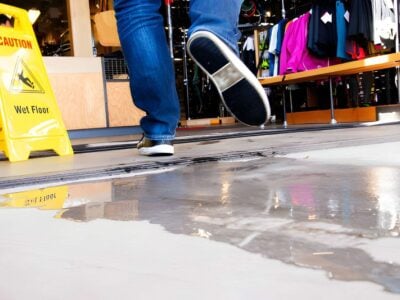

Slip and fall claims fall under premises liability law. Property owners and occupiers owe a duty of care to people who lawfully enter their property, which requires them to take reasonable steps to keep the premises safe.
That includes maintaining walking surfaces, cleaning up spills within a reasonable timeframe, and warning visitors about hazards they might not immediately see.
Common hazardous conditions that give rise to these claims include:
- Wet or freshly mopped floors without adequate warning signs
- Ice and snow accumulation left untreated after a storm
- Broken or uneven stairs, loose handrails, or missing steps
- Cracked or sunken sidewalk pavement
- Poor lighting in hallways, stairwells, or parking areas
- Loose or curled floor mats and torn carpeting
- Spilled food or liquid left unaddressed on a sales floor
When an owner fails to use reasonable care and someone gets hurt as a result, they can be held liable through a civil lawsuit.
The critical point is that simply falling on someone else’s property is not enough. You have to connect the dangerous condition, the owner’s failure to address it, and your injuries in a clear, unbroken chain.
Prior results do not guarantee a similar outcome.
What Do You Have to Prove to Win a Slip and Fall Case?
According to the New York City Bar Association, a plaintiff generally needs to show that a dangerous condition existed, the defendant created it or knew or should have known about it, the defendant failed to fix it within a reasonable time, and the condition caused the injury.
| Element | What you must show |
| Dangerous condition | A specific hazard existed that created an unreasonable risk of harm |
| Notice | The owner created the hazard, knew about it directly, or should have discovered it through routine inspection |
| Failure to act | The owner didn’t fix the problem or provide adequate warning within a reasonable time |
| Causation and damages | The hazard directly caused your fall and your fall caused documented injuries and losses |
The notice element is typically the most contested. New York courts have established through cases like Piacquadio v. Recine Realty Corp. that general awareness of possible danger on a property is not sufficient.
When filing a complaint, your attorney will typically allege each of these elements explicitly, describing how long the condition existed, why it was dangerous, and why your conduct at the time was reasonable given the circumstances.
Defendants routinely argue lack of notice, trivial defect, open and obvious condition, or comparative negligence, and a well-prepared complaint anticipates each of those defenses from the start.
What Is the Statute of Limitations for a Slip and Fall in New York?
This is one of the most important things to understand, and it varies significantly depending on who owns the property where you fell.
| Type of defendant | Deadline | Legal basis |
| Private property owners and businesses | 3 years from the date of injury | CPLR § 214(5) |
| Government entities (municipalities, NYC) | 90-day Notice of Claim, then 1 year and 90 days to file suit | GML § 50-e and GML § 50-i |
| Wrongful death resulting from a fall | 2 years from the date of death | EPTL § 5-4.1 |
For most slip and fall cases against private individuals or businesses, the statute of limitations is three years from the date of the accident.
The New York City Bar Association confirms this general three-year deadline for personal injury negligence actions, tied to CPLR § 214(5), and New York appellate courts have consistently reaffirmed it.
The three-year window sounds generous, but it shrinks fast in practice. Evidence disappears. Surveillance footage gets overwritten within 30 to 90 days.
Witnesses become hard to locate. Waiting too long to start the process has real costs even when you’re technically still within the legal deadline.
Limited exceptions do exist. Tolling provisions under New York law can pause the clock for minors, incapacitated individuals, or in certain other situations established by statute and case law.
Most people, however, should assume the standard deadline applies unless an attorney confirms otherwise.
For government property cases, the clock moves much faster, and the consequences of missing a deadline are more severe.
What Are the Extra Rules for Suing a Government Entity?
When a slip and fall involves property owned or controlled by a city, town, county, school district, or other municipal entity, the filing process is fundamentally different from a private property claim.
There are two distinct deadlines, and missing either one typically ends the case regardless of how strong the underlying facts are.
Step 1: Serve a Notice of Claim within 90 days.
Under General Municipal Law § 50-e, a Notice of Claim must be served on the appropriate municipal entity within 90 days of the accident. This document must be in writing, sworn before a notary, and must include the claimant’s name and address, the nature of the claim, the time, place, and manner in which the claim arose, and the items and dollar amount of damages claimed.
Step 2: Wait at least 30 days before filing suit.
After the Notice of Claim is served, the government entity has at least 30 days to investigate the claim before a lawsuit can be filed. Filing a complaint before that window closes is a procedural error that can affect the case.
Step 3: File the lawsuit within 1 year and 90 days.
Under General Municipal Law § 50-i, the actual lawsuit must be commenced within one year and 90 days of the accident. Critically, filing a lawsuit is not a substitute for filing the Notice of Claim. The complaint itself must plead that a timely Notice of Claim was served, and courts check this.
Expect an examination before trial.
Municipal defendants may require the claimant to submit to an examination under oath and a physical examination by a physician before the case proceeds.
This is essentially a pre-suit deposition focused on the incident and injuries, and it’s worth knowing it’s coming.
Courts can sometimes permit a late Notice of Claim in municipal cases, but they look closely at whether the government had actual knowledge of the claim, whether the claimant was a minor or otherwise incapacitated, and whether the delay prejudices the defense.
The court cannot extend this beyond the outside limit of one year and 90 days. When government property is involved, reaching out to an attorney immediately after the fall is not optional.
How Do You Sue a Business for a Slip and Fall?
New York law requires businesses to maintain reasonably safe conditions for customers and invited guests.
Most commercial properties carry commercial liability insurance and employ claims adjusters whose job is to limit what the business pays out. Early settlement offers, especially those that arrive before you’ve completed treatment, are almost always lower than what the case is actually worth.
Here’s how to protect yourself from the moment a fall happens at a business:
Report it immediately
Tell a manager or supervisor before you leave and request a written incident report. Get a copy, or at minimum the name and title of whoever took it and the date and time. Many retail chains require staff to complete one whenever a customer reports an injury.
Photograph the hazard before it disappears
Stores tend to clean up spills, replace mats, or remove damaged displays within minutes of being notified about an incident. Get photos of the condition from multiple angles before that happens, including wide shots that capture lighting, signage, and the surrounding area.
Request preservation of security footage in writing
Most commercial properties have cameras covering sales floors, entrances, and common areas. Footage is typically overwritten on a 30 to 90 day cycle. A written request, even a follow-up email, creates a record that you asked for it. Your attorney can follow with a formal preservation letter that carries legal weight.
Avoid giving a recorded statement to the insurance representative
They may call within days of the accident. Their questions are designed to produce answers that limit the business’s liability, and you are not obligated to provide a recorded statement to the property owner’s insurer before speaking with an attorney.
What Are the Steps to Filing a Slip and Fall Lawsuit?
Most slip and fall cases resolve through settlement before a lawsuit is ever filed. But if negotiations stall or the insurer refuses to make a fair offer, filing suit becomes the path forward. Here’s how that process actually works for private property and business defendants.
1. Confirm the deadline.
Check the accident date against the three-year personal injury limitation in CPLR § 214(5) using the New York Courts’ statute of limitations timetable, and determine whether any tolling exceptions apply. If government property is involved, the 90-day Notice of Claim deadline under GML § 50-e controls, not the three-year window.
2. Identify the proper defendant.
The claim must be filed against the party who owned, occupied, or controlled the premises when the fall occurred. That might be a landlord, a tenant business, a property management company, or a maintenance contractor. Naming the wrong defendant, or missing a responsible party entirely, can mean leaving compensation on the table or having the case dismissed.
3. Draft and file a summons and complaint.
Filing a lawsuit in New York generally means preparing a complaint stating the facts, the legal theory of negligence and premises liability, the injuries sustained, and the damages sought, then serving it with a summons in the appropriate trial court, typically the Supreme Court of the county where the accident occurred.
4. Plead the four elements clearly.
The complaint alleges that the defendant owed a duty to maintain reasonably safe premises, that a specific dangerous condition existed, that the defendant created it or had notice of it and failed to correct or warn, that the condition directly caused the fall and injuries, and that the plaintiff suffered specific documented damages.
5. Prepare for the defense.
Defendants routinely argue lack of notice, trivial defect, open and obvious condition, or comparative fault. A well-prepared complaint and a strong evidence file anticipate each of these arguments before they’re raised.
6. Discovery and litigation.
Both sides exchange documents and take depositions. Expert witnesses may be retained to speak to the hazard, applicable building codes, or medical causation. Many cases settle during or after discovery, sometimes not until shortly before trial.
Who Is Responsible for Sidewalk Falls in New York City?
Sidewalk cases in New York City operate under a specific rule.
Under New York City Administrative Code § 7-210, sidewalk maintenance responsibility generally falls on the adjacent property owner, not the city.
If you fall on a broken sidewalk in front of a commercial building or apartment complex, the building owner typically bears responsibility for maintaining that section of sidewalk and can be held liable for injuries that result from negligence in doing so.
There is an important exception: one-, two-, and three-family homes that are owner-occupied are generally exempt, with liability remaining with the city for those sidewalks.
For claims against the city itself, there is often a prior written notice requirement, meaning you generally cannot sue unless the city received written notice of the specific defect before your fall.
What Can You Recover in a Slip and Fall Lawsuit?
If negligence can be proven, compensation falls into two main categories.
Economic damages cover everything with a concrete dollar figure: past and future medical expenses, lost wages, reduced earning capacity if the injury affects your ability to work long term, and out-of-pocket costs like transportation to medical appointments or necessary home modifications.
Non-economic damages cover the physical and emotional toll: pain and suffering, loss of enjoyment of life, and emotional distress. New York places no general cap on non-economic damages in standard personal injury cases, so the amount depends heavily on the severity of the injury and how thoroughly its ongoing impact is documented.
Settlement values vary widely. Moderate injuries that heal well might resolve anywhere from $15,000 to $100,000 or more depending on medical costs and lost income.
Catastrophic injuries involving traumatic brain damage, spinal cord injuries, or permanent disability can lead to settlements or verdicts in the hundreds of thousands to millions. Insurance policy limits and the specific facts of each case also shape realistic recovery expectations.
Summing It Up
Property owners and their insurers don’t wait to build their case. Evidence gets cleaned up, footage gets overwritten, and recorded statements get used against you, often before you’ve finished treating your injuries or fully understood what your claim is worth.
Notice, timing, and documentation decide most slip and fall cases in New York.
If the fall happened on government property, the 90-day Notice of Claim deadline under General Municipal Law § 50-e means the clock is already running.
Even for private property cases, the three years under CPLR § 214(5) moves faster than it sounds.
The first step is a free consultation. Tell us what happened, where, and when.
Porter Law Group takes it from there, handling the investigation, the preservation letters, and the insurer negotiations while you focus on getting better.
There’s no upfront cost and no fee unless we win. Contact us before the other side gets too far ahead.
Schedule your free consultation today
Frequently Asked Questions
What is the statute of limitations for a slip and fall in New York?
For most cases against private property owners or businesses, you have three years from the date of injury under CPLR § 214(5), as confirmed by the NYC Bar Association and New York appellate courts. Falls on government property require a Notice of Claim within 90 days and a lawsuit within one year and 90 days under GML § 50-e and GML § 50-i. Wrongful death claims carry a two-year deadline under EPTL § 5-4.1.
How do you sue a business for a slip and fall?
Report the fall to a manager before leaving, request a written incident report, photograph the hazard immediately, and ask in writing that security footage be preserved. Avoid giving a recorded statement to the store’s insurance company without legal advice. Your attorney can then investigate, send a formal demand to the insurer, and file a lawsuit if negotiations don’t produce a fair offer. Recoverable damages can include medical expenses, lost wages, future care costs, and pain and suffering.
What do you have to prove to win a slip and fall case?
You need to show that a dangerous condition existed, that the property owner created it or had actual or constructive notice of it, that they failed to fix or warn about it within a reasonable time, and that this failure directly caused your injuries. General awareness of possible danger on a property is not enough under New York law; the notice must relate to the specific condition that caused the fall.
What is the Notice of Claim requirement for government property falls?
Under General Municipal Law § 50-e, a sworn written Notice of Claim must be served on the municipal entity within 90 days of the accident. It must describe the nature of the claim, when and where it occurred, and the damages sought. After serving it, you must wait at least 30 days before filing suit, and the lawsuit itself must be filed within one year and 90 days under GML § 50-i. Filing a lawsuit does not substitute for the Notice of Claim.
Can I still sue if I was partly at fault for my fall?
Yes. Under CPLR § 1411, New York’s pure comparative negligence rule allows recovery even if you were significantly at fault. Your award is reduced by your percentage of responsibility, not eliminated entirely.
What happens if I fell on a city sidewalk in New York?
Under NYC Administrative Code § 7-210, the adjacent property owner is generally responsible for sidewalk maintenance, not the city. One-, two-, and three-family owner-occupied homes are typically exempt. If the city itself bears responsibility, a Notice of Claim must be filed within 90 days and prior written notice requirements may also apply.
What damages can I recover in a slip and fall lawsuit?
You may be entitled to past and future medical expenses, lost wages, reduced earning capacity, pain and suffering, emotional distress, and loss of enjoyment of life. New York places no general cap on non-economic damages in standard personal injury cases, so the amount depends on the severity of the injury and how thoroughly its impact is documented.
Contact
Porter Law Group
Michael S. Porter, J.D.
Phone: +1 833-767-8379
Email: info@porterlawteam.com