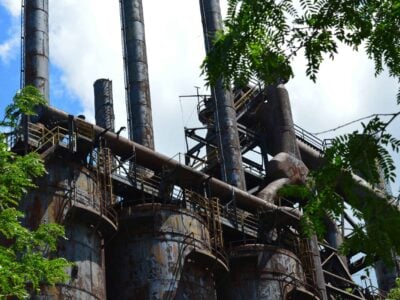


For decades, the Delphi Harrison Thermal Systems plant (formerly Harrison Radiator) in Lockport, New York, manufactured automotive radiators and thermal components. Like many industrial facilities of its era, the plant used trichloroethylene, commonly known as TCE, as a degreasing solvent to clean metal parts.
New York’s Department of Environmental Conservation has documented TCE contamination at this site for decades, and federal health authorities now recognize TCE as a chemical strongly linked to kidney cancer.
If you worked at this facility, particularly in or around Building 8 or in degreasing and maintenance operations, that history may be relevant to your health and, potentially, to your legal rights.
Prior results do not guarantee a similar outcome.
What NYSDEC Records Show
According to New York’s own Inactive Hazardous Waste Registry, Building 8 in the north-central part of the Lockport complex formerly housed degreasing operations that used TCE, and an aboveground storage tank sat near the building’s southeast corner until it was decommissioned in May 1994.
That same year, during an excavation to repair a fire protection line near the former tank, workers discovered TCE-contaminated soil, and Delphi Thermal Systems notified NYSDEC, which assigned the incident a formal spill number. The site was added to New York’s Inactive Hazardous Waste Registry as a Class 3 site in March 1999, meaning it doesn’t currently present a significant threat under that classification, though institutional and engineering controls remain in place.
NYSDEC’s investigation found that groundwater beneath the site was extensively contaminated with TCE and its breakdown products, with historical concentrations reported far above New York’s Class GA groundwater standard of 5 micrograms per liter.
Under a 2011 administrative settlement, GM Components Holdings, LLC, the party currently bound by the consent order, implements a monitored natural attenuation remedy approved under NYSDEC’s March 2005 Record of Decision, with long-term groundwater monitoring ongoing since 2006 and continuing through the most recent periodic review reports.
It’s worth being precise about what this documentation does and doesn’t establish. It confirms that TCE contamination existed at this site and has been formally tracked by the state for over two decades.
It does not, by itself, prove that any specific former worker was exposed at a level sufficient to cause a particular illness. That connection requires individual, case-specific evidence.
What is Trichloroethylene and How Workers Were Likely Exposed
TCE is a colorless, nonflammable solvent that dissolves grease efficiently and evaporates quickly, properties that made it a standard degreasing agent in automotive manufacturing for decades.
The inhalation of TCE vapors during degreasing operations was likely the most significant exposure pathway for Lockport workers, particularly those operating degreasers, loading and unloading parts, or performing maintenance on the equipment itself.
Because TCE vapor spreads through poorly ventilated spaces, workers in adjacent departments, not just those directly running the degreasing equipment, could also have been exposed. Skin contact with solvent-wet parts or contaminated surfaces represents a secondary exposure route.
It’s important not to assume too much from a job title alone. Whether a specific worker had meaningful exposure depends heavily on their building assignment, department, specific tasks, and years of employment, not simply on having worked somewhere in the broader facility.
What Health Effects Are Linked to TCE
Federal health agencies, including the CDC’s Agency for Toxic Substances and Disease Registry, describe strong evidence that TCE causes kidney cancer, specifically renal cell carcinoma, with more limited but still recognized evidence connecting it to non-Hodgkin lymphoma and, to a lesser degree, liver cancer.
Beyond cancer, TCE affects the liver and kidneys directly and can cause nervous system effects ranging from acute dizziness and confusion to more subtle, chronic problems with memory, concentration, and peripheral sensation.
Some research has also found associations between TCE exposure and autoimmune conditions like systemic sclerosis, and New York’s Department of Health has raised specific concerns about TCE’s effects on fetal heart development during critical windows of pregnancy.
A newer, still-developing area of research has explored a possible connection to Parkinson’s disease, though this evidence hasn’t yet been incorporated into formal regulatory toxicology assessments the way the cancer findings have.
None of this means every health condition a former worker experiences is connected to TCE. It means these are the specific conditions worth discussing with a physician who understands your occupational history.
What Regulatory Standards Tell You and Don’t
Regulatory limits for TCE have tightened considerably as the science has developed, and that gap matters for understanding historical exposure.
OSHA’s legacy permissible exposure limit, still legally in effect for general industry, is 100 parts per million as an eight-hour average, a standard that predates most of the cancer research discussed above.
By contrast, EPA’s December 2024 rule under the Toxic Substances Control Act establishes a far stricter interim workplace concentration limit of just 0.2 parts per million for certain continuing uses, a limit 500 times lower than OSHA’s older standard.
This gap doesn’t mean historical compliance with the older OSHA limit was illegal at the time, but it does mean that limit was never a health-protective guarantee, and it shouldn’t be treated as proof that historical exposures were actually safe.
Workers’ Compensation for Occupational Disease
If your illness is connected to your work at the Lockport facility, New York workers’ compensation may be your first avenue for benefits.
The New York Workers’ Compensation Board generally requires an occupational disease claim to be filed within two years of the date of disability, or from when you knew or should have known the disease was connected to your work, whichever applies to your situation, using Form C-3 to start the claim.
Because TCE-related illnesses like kidney cancer often don’t appear until years or decades after the exposure that caused them, this discovery-based approach is specifically designed to accommodate that kind of delay, rather than requiring you to have filed before your diagnosis even existed.
Workers’ compensation covers medical treatment and a portion of lost wages but doesn’t compensate for pain and suffering, and it’s generally your exclusive remedy against your own direct employer.
Civil Claims Against Other Responsible Parties
Depending on the specific facts, potential third-party claims could involve a manufacturer or supplier of TCE-containing solvents who failed to adequately warn about known cancer risks, a contractor who created unsafe conditions, or, for community residents rather than employees, a claim connected to off-site groundwater migration or vapor intrusion into nearby homes.
Causation is the central challenge in any of these claims. New York courts require proof that TCE exposure more likely than not caused your specific disease, which almost always requires expert testimony connecting your documented exposure history, the scientific literature on TCE and your particular illness, and your individual medical picture, including other risk factors like smoking history or family history that a defense will likely raise.
Summing It Up
A documented contamination site gives a case real context, but it’s never the whole story. Porter Law Group works with industrial hygienists and medical experts to connect a specific former worker’s documented tasks and exposure history to a specific diagnosis, rather than relying on the site’s history alone.
Porter Law Group has recovered more than $500 million for injured clients across New York. Prior results do not guarantee a similar outcome.
If you worked at the Delphi Harrison Thermal Systems plant in Lockport and have since developed a serious illness, Porter Law Group can help you understand your options. Call 833-PORTER9, email info@porterlawteam.com, or visit porterprotects.com/contact.
This article is for informational and educational purposes only. It is not a substitute for medical advice from a qualified healthcare provider or legal advice based on your specific circumstances.
Frequently Asked Questions
I worked at the Lockport plant but never in Building 8. Does the contamination still matter to me?
Possibly, though your exposure picture is likely different from someone who worked directly with degreasing operations. TCE vapor can spread through a poorly ventilated facility beyond its original source, so proximity, ventilation conditions, and how much time you spent in affected areas all matter. A case-specific review of your department, tasks, and years of employment is the only way to actually assess this.
Does the site’s “Class 3” designation mean there’s nothing to worry about?
Not necessarily, at least not for a past exposure question. That classification reflects the state’s current assessment of the site’s present environmental risk under its ongoing monitoring program, not a determination about historical workplace exposure that may have occurred years or decades before the classification existed. A worker’s potential exposure during the plant’s active TCE use is a separate question from the site’s current regulatory status.
I was exposed decades ago, but I’m only sick now. Am I too late to file anything?
Not necessarily. New York’s occupational disease framework and its toxic exposure discovery rules are both designed around the reality that illnesses like kidney cancer often take years or decades to appear, generally starting the clock when you’re diagnosed or reasonably should have connected your illness to your work, not from the date of the original exposure. Because the exact deadline depends on your specific situation, it’s worth having it reviewed rather than assuming either way.
Can I sue Delphi directly, or is workers’ compensation my only option against them?
For your former direct employer, workers’ compensation is generally your exclusive remedy, which typically bars a separate negligence lawsuit against that employer specifically. That said, other parties, such as a chemical supplier or another company involved in the site’s history, may not have that same protection, and it’s worth having a full picture of everyone who was involved before assuming your options are limited to workers’ comp alone.
What if I don’t know exactly which chemicals I was exposed to at the plant?
That’s a common starting point, not a dead end. An attorney or industrial hygienist can often reconstruct what chemicals were used in your specific work area using historical safety records, NYSDEC site documents, and coworker accounts, even when you only remember general details like a strong chemical smell or a specific cleaning process rather than the chemical’s name.