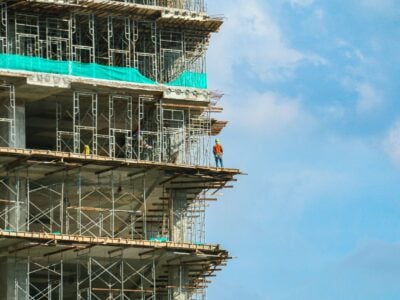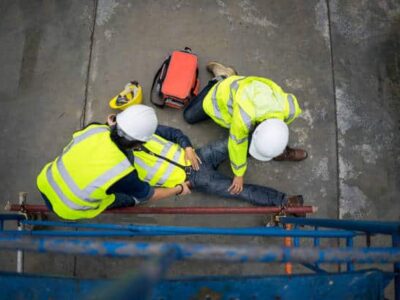

A hammer dropped from 20 feet up. A brick dislodged from scaffolding. A bucket of tools knocked loose during dismantling.
Any of these can cause devastating injuries to workers or pedestrians below, and New York law provides unusually strong protection for the workers among them.
But that protection has real limits that a lot of general-audience articles gloss over, and understanding them matters for knowing how strong your case actually is.
Prior results do not guarantee a similar outcome.
Does Every Falling Object From a Construction Site Trigger Strict Liability?
No, and this is the part of the law most people don’t realize until they’re already deep into a claim. New York’s Labor Law Section 240(1), the Scaffold Law, provides absolute liability for workers injured by falling objects, but only under a specific legal test.
In Narducci v. Manhasset Bay Associates, New York’s Court of Appeals held that the object has to have been something that “required securing for the purposes of the undertaking” at the time it fell.
A load being hoisted by crane, a brick sitting on a scaffold plank near the edge, a tool being lowered during dismantling, these clearly needed securing, and if the required hoisting or securing devices were missing or inadequate, the statute applies.
What doesn’t automatically qualify is an object that fell for reasons unrelated to the hoisting or securing work itself.
In Narducci, a piece of glass fell and struck a worker who was removing window frames, and the Court of Appeals held the statute didn’t apply, because the glass wasn’t a material being hoisted or a load that required securing as part of the task at hand.
It was, in the court’s words, a general hazard of the work rather than the specific gravity-related risk the statute targets. This distinction matters enormously for how your case gets built and evaluated.
What Kinds of Falling Object Accidents Are Covered?
The strongest cases share common features: the object was heavy or substantial, it was located at a meaningful height, and it was actually part of the construction work being performed, not just incidentally present.
Adequate protection against this specific hazard might mean toe boards along scaffold edges, debris netting suspended below work areas, properly secured hoisting equipment, or tool lanyards.
When those protections are missing or fail and someone gets hurt as a result, Section 240(1) typically applies.
Common causes include tools left on scaffold planks without securing straps, materials stacked near an edge without proper containment, missing or improperly installed toe boards and debris netting, components dropped during scaffold dismantling, and rigging failures during hoisting operations.
Weather plays a role too, wind can blow unsecured materials off a platform, and rain or ice increases the chance something gets knocked loose.
Who Gets Hurt When Objects Fall, and Does It Change Their Claim?
Workers directly below elevated platforms are the obvious victims, but falling objects bounce, ricochet, and break apart on impact, meaning someone well away from the scaffold’s base can still be struck. Workers on the scaffolding itself can be hurt by a coworker’s dropped tool or a mishandled component during dismantling.
And in dense areas where scaffolding extends over public sidewalks, pedestrians face the same risk as anyone working below.
This is where the legal path diverges sharply. If you were a construction worker engaged in covered work, building, demolishing, repairing, altering, painting, or cleaning a structure, Labor Law 240(1) may give you a direct, strict-liability claim against the property owner and general contractor once you clear the Narducci test above.
If you were a pedestrian or otherwise not engaged in that covered work, the Scaffold Law doesn’t apply to you at all, and your claim instead rests on ordinary negligence and premises liability, meaning you’ll need to show the responsible party breached a duty of care that caused your injury.
Other Labor Law provisions can also apply. Labor Law Section 241(6) requires construction sites to comply with specific Industrial Code safety regulations, and a falling-object accident traced to a violation of one of those detailed rules can support a claim under 241(6) alongside or instead of a 240(1) claim.
Labor Law Section 200 codifies the general duty to provide a reasonably safe workplace, but unlike 240(1), it requires proving the property owner or contractor had actual or constructive notice of the hazard, closer to ordinary negligence.
Does an OSHA Violation Help Your Case?
Federal OSHA regulations set minimum standards for scaffolding and fall protection, including guardrails, toe boards, and debris netting requirements.
An OSHA violation doesn’t automatically win your case, and you don’t need one to succeed under Labor Law 240(1), but a citation for missing toe boards or inadequate netting is strong supporting evidence that the required protections weren’t in place.
OSHA and New York’s Labor Law work on parallel tracks: OSHA regulates and penalizes unsafe conditions, while the Labor Law compensates injured workers and holds owners and contractors financially responsible when accidents happen anyway.
Who Can Be Held Liable?
Under Labor Law 240(1), the property owner and general contractor are the primary defendants, and this holds even if they weren’t directly involved in the work or hired a reputable subcontractor, since the duty is nondelegable.
This is actually protective for injured workers in one specific way: your own employer is generally immune from a direct lawsuit under the workers’ compensation exclusivity rule, but Section 240(1) creates liability for the owner and general contractor, who are typically not your direct employer, which is exactly why this statute matters so much for construction workers.
Subcontractors don’t face direct 240(1) liability the way owners and contractors do, but they can still be liable under 241(6) or ordinary negligence, and a scaffold company or equipment manufacturer can be liable if a defective product contributed to the accident.
What Are the Key Deadlines in a New York Falling Object Case?
Situation | Deadline | Rule |
|---|---|---|
Claim against a private property owner, contractor, or manufacturer | 3 years from the date of the accident | |
Notice of claim if a government entity or public project was involved | 90 days | |
Wrongful death claim | 2 years from the date of death |
Serious injuries like brain trauma and spinal damage don’t always reveal their full extent right away, but the three-year deadline still runs from the date of the accident itself, not from when your condition stabilizes. Starting the legal process early preserves your rights while your medical picture becomes clearer.
Summing It Up
Being struck by a falling tool or material from scaffolding can be life-changing, and New York law offers real protection for the workers among these accidents. But that protection isn’t automatic.
Porter Law Group has built its reputation on trial-tested representation for injured New Yorkers, and our attorneys work on a contingency fee basis, meaning you pay nothing unless we win.
If you or someone you love was hurt by an object falling from scaffolding, reach out to discuss what happened and what your legal options look like.
Call 833-PORTER9 or email info@porterlawteam.com to schedule a free consultation.
Prior results do not guarantee a similar outcome.
Frequently Asked Questions
Does Labor Law 240(1) cover every object that falls at a construction site?
No. Under Narducci v. Manhasset Bay Associates, the object has to have been something that required securing or hoisting as part of the work being performed. An object that falls for reasons unrelated to that specific hazard may not trigger the statute, even though gravity was obviously involved.
Can I sue if I was a pedestrian hit by something falling from a construction site?
Yes, though your claim is based on ordinary negligence and premises liability rather than the Scaffold Law, which only protects workers engaged in covered construction activities. You’ll need to show the responsible party breached a duty of care that caused your injury.
Can I sue if I’m already receiving workers’ compensation for this injury?
Often, yes. Workers’ compensation is generally your exclusive remedy against your own employer, but Labor Law 240(1) creates a separate claim against the property owner and general contractor, who typically aren’t your direct employer, so both can proceed together.
Does an OSHA citation automatically win my case?
No, but it’s strong supporting evidence. You don’t need an OSHA violation to succeed under Labor Law 240(1), but a citation for something like missing toe boards or inadequate debris netting helps show the required safety protections weren’t in place.
How much does a construction accident lawyer cost in New York?
Most plaintiff-side personal injury attorneys, including Porter Law Group, work on a contingency fee basis. You pay nothing upfront, and there is no fee unless the firm recovers compensation on your behalf.
This article is for informational purposes only and does not constitute legal advice. Attorney advertising. Prior results do not guarantee similar outcomes.