
A slip and fall happens in a moment. Proving who is legally responsible for it takes considerably longer, and it requires more than showing that you fell on someone else’s property.
Property owners in New York have a legal duty to maintain reasonably safe conditions, but demonstrating that they failed in that responsibility means satisfying specific legal elements, gathering the right evidence, and understanding how courts actually evaluate these claims.
Whether you slipped on a wet grocery store floor, tripped on a broken sidewalk, or went down on an icy parking lot, what you do after the fall, and what your attorney does in the weeks that follow, will shape what you’re ultimately able to recover.
Prior results do not guarantee a similar outcome.
What Are the Elements of Negligence in a Slip and Fall Case?
According to the New York City Bar Association, to hold a property owner responsible you generally need to show four things: a dangerous condition existed, the defendant created it or knew or should have known about it, the defendant failed to fix it within a reasonable time, and the condition caused the injury.
Miss any one of them, and the claim doesn’t hold up regardless of how serious the injury is.
| Element | What you must show |
| Duty of care | The property owner had a legal obligation to keep the premises reasonably safe |
| Breach of duty | They failed to meet that obligation |
| Causation | Their failure directly caused your fall and injuries |
| Damages | You suffered actual, documented harm as a result |
These four elements work together. Think of them as links in a chain. A property owner who owed you a duty but whose hazard didn’t actually cause your fall isn’t liable.
A hazard that caused your fall but left you with no injury doesn’t support a valid claim. Every link has to hold.
Under CPLR § 214, you generally have three years from the date of the accident to file a lawsuit in New York. But the strength of the claim itself depends entirely on those four elements and the evidence behind them.
What Does Duty of Care Mean in a Slip and Fall Case?
In New York, property owners and those who control property owe lawful visitors a duty to maintain their premises in a reasonably safe condition.
This applies across settings: a grocery store, an apartment building, a parking lot, a public sidewalk adjacent to a commercial property.
The duty exists whether you’re a paying customer, a tenant, a delivery worker, or a social guest.
The law doesn’t require perfect safety. What it requires is reasonable care under the circumstances.
A property owner who is completely unaware of a hazard that formed seconds before you walked past it is in a very different position than one who knew about a chronic leak for months and never fixed it.
Both involve a duty of care, but whether that duty was breached depends on what a reasonably careful person would have done given what the owner knew or should have known.
What Counts as a Breach of Duty in a Slip and Fall Case?
In the New York Court of Appeals case Piacquadio v. Recine Realty Corp., the court held that liability depends on actual or constructive notice of the specific hazardous condition that caused the fall, not just a vague sense that the property could be dangerous.
A breach occurs when the property owner failed to act as a reasonably careful person would under the same circumstances. That can take several forms.
Breach through creating the hazard.
If a store employee mops a floor and doesn’t post a wet floor sign, or a landlord performs repairs that leave a surface uneven or unstable, the owner created the dangerous condition directly. In those situations, you don’t need to prove they had prior knowledge because they made the hazard themselves.
Breach through ignoring a known hazard.
Actual notice means the property owner had direct knowledge of the problem and didn’t fix it. Evidence of actual notice can include prior customer complaints about the same condition, internal maintenance requests that were ignored, employee reports about a recurring spill, or work orders for repairs that were delayed unreasonably.
Breach through failing to discover a hazard.
Constructive notice is the most commonly litigated form of breach. Even without direct knowledge, a property owner can be held liable if the hazardous condition existed long enough that a reasonable owner conducting ordinary inspections would have found it and corrected it.
New York appellate courts have explained that constructive notice exists when the condition was visible and apparent and existed long enough for the defendant to discover and remedy it, and defendants frequently try to defeat claims by arguing they lacked this notice.
Courts look at several factors when evaluating constructive notice:
- How long the hazard had been present
- Whether it was visible and apparent
- Whether similar conditions had occurred at the same location before
- Whether the owner had any inspection or maintenance schedule in place
What Qualifies as a Hazardous Condition Under Premises Liability?
Not every imperfection on a property creates liability. New York premises liability law requires showing that the condition was genuinely dangerous, not just inconvenient or slightly worn.
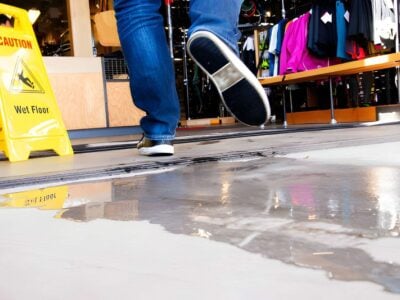
Wet and slippery surfaces. Spills from leaking refrigerators, broken pipes, or dropped merchandise. Recently mopped floors without adequate warning signs. Tracked-in rain or snow in building entryways on smooth tile. Leaking roofs or windows that create persistent puddles.
Uneven surfaces and tripping hazards. Cracked or broken pavement, potholes in parking lots, loose or curled floor mats, clutter in walkways, uneven transitions between flooring types, missing or deteriorated floor tiles. Stairs with irregular step heights, broken or missing handrails, or worn edges that create an unpredictable surface underfoot.
Ice and snow. New York winters generate a significant share of slip and fall claims. Property owners are generally required to clear ice and snow within a reasonable time after a storm ends. A fall that happens during active snowfall is harder to pursue since the law recognizes owners can’t keep pace with precipitation that’s still coming down. But ice that’s been sitting for hours after a storm ended, or that has visibly refrozen overnight, suggests the owner had time to act and didn’t.
Poor lighting. Burned-out bulbs in stairwells, inadequate exterior lighting in parking areas, dark hallways in apartment buildings, and shadowed areas where design creates blind spots all contribute to falls by preventing people from seeing hazards in time to avoid them.
Maintenance failures. Deferred repairs, inadequate inspection schedules, and failure to respond to known recurring problems all demonstrate unreasonable care. Building codes and safety regulations establish minimum standards for handrails, stair dimensions, non-slip surfaces, and lighting. While code violations alone don’t automatically prove negligence, they provide strong supporting evidence that reasonable safety standards weren’t met.
What Is the Burden of Proof in a Slip and Fall Case?
In a New York civil case, including premises liability claims, the plaintiff carries the burden of proof. According to the New York Courts’ statute of limitations timetable, which references CPLR § 214(5), the general filing deadline for personal injury slip and fall cases is three years from the date of the accident.
The evidentiary standard throughout the case is preponderance of the evidence, meaning it must be more likely than not, greater than 50 percent, that the property owner’s negligence caused your injuries.
This is a lower threshold than the “beyond a reasonable doubt” standard used in criminal cases, but it still requires concrete, credible evidence supporting each of the four elements.
The burden sits with you, not the property owner. They don’t have to prove they were careful. You have to prove they weren’t.
That’s why the evidence gathered immediately after a fall matters so much, and why gaps in that evidence can be costly.
What Evidence Do You Need to Prove Your Claim?
As the NYC Bar Association notes, a case is not just about falling. It is about proving the property owner’s negligence with evidence strong enough to show they caused the hazard or failed to correct it after notice.
The evidence that tends to make or break these cases falls into several categories.
Scene documentation
Photographs and video of the hazardous condition from multiple angles, showing its size, location, and appearance. The surrounding area for context on lighting and visibility.
The presence or absence of warning signs. Time-stamped images where possible. This documentation is often the most immediate and decisive step you can take.
Incident reports
Many commercial properties require staff to complete a report when a customer is injured on the premises. Ask for one before leaving and get a copy.
These reports often contain valuable admissions and staff observations about how the condition appeared and how long it may have existed.
Witness information
Names, phone numbers, and contact details for anyone who saw the fall, noticed the hazard beforehand, or can speak to how long the condition was present. Independent witnesses with no connection to you carry particular weight with juries.
Surveillance footage
Video can show exactly how long a hazard existed before your fall, whether employees or management walked past it without acting, and the full circumstances of the accident. Property owners typically overwrite footage on a 30 to 90 day cycle.
A preservation letter from your attorney demanding that video be retained is one of the most time-sensitive steps in these cases, because that footage can disappear before you’ve even fully understood the extent of your injuries.
Maintenance and inspection records
Cleaning schedules, inspection logs, repair requests, and work orders can reveal whether the property owner had any protocol in place and whether that protocol was actually followed. Gaps in scheduled inspections or ignored repair requests go directly to the breach of duty element.
Prior complaints and incident reports
Written complaints from other customers or tenants about the same condition, or prior incident reports from the same location, are among the strongest forms of notice evidence available. They demonstrate the owner was aware of a recurring problem and chose not to resolve it.
Emergency room notes, imaging reports, follow-up treatment, and physical therapy records document what you suffered and connect it to the fall.
Gaps in treatment are routinely used by insurance companies to argue the injury wasn’t serious, so following medical advice consistently throughout your recovery matters.
A personal journal
A written log of daily symptoms, limitations, missed work, and how the injury has affected your life provides contemporaneous evidence of pain and suffering that’s far more persuasive than testimony reconstructed from memory months later.
How Does New York’s Comparative Negligence Rule Affect Your Case?
For slip and fall claims, New York follows a pure comparative negligence system under CPLR 1411(a). This means that even if you were partly at fault for your fall, you can still recover compensation. Your total award is simply reduced by your percentage of responsibility.
If a jury finds your damages total $100,000 but that you were 25 percent at fault because you were looking at your phone, the award would be reduced to $75,000. The property owner is still on the hook for their 75 percent share.
What Happens When You Fall on a Sidewalk or Government Property?
In New York City, adjacent property owners are generally responsible for maintaining the public sidewalk in front of their building, including snow and ice removal.
Other municipalities allocate this responsibility differently. If a municipal entity is responsible, the procedural requirements become significantly stricter.
Under New York General Municipal Law § 50-e, anyone bringing a tort claim against a public corporation must file a sworn Notice of Claim within 90 days of the accident. That document must describe the nature of the claim, when and where it occurred, and how it happened.
Miss this window, and the claim is typically barred entirely regardless of the severity of the injury or how obvious the negligence was.
Summing It Up
Proving a slip and fall case in New York comes down to notice, evidence, and timing. The property owner’s insurer knows this, and they start building their defense the same day you’re hurt.
Surveillance footage disappears, hazards get repaired, and recorded statements get used against you, often before you fully understand what your case is worth.
The burden of proof rests with you.
Porter Law Group handles the investigation, the evidence preservation, and the insurer negotiations while you focus on recovering. There’s no upfront cost and no fee unless we win. Contact us
The Property Owner's Insurer Started Building Their Defense the Day You Got Hurt.
Frequently Asked Questions
What are the elements of negligence in a slip and fall case?
According to the NYC Bar Association, you must prove four things: a dangerous condition existed, the property owner created it or knew or should have known about it, they failed to fix it within a reasonable time, and the condition caused your injury and damages.
What does breach of duty mean in a slip and fall case?
Breach of duty means the property owner failed to act as a reasonably careful person would under the same circumstances. This can mean creating a hazard directly, ignoring a known one, or failing to inspect their property often enough to catch a dangerous condition before someone was hurt. New York courts have been clear that general awareness of possible danger is not enough; the notice must relate to the specific condition that caused the fall.
What is the burden of proof in a slip and fall case in New York?
The plaintiff carries the burden and must show by a preponderance of the evidence, meaning more likely than not, that the property owner’s negligence caused the injury. The general filing deadline is three years from the accident date under CPLR § 214, as referenced in the New York Courts’ statute of limitations timetable.
What qualifies as a hazardous condition under premises liability?
Wet or slippery surfaces, uneven or broken flooring, inadequate lighting, ice and snow left untreated after a reasonable period, and maintenance failures that create ongoing risks can all qualify, depending on how long they existed and what the owner knew or should have known.
Does the property owner have to know about the hazard for me to have a case?
Not necessarily. If they created the hazard themselves, no prior notice is required. If someone else created it, you need to show either that the owner had direct knowledge or that the condition existed long enough that a reasonable owner doing routine inspections would have found it.
Can I still recover if I was partly at fault for my fall?
Yes. Under CPLR § 1411, New York’s pure comparative negligence rule allows you to recover damages even if you were significantly at fault. Your award is reduced by your percentage of responsibility, not eliminated.
How long do I have to file a slip and fall lawsuit in New York?
Generally three years from the date of the accident under CPLR § 214. Falls on government property require a Notice of Claim within 90 days under General Municipal Law § 50-e.
Contact
Porter Law Group
Michael S. Porter, J.D.
Phone: +1 833-767-8379
Email: info@porterlawteam.com