

A burn injury changes everything. The pain is immediate and intense, the recovery is long and difficult, and the scars, both physical and emotional, can last a lifetime. If you or someone you love was burned in a truck accident in New York, you are likely facing months of medical care, surgeries, and time away from work, all while trying to figure out what your legal options actually are.
You do not have to navigate that alone. Porter Law Group has recovered more than $500 million for injured clients across New York, including people who suffered severe burn injuries in truck accidents. We handle everything while you focus on healing.
Burn injury settlements in New York typically range from $500,000 to over $10 million. The value of your case depends on how serious the burns are, how much of your body was affected, and what your recovery will require over the long term.
Prior results do not guarantee a similar outcome.
Why Choose Porter Law Group for Truck Accident Burn Injury Cases?
Not every law firm has experience handling burn injury cases. These cases are more demanding than most personal injury claims. They require medical experts who specialize in burn care, detailed records from burn centers, and a long-term care plan that projects the cost of treatment for years or even decades into the future.
Porter Law Group is led by Michael S. Porter, a Harvard-educated attorney and former U.S. Army JAG Corps Captain with more than 20 years of trial experience. All eight attorneys have been selected to Super Lawyers or Rising Stars, an honor earned by fewer than 5% of attorneys in New York. The firm works with burn surgery specialists, reconstructive surgery experts, and life care planners who make sure the full lifetime cost of your injuries is accounted for in your claim.
Insurance companies know burn cases are expensive, and they move quickly to limit what they pay. The firm’s published results show jury verdicts that reached 20 to 34 times what the insurance company originally offered. That difference matters enormously when the injury is permanent.

REQUEST A NO-OBLIGATION CASE REVIEW
How Serious Is Your Burn Injury? Understanding The Degrees
Burns are classified by how deep they go into the skin. The deeper the burn, the more serious the treatment, the longer the recovery, and the higher the potential compensation. Most people have heard of first-, second-, and third-degree burns, but truck accident victims often suffer fourth-degree burns as well.
Here is what each level means in plain terms, along with the typical settlement ranges we see in New York:
| Classification | Depth | Appearance | Treatment | Typical Settlement |
| First-degree | Epidermis only (surface) | Red, dry, painful (sunburn-like) | Topical treatment, heals in 1-2 weeks | $10,000 to $50,000 |
| Second-degree (partial thickness) | Epidermis and partial dermis | Blistered, moist, extremely painful | Wound care, possible grafting, heals in 2-6 weeks with scarring | $75,000 to $500,000+ |
| Third-degree (full thickness) | Entire dermis destroyed | White/brown/black, leathery, painless (nerves destroyed) | Skin grafting required, permanent scarring | $250,000 to $3M+ |
| Fourth-degree | Through skin into muscle, tendon, or bone | Charred, no sensation | Amputation often required, multiple surgeries, ICU for weeks or months | $1M to $10M+ |
It is also common for truck accident victims to have burns of different degrees on different parts of the body. Someone with third-degree burns on their arms and second-degree burns on their face has a more complex and costly recovery than any single category suggests, and the legal claim reflects that.
How Do Truck Accidents Cause Burn Injuries in New York?
Burn injuries in truck accidents happen differently than in most car accidents. The size and weight of commercial trucks, combined with the cargo they carry, creates fire and burn hazards that ordinary vehicles simply do not.
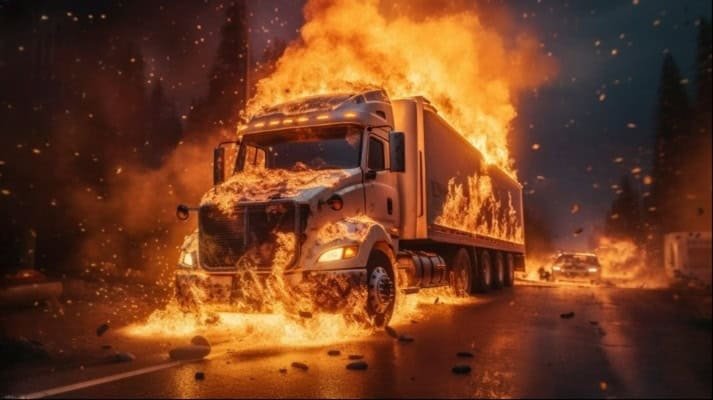
Fuel fires are the most common source. Commercial trucks carry large amounts of diesel fuel in tanks along the frame. A serious collision can rupture those tanks, and the spilled fuel can ignite from sparks or electrical contact. Tanker trucks hauling gasoline or other flammable liquids create even greater danger. A ruptured tanker can produce a fireball that spreads rapidly and burns anyone nearby, not just the people directly involved in the crash.
Chemical burns happen when tanker trucks carrying industrial acids, corrosive liquids, or other hazardous materials are involved in an accident. What makes chemical burns especially dangerous is that the damage keeps happening as long as the substance stays on the skin. Exposure to the eyes or airways can cause permanent harm.
Electrical burns occur when a truck knocks down a power line or, in the case of a dump truck with its bed raised, contacts overhead electrical lines. These burns are often more serious than they appear on the outside because electricity travels through the body and damages tissue internally.
Friction burns affect motorcyclists, cyclists, and pedestrians who are hit by a truck and dragged along the pavement. These injuries can cover large areas of skin and typically involve deep abrasions with road debris embedded in the wound.
Steam and hot fluid burns happen when a crash ruptures the truck’s cooling system. The steam and coolant released can reach extremely high temperatures and burn anyone who approaches the wreckage, including bystanders trying to help.
Who Is Liable for Burn Injuries Caused by a Truck Accident in New York?
One of the most important things an attorney does in a burn injury case is identify every party who may be responsible. This matters because the cost of treating serious burns is often very high, sometimes exceeding what a single insurance policy covers. Having more than one responsible party means more potential sources of compensation for you.
The truck driver and trucking company are usually the first place to look. If the crash happened because the driver was distracted, fatigued, speeding, or operating an unsafe vehicle, both the driver and the company that employs them can be held responsible for the resulting injuries. Learn more about trucking company liability.
The company that shipped the cargo may also bear responsibility. When hazardous chemicals spill because they were improperly packed, mislabeled, or misclassified, the shipper can be independently liable for the burns that result.
The truck manufacturer can be responsible if the fuel tank or another component failed in a way it should not have. Fuel tanks are designed to withstand crash forces. When a tank ruptures in a collision it should have survived, the manufacturer may face liability that is entirely separate from any fault by the driver or carrier.
New York law allows burn injury victims to pursue compensation from every party at fault, not just one. An experienced attorney investigates all potential sources so that nothing is left on the table.
What Compensation Can You Recover for Truck Accident Burn Injuries?
The compensation available in a burn injury case covers far more than just the initial hospital bills. Here is what can typically be claimed:
Current medical costs include the emergency room, burn center hospitalization, surgeries, wound care, and any treatment received to date. Burns requiring intensive care can cost $10,000 or more per day in the hospital, and that adds up very quickly.
Future medical costs are often the largest part of the claim in serious burn cases. Skin grafts, scar revision surgeries, physical therapy, compression garments, and mental health treatment may all be needed for years after the accident. A life care plan created by a medical expert projects these future costs so they are fully included in your claim.
Lost income covers the wages missed during treatment and recovery. If the injuries prevent a return to the same job or type of work, the loss of future earning capacity can also be claimed.
Pain and suffering compensates for the physical pain, the emotional toll, and the permanent impact on how a person lives, feels about themselves, and connects with others. Burn injury cases consistently produce some of the highest pain and suffering awards in personal injury law. Juries respond to visible, permanent scarring in ways that reflect its true impact on a person’s life.
Loss of enjoyment of life recognizes that burn injuries can prevent someone from participating in activities, relationships, and experiences they valued before the accident.
New York generally does not cap pain and suffering or other non-economic damages in personal injury cases. A narrow exception can limit recovery to $100,000 for certain at-fault drivers. Under Insurance Law 5104(d), in motor vehicle lawsuits commenced on or after May 26, 2026, that limit on non-economic damages applies only when the injured person was operating a motor vehicle, was partly at fault but not barred from recovery by CPLR 1411, had a serious injury, and was either driving an uninsured vehicle they were responsible for insuring (a coverage lapse of less than thirty days does not count), driving while impaired and convicted of it, or committing a felony or fleeing from one while driving and convicted of that felony. The limit does not apply to claims for injuries resulting in death.
FIND OUT WHAT YOUR BURN INJURY CASE IS WORTH
Case Results
Porter Law Group has obtained more than 53 results at or above $1 million, anchored by a $17.8 million settlement and a $13.5 million jury verdict.
$5,700,000 Settlement: A 52-year-old man suffered a lower limb amputation in a commercial trucking accident. The firm established liability through driver record violations and secured a settlement covering lifetime prosthetic costs and lost earning capacity.
$3,400,000 Jury Verdict: A 40-year-old man sustained a traumatic brain injury in a vehicle collision. The insurance company offered $100,000. Porter Law Group recovered $3.4 million, 34 times the initial offer.
Every case is different. Past results do not guarantee future outcomes.
How Long Do You Have to File a Truck Accident Burn Injury Claim in New York?
Most truck accident burn injury claims must be filed within 3 years of the accident. That may sound like a long time, but burn treatment often takes priority for the first several months, and evidence such as truck maintenance records, driver logs, and vehicle data can disappear quickly if steps are not taken early to preserve it.
If a government vehicle or government-owned road was involved, a written notice must be filed within just 90 days of the accident. Missing this deadline can permanently eliminate the right to make a claim.
If the burn injury resulted in death, the family has 2 years from the date of death to file a wrongful death claim. Claims involving minors may have extended deadlines.
Because some of these windows are short, reaching out to an attorney early protects your rights even when medical treatment is the immediate focus.
ACT NOW TO PROTECT YOUR RIGHTS
Get a free consultation to understand your rights, treatment costs, and compensation options.
How Long Do You Have to File a Truck Accident Burn Injury Claim in New York?
Most truck accident burn injury claims must be filed within 3 years of the accident. That may sound like a long time, but burn treatment often takes priority for the first several months, and evidence such as truck maintenance records, driver logs, and vehicle data can disappear quickly if steps are not taken early to preserve it.
If a government vehicle or government-owned road was involved, a written notice must be filed within just 90 days of the accident. Missing this deadline can permanently eliminate the right to make a claim.
If the burn injury resulted in death, the family has 2 years from the date of death to file a wrongful death claim. Claims involving minors may have extended deadlines.
Because some of these windows are short, reaching out to an attorney early protects your rights even when medical treatment is the immediate focus.
What Should You Do After Sustaining Burn Injuries in a Truck Accident?
1. Get to a burn center as soon as possible. Not every hospital is equipped to treat serious burns. Specialized burn centers have the staff and equipment to handle major burn injuries properly. If the emergency room where you are taken does not have burn care capabilities, ask about a transfer to a verified burn center.
2. Have a family member preserve evidence. When someone is hospitalized with burns, they cannot investigate the crash themselves. A family member or attorney should photograph the scene if possible, collect the police report, and note the truck’s company name and identification number before the vehicle is repaired or moved.
3. Keep records of every medical appointment and expense. Save every bill, prescription, and provider contact from the moment of the accident forward. Detailed, organized records form the foundation of a strong legal claim and help ensure nothing is missed when calculating the full cost of your injuries.
4. Do not accept a quick settlement offer. Insurance companies sometimes approach burn victims while they are still in the hospital. These early offers are almost always far below the true value of the claim. The full value cannot be known until the extent of the scarring and the number of future surgeries are understood.
5. Contact a truck accident lawyer as early as possible. Early legal involvement allows an attorney to preserve evidence, identify all responsible parties, and bring in the right medical experts while treatment is still underway. Porter Law Group works on a contingency fee basis, meaning there is no cost to you unless compensation is recovered.
Truck Accident Burn Injury Lawyer Near You in New York
Porter Law Group represents burn injury victims throughout New York State. Whether the accident happened in the middle of New York City or on a rural upstate highway, the firm handles claims in every county and jurisdiction across New York.
Serving clients statewide, including:
- New York City (Manhattan, Brooklyn, Queens, The Bronx, Staten Island)
- Long Island (Nassau County, Suffolk County)
- Westchester County (Yonkers, White Plains, New Rochelle)
- Syracuse and Central New York (Onondaga, Cayuga, Oswego counties)
- Buffalo and Western New York (Erie, Niagara, Chautauqua counties)
- Rochester and the Finger Lakes (Monroe, Ontario, Livingston counties)
- Albany and the Capital Region (Albany, Rensselaer, Schenectady counties)
- Utica, Binghamton, and the Southern Tier
- The North Country and Hudson Valley
Wherever in New York the accident occurred, Porter Law Group can help. Call (833) PORTER-9 for a free consultation with a truck accident burn injury attorney. There is no obligation and no upfront cost.
Frequently Asked Questions About Truck Accident Burn Injuries in New York
How much is a truck accident burn injury case worth in New York?
It depends on the severity and extent of the burns, the treatment required, and how the injuries affect your ability to work and live your life. Second-degree burns with significant scarring may settle for $75,000 to $500,000. Severe burns covering large portions of the body, requiring many surgeries and causing permanent disfigurement, can result in settlements or verdicts well above $1 million. The only way to get a reliable estimate for your specific situation is to have an attorney review the facts of your case.
Can I file a claim even if I was not in the truck or the car that was hit?
Yes. Bystanders, pedestrians, motorcyclists, and people in nearby vehicles who were burned by a truck fire, explosion, or chemical spill can all have valid claims. You do not need to have been directly involved in the collision to be entitled to compensation for your injuries.
What kind of long-term effects do serious burn injuries cause?
Severe burns can result in permanent scarring, tightening of the skin that limits movement in the arms or legs, sensitivity to heat and cold, and a higher risk of skin breakdown over time. Many survivors also experience anxiety, depression, and changes in how they see themselves and relate to others. These effects are real, recognized by the law, and compensable as part of your claim.
Can more than one party be held responsible for my burn injuries?
Yes, and in many truck accident burn cases, multiple parties share responsibility. The driver, the trucking company, the cargo shipper, and even the truck manufacturer can each be liable depending on what caused the accident and what caused the fire or chemical exposure. Identifying every responsible party is one of the most important things an attorney does in these cases.
How much does it cost to work with Porter Law Group?
Nothing upfront. The firm works on a contingency fee basis, which means you pay no attorney fees unless the firm recovers money for you. All costs for experts, including burn surgery specialists and life care planners, are covered by the firm during the case.
What Clients Say About Porter Law Group
Meet the Attorney

Michael S. Porter, J.D.
Founder and managing partner of Porter Law Group. Harvard University (B.A., 1994), Syracuse University College of Law (J.D., 1997). Former U.S. Army JAG Corps Captain, Airborne Training School graduate. Super Lawyers 14 consecutive years, 10.0 Superb on Avvo, Distinguished rating from Martindale-Hubbell. Over 20 years of trial experience and $500 million in recoveries.
Reviewed by Michael S. Porter, J.D. | Last updated: [April, 2026]
Contact Porter Law Group Today
Burn injuries from truck accidents are serious, painful, and life-altering. The legal process should not be something you have to figure out on your own while you are still recovering.
Contact Porter Law Group for a free, no-obligation consultation. There are no upfront costs, and you pay nothing unless we win your case.
Phone: +1 833-767-8379
Email: info@porterlawteam.com
Monday to Friday: 8 AM to 5 PM | Saturday and Sunday: Closed