

If you or someone you love was hurt in a tanker truck accident in New York, you may be dealing with injuries far more serious than a typical car crash. Tanker trucks carry gasoline, diesel fuel, industrial chemicals, and other hazardous materials that can cause fires, explosions, and toxic exposure when something goes wrong. The settlements in these cases often exceed $1 million and can reach $5 million or more for severe injuries or wrongful death. New York law allows injured victims to seek compensation from multiple parties, including the truck driver, the trucking company, the cargo shipper, and even the tank manufacturer.
Prior results do not guarantee a similar outcome.
Why Choose Porter Law Group for Tanker Truck Accident Cases?
Tanker truck accidents are not like other truck crashes. They involve hazardous cargo, specialized trucking regulations, and injuries that can affect dozens of people far beyond the original collision. You need a legal team with experience handling exactly these types of cases.
Porter Law Group has recovered more than $500 million for injured clients since 2009. Our attorneys and staff include former military officers, Super Lawyers-rated trial attorneys, and specialists who understand the full scope of hazmat trucking cases. Founder Michael S. Porter is a Harvard-educated attorney and former U.S. Army JAG Corps Captain with over 20 years of trial experience. All eight attorneys have been selected to Super Lawyers or Rising Stars, an honor earned by fewer than 5% of attorneys in New York.
We work with experts in hazardous materials compliance, chemical exposure, and burn injuries so that every angle of your case is fully developed and documented.

REQUEST A NO-OBLIGATION CASE REVIEW
What Makes Tanker Truck Accidents So Dangerous?
The danger of a tanker crash depends entirely on what the tanker is carrying. Each cargo type creates different hazards for crash victims, first responders, and nearby residents.
| Cargo Type | Primary Hazard | Injury Pattern | Federal Regulation |
| Gasoline/diesel | Explosion and fire upon tank rupture or leak near ignition source | Severe burns, smoke inhalation, blast injuries to nearby vehicles and bystanders | 49 CFR Part 397 (hazmat routing), Part 172 (placarding) |
| Industrial chemicals | Toxic fume release, skin and eye contact, groundwater contamination | Chemical burns, respiratory damage, long-term organ damage from toxic exposure | 49 CFR Part 397, Part 173 (packaging), Part 180 (tank testing) |
| Liquefied gases (propane, LNG) | BLEVE (boiling liquid expanding vapor explosion) producing massive fireball | Fatal thermal burns within hundreds of feet, blast wave injuries | 49 CFR Part 397, Part 178 (tank specifications) |
| Corrosive liquids (acids, bases) | Immediate chemical burning of skin, eyes, and airways upon contact | Permanent scarring, blindness, respiratory system destruction | 49 CFR Part 397, Part 173 (packaging requirements) |
| Milk, water, food-grade liquids | Liquid surge causing rollover (non-toxic but mechanically dangerous) | Standard collision injuries to other vehicles from rollover or jackknife | FMCSA general regulations (not hazmat-classified) |
FIND OUT WHO IS LIABLE FOR YOUR TANKER TRUCK ACCIDENT
How Do Tanker Truck Accidents Happen in New York?
Liquid surge and rollover is the most common tanker-specific crash. Unlike solid cargo that stays in place, liquid inside a tanker shifts during turns, braking, and lane changes. This movement, called liquid surge or slosh, changes the tanker’s center of gravity in real time and can tip the vehicle during maneuvers that would be safe for a dry-van trailer. Partially filled tankers are the most dangerous because the liquid has room to build momentum as it moves from one side of the tank to the other. Rollover accidents involving tankers are more common on highway exit ramps, interchange curves, and the winding routes through the Hudson Valley and Catskills where advisory speed signs are calibrated for passenger vehicles, not liquid-cargo trucks.
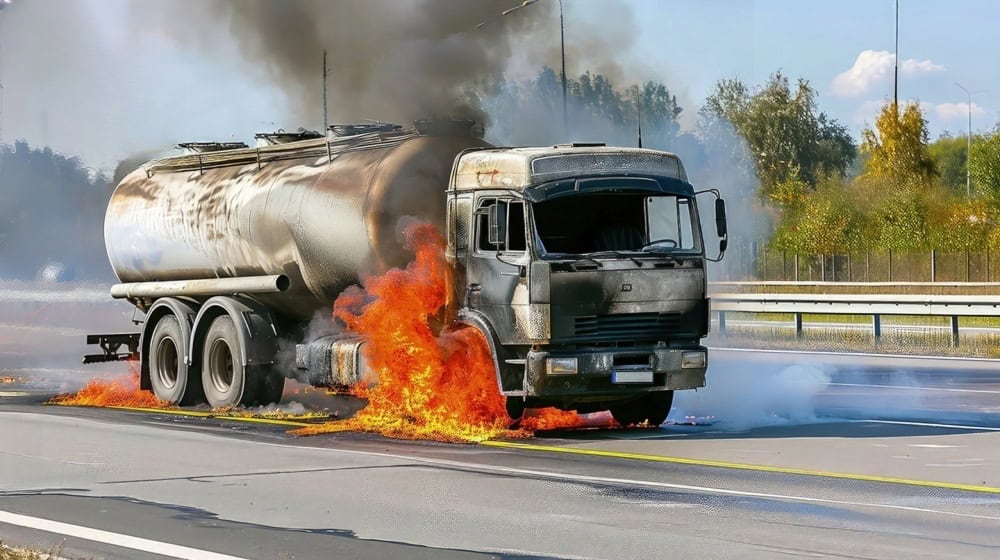
Tank rupture causing fire and explosion occurs when the tanker is struck, rolls over, or is involved in a high-speed collision that breaches the tank wall. Gasoline and diesel fuel ignite on contact with sparks from the collision, creating fireballs that engulf nearby vehicles. Liquefied gases like propane can produce a BLEVE (boiling liquid expanding vapor explosion) that generates a thermal fireball hundreds of feet in diameter. These secondary hazards injure bystanders, first responders, and residents of nearby buildings who were not involved in the original collision. Burn injuries from tanker fires regularly exceed $500,000 in medical costs and produce lifelong scarring.
Chemical spill and toxic exposure happens when the tanker is carrying industrial chemicals, corrosive liquids, or toxic substances. A spill releases fumes that spread downwind, contaminate soil and groundwater, and create inhalation hazards for everyone in the area. Chemical exposure injuries are especially dangerous because symptoms may not appear for hours or days after contact, and long-term health effects including cancer, organ damage, and respiratory disease may develop years later.
Driver error compounded by cargo physics makes tanker crashes worse than comparable errors in dry-van trucks. A distracted or fatigued tanker driver who overcorrects a lane drift creates a liquid surge that amplifies the correction into a full rollover. A driver who speeds into a curve generates centrifugal force that the shifting liquid magnifies beyond the vehicle’s stability threshold. The same errors that produce survivable crashes in dry-van trucks produce catastrophic rollovers and fire in tanker trucks.
Who Is Liable in a Tanker Truck Accident in New York?
In most tanker truck accident cases, more than one party bears responsibility. New York law allows you to seek compensation from each party that contributed to your injuries.
The truck driver may be at fault for speeding, distracted driving, taking an incorrect route, or failing to inspect the truck properly before getting on the road.
The trucking company may be responsible for hiring unqualified drivers, skipping required maintenance checks, failing to properly train drivers on tanker-specific hazards, or allowing drivers to work beyond safe hours.
The cargo shipper may share fault if the hazardous materials were incorrectly labeled, improperly packaged, or if the shipper provided inaccurate information about what was being transported.
The tank manufacturer may be liable if a defect in the tank’s design or construction caused it to rupture during the accident. Tanks must be periodically tested and inspected, and a carrier that skipped those required tests can also be held responsible.
Our truck accidents legal team investigates all potential sources of liability to make sure no responsible party escapes accountability.
What Compensation Can You Recover After a Tanker Truck Accident?
If you were injured in a tanker truck accident, you may be entitled to compensation for:
Medical expenses: Emergency care, hospitalization, surgery, rehabilitation, and any ongoing treatment costs. Burn injuries alone can cost more than $500,000 to treat and often require years of follow-up care. Brain injuries from blast-wave impact can require even longer-term support.
Lost income: Money you were unable to earn while recovering, plus any future income you may lose if your injuries affect your ability to work.
Pain and suffering: The physical pain, emotional trauma, and lasting impact on your quality of life. New York does not place a legal cap on this type of compensation.
Disfigurement and disability: Burn survivors and amputation victims often face life-altering changes that deserve significant recognition in a settlement or verdict.
Wrongful death: If you lost a family member in a tanker truck accident, the estate may seek compensation for loss of income, funeral costs, and the profound loss the family has suffered. Wrongful death claims in these cases typically settle between $1 million and $10 million.
FIND OUT WHAT YOUR TANKER TRUCK ACCIDENT CASE IS WORTH
Case Results
Our results page shows more than more than 50 cases at or above $1 million, including a $17.8 million settlement and a $13.5 million jury verdict.
$5,700,000 Settlement: A 52-year-old man suffered a lower extremity amputation in a commercial trucking accident. Porter Law Group established liability through logbook violations and secured a settlement covering lifetime prosthetic costs and lost earning capacity.
$3,400,000 Jury Verdict: A 40-year-old man sustained a traumatic brain injury in a vehicle collision. The insurer offered $100,000. Porter Law Group secured $3.4 million, a 34x increase over the pre-trial offer.
Every case is different. Past results do not guarantee future outcomes.
Get a free consultation to understand your rights, liability options, and compensation claim.
How Long Do I Have to File a Tanker Truck Accident Claim in New York?
Standard injury claims: You generally have 3 years from the date of the accident to file a claim in New York.
Chemical exposure injuries: If your symptoms from toxic exposure did not appear right away, the filing deadline may be extended. However, the evidence from the crash, including the tanker itself and shipping records, can be destroyed quickly. Contacting an attorney as soon as possible is essential.
Wrongful death claims: The family has 2 years from the date of death to file. Claims involving minors are handled differently.
Claims involving a government entity: If a poorly maintained road or missing signs played a role in the crash, a formal notice must be filed within 90 days of the accident.
The sooner you reach out to an attorney, the better the chances of preserving the key evidence your case depends on.
ACT NOW BEFORE YOUR DEADLINE EXPIRES
What Should You Do After a Tanker Truck Accident in New York?
1. Move upwind and to higher ground immediately. Tanker spills release flammable vapors that travel along the ground and toxic fumes that drift downwind. Do not approach the tanker or spill area. Call 911 and report that a tanker truck is involved and describe the hazmat placards if visible.
2. Note the hazmat placards on the tanker. Every tanker carrying hazardous materials must display diamond-shaped placards indicating the cargo type: red for flammable, yellow for oxidizer, white for poison, orange for explosive. Photograph the placard from a safe distance if possible. This information tells first responders what they are dealing with and identifies the cargo for your legal claim.
3. Seek medical evaluation even without visible injuries. Chemical exposure injuries from fume inhalation and skin contact may not produce symptoms for hours or days. Tell the emergency room that you were exposed to a tanker spill and request toxicology screening. Document every symptom that develops in the days and weeks following the exposure.
4. Do not give a recorded statement to the carrier or its insurer. Tanker truck cases involve large insurance policies and aggressive corporate defense teams. Direct all communication to your attorney.
5. Contact a truck accident lawyer immediately. An attorney can send spoliation letters demanding preservation of the tank, hazmat shipping documents, driver endorsement records, tank testing history, and the carrier’s hazmat compliance files. Porter Law Group offers free consultations on a contingency-fee basis.
Tanker Truck Accident Lawyer Near You in New York
Porter Law Group represents tanker truck accident victims throughout New York State. No matter where the accident happened, our team is ready to help.
- Syracuse (Main Office) 100 Madison St #1500, Syracuse, NY 13202
- New York City By appointment
- Buffalo By appointment
- Rochester By appointment
- Albany By appointment
- Saratoga Springs By appointment
We also serve clients in Yonkers, White Plains, Utica, Binghamton, Long Island, and every county across New York State. View all locations →
Call (833) PORTER-9 to speak with an experienced truck accident attorney today.
Frequently Asked Questions About Tanker Truck Accidents in New
How much is a tanker truck accident settlement worth in New York?
Settlements often exceed $1 million and can reach $5 million or more depending on the severity of your injuries. Tanker cases tend to produce higher settlements than other truck accidents because the injuries are more severe, more people are often affected, and the trucking companies involved carry larger insurance policies.
Can I file a claim if I was not in the crash but was exposed to chemicals?
Yes. If you were a bystander, nearby resident, or first responder who suffered health effects from toxic fumes, chemical contact, or an explosion, you have the right to file a claim. You do not need to have been in the vehicles involved. Because chemical exposure symptoms can be delayed, see a doctor as soon as possible and document everything.
Who can be held responsible for a tanker truck accident?
The driver, the trucking company, the cargo shipper, and the tank manufacturer can all share responsibility depending on what caused the crash. Our attorneys investigate every possible source of fault to pursue the maximum compensation available to you.
How long do I have to file my claim?
In most cases, 3 years from the accident date. Wrongful death claims must be filed within 2 years. If a government agency was involved, a formal notice is required within 90 days. Chemical exposure claims may have different timelines. Contact us as soon as possible so that critical evidence is preserved.
How much does it cost to hire Porter Law Group?
Nothing upfront. We work on a contingency-fee basis, which means you pay nothing unless we recover compensation for you. All case expenses, including expert consultants and litigation costs, are covered by our firm.
What Clients Say About Porter Law Group
Meet the Attorney

Michael S. Porter, J.D.
Founder and managing partner of Porter Law Group. Harvard University (B.A., 1994), Syracuse University College of Law (J.D., 1997). Former U.S. Army JAG Corps Captain, Airborne Training School graduate. Super Lawyers 14 consecutive years, 10.0 Superb on Avvo, Distinguished rating from Martindale-Hubbell. Over 20 years of trial experience and $500 million in recoveries.
Reviewed by Michael S. Porter, J.D. | Last updated: [April, 2026]
Contact Porter Law Group Today
A tanker truck accident can change your life in an instant. Whether you were in a collision, caught in a fire, or exposed to toxic chemicals, you deserve answers and you deserve an experienced legal team fighting for you.
Contact Porter Law Group at (833) PORTER-9 or reach out online for a free, no-obligation consultation. We work on a contingency-fee basis. You pay nothing unless we win.
Phone: +1 833-767-8379
Email: info@porterlawteam.com
Monday to Friday: 8 AM to 5 PM | Saturday and Sunday: Closed