

If you or someone you love was hurt in a jackknife truck accident in New York, you need someone in your corner who knows exactly how these cases work. Jackknife accidents are among the most violent and unpredictable types of truck crashes on any road. When a massive 18-wheeler or tractor-trailer loses control and folds in on itself, nearby drivers and passengers can suffer life-changing injuries in seconds. At Porter Law Group, our jackknife accident lawyers in New York have spent decades fighting for victims of serious truck crashes across the state. We offer free consultations and handle every case on a contingency-fee basis, which means you pay nothing unless we win for you. Call us today at (833) PORTER-9.
Prior results do not guarantee a similar outcome.
What Is A Jackknife Truck Accident?
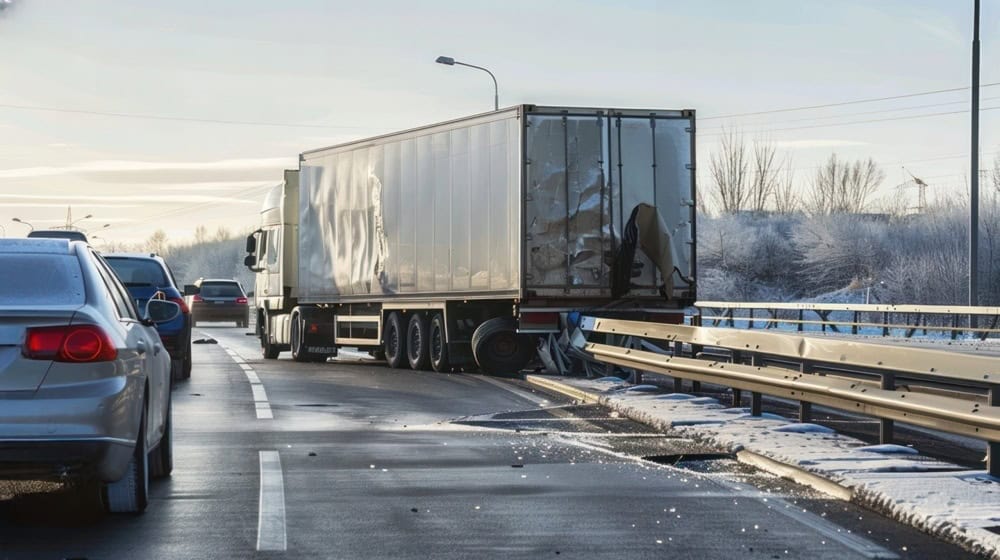
Think of the way a folding pocketknife snaps back on itself. That is what happens in a jackknife accident. When a large truck, such as a semi-truck or 18-wheeler, loses traction or brakes too sharply, the trailer swings out to the side instead of following straight behind the cab. The trailer folds forward at an angle, forming a sharp “V” or “L” shape with the front of the truck. At that point, the driver has very little control. The truck can sweep across multiple lanes of highway traffic in seconds, striking any vehicle in its path.
Jackknife accidents are terrifying to witness and even more dangerous to be caught in. A fully loaded commercial truck can weigh up to 80,000 pounds. When that much weight goes out of control, the damage it causes to smaller passenger vehicles is devastating.

REQUEST A NO-OBLIGATION CASE REVIEW
Common Causes Of Jackknife Accidents In New York
Jackknife accidents rarely just happen. In most cases, they are the result of a truck driver, trucking company, or another responsible party failing to do their job safely. Some of the most common causes include:
Sudden Or Hard Braking – When a truck driver slams on the brakes, especially at highway speed, the trailer continues moving forward. If the trailer wheels lock up while the cab is still rolling, the trailer swings out to the side. This is one of the most preventable causes of jackknife crashes.
Slippery Or Wet Roads – Rain, snow, ice, and black ice are serious hazards for large trucks in New York. When tires lose grip on the road surface, even a slight press of the brakes can send a trailer into a jackknife. Truck drivers are expected to slow down and adjust to road conditions, and failure to do so is negligence.
Speeding – Driving too fast for road conditions reduces a driver’s ability to stop safely or navigate turns. On New York highways like I-87, I-90, and I-81, high speeds combined with poor weather create serious jackknife risks.
Improper Brake Maintenance If a truck’s brakes are worn down or have not been properly serviced, they may not apply evenly across all the wheels. Uneven braking can cause the trailer to pull to one side and fold out of alignment. Trucking companies are legally required to keep their vehicles in safe working condition, and violations of that duty can mean they share responsibility for the crash.
Overloaded Or Improperly Loaded Cargo – There are strict federal rules on how much a truck can carry and how cargo must be secured inside the trailer. When a trailer is overloaded or loaded incorrectly, the weight becomes unstable during braking or turns, making a jackknife far more likely. You can read more about cargo loading requirements from the Federal Motor Carrier Safety Administration (FMCSA).
Driver Fatigue Or Distraction – Tired or distracted drivers react more slowly to changes in traffic and road conditions. By the time a fatigued driver realizes they need to slow down or steer, it may already be too late to avoid a jackknife.
How Dangerous Are Jackknife Accidents?
Very. A jackknifing truck does not just affect a single vehicle. It can sweep across all lanes of traffic and create a chain of collisions. On busy New York interstates, this can mean multiple cars and passengers caught in the same crash within seconds. The size and weight of commercial trucks mean that even a partial impact from a swinging trailer can total a passenger vehicle and seriously injure everyone inside.
Jackknife accidents are also more likely to cause secondary crashes. When a trailer blocks multiple lanes or rolls over, drivers behind it may not have enough time or distance to stop. Highway interchanges, bridge approaches, and tight overpasses throughout New York add to the danger. According to the National Highway Traffic Safety Administration (NHTSA), passenger vehicle occupants account for the large majority of fatalities in crashes involving large trucks, reflecting the severe size imbalance between a commercial truck and an ordinary car.
Injuries Commonly Seen In Jackknife Truck Accidents
The injuries people suffer in jackknife accidents tend to be serious because of the force and unpredictability involved. Some of the most common include:
- Broken bones, including fractures to the arms, legs, ribs, and pelvis
- Head and brain injuries, ranging from concussions to traumatic brain injuries that can affect memory, speech, and daily functioning long after the accident
- Spinal cord injuries, which can cause partial or full paralysis
- Crushing injuries when a vehicle is pinned beneath or against a trailer
- Lacerations and scarring from broken glass or torn metal
- Internal injuries that may not show visible symptoms right away but can become life-threatening
- In the worst crashes, wrongful death
Many of these injuries require surgery, extended hospital stays, and months or years of rehabilitation. Some victims are never fully able to return to work or resume the daily activities they had before the accident.
Who Can Be Held Responsible After A Jackknife Accident?
One of the most important things to understand is that the truck driver is not always the only person who can be held accountable. In New York, jackknife accident victims often have claims against multiple parties, which can mean more sources of compensation.
The Truck Driver can be held responsible when their own actions, such as speeding, distracted driving, or hard braking on a slick road, caused or contributed to the accident.
The Trucking Company may be responsible for negligent hiring, failing to properly train drivers, pressuring drivers to skip required rest breaks, or neglecting regular vehicle maintenance. In New York, trucking companies are generally responsible for the actions of their drivers while on the job.
Maintenance And Repair Companies that service commercial trucks can be held liable when a mechanical issue they should have caught caused the jackknife.
Cargo Loading Companies can share responsibility when improperly loaded or overweight freight made the truck unstable.
Truck Or Parts Manufacturers may be liable when a defective brake system, tire, or other component contributed to the loss of control.
Having a jackknife accident lawyer conduct a full investigation means all of these possibilities are explored, not just the most obvious one. Insurance companies often look for the simplest explanation to limit what they pay. A strong legal team looks at the full picture to make sure every responsible party is held accountable.
What Compensation Can You Recover?
After a jackknife accident in New York, you may be entitled to compensation for:
- Medical bills, including emergency care, surgery, hospital stays, physical therapy, and any ongoing or future treatment related to your injuries
- Lost income during recovery, and future lost earnings if your injuries limit your ability to work long-term
- Pain and suffering, covering physical pain as well as emotional distress and anxiety following the accident
- Property damage, including the cost to repair or replace your vehicle
- Loss of enjoyment of life when your injuries prevent you from doing things that mattered to you before the accident
- Wrongful death damages for surviving family members when a loved one was killed in the crash
New York does not place a limit on what victims can recover for pain and suffering in serious injury cases. If the trucking company’s conduct was especially reckless, additional punitive damages may also be available. Our lawyers work to recover the full amount you are owed based on the real impact the accident has had on your life.
What To Do After A Jackknife Accident In New York
What you do in the hours and days following a jackknife accident can have a real impact on your claim. Here is what to keep in mind:
- Get to safety and call 911. Even if injuries seem minor at first, call for emergency help right away. Ask the responding officer to document the truck driver’s identity, license number, trucking company name, and the truck’s DOT number.
- Photograph everything you safely can. Take pictures of your vehicle, the truck, the road, skid marks, road signs, weather or light conditions, and any visible injuries. If there are witnesses, try to get their contact information.
- Get medical attention the same day. Some serious injuries, including internal bleeding and brain injuries, do not show clear symptoms right away. Seeing a doctor immediately also creates a medical record that connects your injuries directly to the accident.
- Do not speak with the trucking company or their insurance. Trucking companies may reach out quickly and ask for a recorded statement or offer a fast settlement. Do not sign anything or agree to anything before speaking with a lawyer.
- Contact a jackknife accident lawyer as soon as possible. Key evidence such as the truck’s electronic data, driver logs, and dashcam footage can be deleted or overwritten within days of a crash. The sooner an attorney gets involved, the better the chance of securing the evidence you need.
FREE CASE EVALUATION: CALL (833) PORTER-9
Let us help. Our clients don't have to pay anything unless we win.
How Porter Law Group Handles Your Jackknife Accident Case
At Porter Law Group, no two truck accidents are exactly alike, and we treat every client’s case with the individual attention it deserves. When you come to us, here is what happens:
We immediately send legal preservation notices to the trucking company requiring them to retain all evidence, including electronic driver logs, vehicle data recorder information, maintenance records, and any dashcam footage.
We investigate every possible angle, including the driver’s history, the truck’s service records, how cargo was loaded, and whether any federal safety regulations were violated before or during the crash.
We work with accident reconstruction specialists and other experts who can explain exactly what happened and why, in terms that a jury or insurance adjuster can understand.
We negotiate with force against insurance companies who try to minimize or deny valid claims, and we are prepared to take your case to trial if they will not offer fair compensation.
You pay nothing unless we win. Porter Law Group has recovered more than $500 million for injured clients across New York, and we bring that same determination to every jackknife accident case we take.
Jackknife Accident Lawyer Near You In New York
Porter Law Group represents jackknife accident victims throughout all of New York State. Whether your accident happened on a busy upstate interstate, a crowded New York City street, or a rural highway, our attorneys are ready to help. We serve clients in every county and region across New York, including:
Long Island (Nassau and Suffolk Counties)
No matter where in New York your jackknife accident occurred, Porter Law Group offers free consultations and handles cases on a contingency-fee basis statewide. Call (833) PORTER-9 to speak with an experienced jackknife accident lawyer who knows New York roads, courts, and trucking routes.
Frequently Asked Questions About Jackknife Accidents In New York
How long do I have to file a jackknife accident claim in New York?
In most cases, you have three years from the date of the accident to file a personal injury lawsuit in New York. There are important exceptions, however. If a government-owned vehicle or government road was involved, you may need to file a Notice of Claim within just 90 days. In wrongful death cases, the deadline is two years from the date of death. Because evidence can disappear quickly after a truck accident, it is always best to contact a lawyer as soon as possible rather than waiting.
Can I still get compensation if I was partly at fault?
You may be able to. New York uses a comparative negligence system, which means you may still recover compensation even if you were partially responsible for the accident. In personal injury cases covered by New York’s no-fault motor vehicle law and commenced on or after May 26, 2026, recovery is barred if your fault is greater than the combined fault of the parties you are suing. Otherwise, your total compensation is reduced by your percentage of fault. For example, if your damages total $400,000 and you are found 15% responsible, the award would be reduced to $340,000.
Do not assume you cannot make a claim just because you were not completely blameless.
Can I sue the trucking company, not just the driver?
Yes, and in many jackknife accident cases, pursuing the trucking company is where the strongest recovery comes from. Trucking companies in New York can be held responsible for the actions of their drivers, and they can also face direct liability for negligent hiring, inadequate driver training, poor vehicle maintenance, or pressuring drivers to skip required rest. Each of these is a separate basis for a claim and can significantly affect what you are able to recover.
What evidence matters most in a jackknife accident case?
Some of the most valuable evidence includes the truck’s electronic logging device data showing how long the driver was on the road, the vehicle’s event data recorder showing speed and braking just before impact, the truck’s maintenance records, cargo loading documentation, dashcam footage, police reports, and nearby surveillance camera footage. Much of this data can be deleted or overwritten within days of a crash, which is why contacting a lawyer promptly is so important.
How much does it cost to hire a jackknife accident lawyer?
At Porter Law Group, there is no upfront cost. We work entirely on a contingency-fee basis, meaning we only get paid if we recover compensation for you. There are no hourly fees, no retainers, and no out-of-pocket costs for expert witnesses, accident reconstruction, or filing fees. If we do not win your case, you owe us nothing.
What Clients Say About Porter Law Group
Meet the Attorney

Michael S. Porter, J.D.
Founder and managing partner of Porter Law Group. Harvard University (B.A., 1994), Syracuse University College of Law (J.D., 1997). Former U.S. Army JAG Corps Captain, Airborne Training School graduate. Super Lawyers 14 consecutive years, 10.0 Superb on Avvo, Distinguished rating from Martindale-Hubbell. Over 20 years of trial experience and $500 million in recoveries.
Reviewed by Michael S. Porter, J.D. | Last updated: [April, 2026]
Ready To Talk To A Jackknife Accident Lawyer In New York?
A jackknife accident can change your life in a matter of seconds. Medical bills stack up fast, you may be unable to work, and the trucking company’s insurance team is already focused on protecting their interests, not yours.
You do not have to go through this alone. At Porter Law Group, our New York jackknife accident lawyers fight for people who have been hurt by negligent truck drivers and the companies that employ them. We have recovered more than $500 million for injured New Yorkers across the state, and we are ready to put that record to work for you.
Phone: +1 833-767-8379
Email: info@porterlawteam.com
Monday to Friday: 8 AM to 5 PM | Saturday and Sunday: Closed