

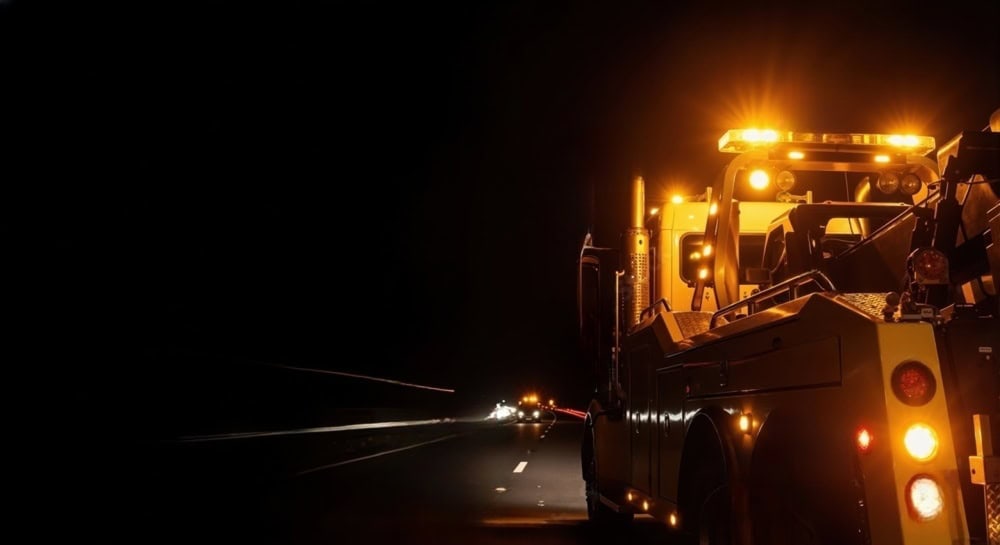
Tow truck accidents in New York can be devastating, and the injuries that come from them are often life-changing. Settlements typically range from $75,000 to over $3 million depending on how serious the injuries are, and wrongful death cases from highway crashes can exceed $2 million. What makes tow truck accidents different from most other road accidents is where and how they happen. These trucks often work on the sides of busy highways, where they are exposed to fast-moving traffic. A towed vehicle that breaks loose at highway speed, a tow truck blocking part of a travel lane, or an operator working on foot alongside the road, any of these situations can result in a catastrophic crash.
In New York, drivers who pass a stopped tow truck with flashing lights are required by law to slow down and move over to a non-adjacent lane if it is safe to do so. When drivers ignore this rule and someone gets hurt, that is a strong basis for a legal claim. New York’s fault rules also allow injured victims to recover money from every party who played a role in the crash, whether that is the tow truck driver, the towing company, the passing driver, or even a government agency responsible for road conditions.
Prior results do not guarantee a similar outcome.
Why Choose Porter Law Group for Tow Truck Accident Cases?
Tow truck accident cases are not straightforward. They raise questions that other vehicle accident cases do not: Was the towed vehicle secured properly? Was the tow truck operator standing in a safe spot? Did a passing driver fail to slow down and move over as required?
Porter Law Group has recovered more than $500 million for injured clients since 2009. Led by Harvard-educated attorney Michael S. Porter, a former U.S. Army JAG Corps Captain with over 20 years of trial experience, the firm investigates both the tow truck operator’s conduct and the actions of other drivers who may have caused the crash. All eight attorneys have been selected to Super Lawyers or Rising Stars, a distinction earned by fewer than 5% of New York attorneys.

REQUEST A NO-OBLIGATION CASE REVIEW
What Are the Two Main Types of Tow Truck Accidents?
Not all tow truck accidents happen the same way. There are two broad categories, and each one involves different responsible parties and different types of evidence.
| Factor | Tow Truck Causes the Crash | Passing Driver Strikes the Tow Truck |
| Common scenario | Towed vehicle detaches on highway, tow truck blocks traffic lane during hook-up, driver speeds or drives recklessly while towing | Car or truck strikes tow truck parked on shoulder or operator working on foot beside the road |
| Primary liable party | Tow truck driver and towing company | Passing driver who failed to move over or slow down |
| Key statute | Standard negligence, VTL violations for reckless driving or improper towing | Move Over Law (VTL §1144-a) violation |
| Who gets hurt | Occupants of other vehicles struck by the tow truck or detached towed vehicle | Tow truck operator, stranded motorist standing roadside, bystanders |
| Key evidence | Hook-up records, tow equipment condition, dashcam, witness testimony | Traffic camera footage, Move Over Law compliance, passing driver’s phone records |
How Do Tow Truck Accidents Happen in New York?
Towed vehicle detachment on the highway is the most dangerous tow-truck-specific hazard. When the hook-up is improper, chains are not secured, or the wheel lift mechanism fails, the towed vehicle separates from the tow truck at highway speed and rolls uncontrolled into traffic. A detached vehicle weighing 3,000 to 5,000 pounds becomes an unmanned projectile that can strike multiple vehicles, cross the median, or roll into oncoming traffic causing head-on collisions. The tow truck driver and towing company bear full liability for detachment because proper securing of the towed vehicle is the fundamental job requirement.
Roadside strikes during hook-up and loading occur when a passing vehicle hits the tow truck, the stranded motorist, or the tow truck operator while they are working on the highway shoulder. New York’s Move Over Law (VTL & sect;1144-a) requires approaching drivers to reduce speed and, if safely possible, move into a lane not adjacent to the stopped tow truck. Despite this law, tow truck operators are struck on New York highways every year by distracted or speeding drivers who fail to move over.
Reckless driving while towing happens when tow truck drivers speed to reach the next call, run red lights in congested areas, or drive aggressively with a towed vehicle that extends their overall vehicle length and changes their stopping distance. A tow truck hauling a vehicle on a flatbed or towing with a wheel lift has significantly different handling characteristics than the tow truck alone, including wider turns, longer stopping distance, and blind spots created by the towed vehicle behind the truck.
Improper blocking of travel lanes creates rear-end collision hazards. When a tow truck blocks part of a travel lane during hook-up without adequate warning (flares, cones, reflective triangles), approaching vehicles may not see the obstruction until it is too late to stop, particularly at night or in curves. These crashes produce rear-end collisions at or near full speed because the tow truck is stationary while traffic approaches at highway velocity.
Who Is Responsible For A Tow Truck Accident In New York?
The Tow Truck Driver
If the driver hooked up the vehicle incorrectly, drove recklessly, or blocked a travel lane without proper warning, that driver is responsible. This includes situations where the driver was speeding to get to the next job or failed to follow safe operating procedures during hook-up.
The Towing Company
The company that employs the driver can also be held responsible, often in more than one way. Companies that do not train their drivers properly, maintain their equipment poorly, or create pressure to rush through jobs bear direct responsibility. If the company pays drivers per tow rather than by the hour, that pay structure can incentivize unsafe driving, and that is evidence the company contributed to the crash. Learn more about truck accidents and how company liability works.
The Passing Driver
If a driver failed to slow down or move over when approaching a tow truck stopped on the shoulder with its lights flashing, and someone was hurt as a result, that driver can be held liable. Cell phone records can show whether the driver was distracted at the time of impact. If the driver was working at the time of the crash, their employer may also be responsible.
A Government Agency
In some cases, the road itself contributes to the accident. Shoulders that are too narrow for tow operators to work safely, missing guardrails, or poor lighting near common breakdown spots can all be factors. Claims against a government agency require filing a specific notice within 90 days of the accident, which is why contacting a lawyer quickly matters.
What Compensation Can You Recover After a Tow Truck Accident?
Costs You Can Document
This includes your medical bills, future treatment costs, money you lost because you could not work, and damage to your vehicle. If your injuries are severe, spinal cord injuries, amputations, or serious brain injuries, these costs can easily reach into the millions over your lifetime.
Pain, Suffering, And Loss Of Quality Of Life
New York generally does not cap compensation for pain and suffering, which means that if the accident has changed how you live, what you can do, or how much pain you experience every day, those impacts have real value in a legal claim. A narrow exception can limit recovery to $100,000 for certain at-fault drivers. Under Insurance Law 5104(d), in motor vehicle lawsuits commenced on or after May 26, 2026, that limit on non-economic damages applies only when the injured person was operating a motor vehicle, was partly at fault but not barred from recovery by CPLR 1411, had a serious injury, and was either driving an uninsured vehicle they were responsible for insuring (a coverage lapse of less than thirty days does not count), driving while impaired and convicted of it, or committing a felony or fleeing from one while driving and convicted of that felony. The limit does not apply to claims for injuries resulting in death.
Wrongful Death
If a family member was killed in a tow truck accident, the family may be able to file a wrongful death claim. These cases typically settle between $1 million and $10 million, depending on the circumstances. Our results page shows the types of recoveries we have achieved for families in situations like yours.
Punitive Damages
In cases where a towing company knowingly hired an unqualified driver, provided defective equipment, or ran their operation in a reckless way, additional damages may be available as a form of punishment for that conduct.
FIND OUT WHAT YOUR TOW TRUCK ACCIDENT CASE IS WORTH
Case Results
Porter Law Group’s published results include more than 50 cases at or above $1 million, anchored by a $17.8 million settlement and a $13.5 million jury verdict.
$5,700,000 Settlement: A 52-year-old man suffered a lower extremity amputation in a commercial trucking accident. Porter Law Group established liability and secured a settlement covering lifetime costs and lost earning capacity.
$3,400,000 Jury Verdict: A 40-year-old man sustained a traumatic brain injury in a vehicle collision. The insurer offered $100,000. Porter Law Group secured $3.4 million, a 34x increase over the pre-trial offer.
Every case is different. Past results do not guarantee future outcomes. See more of our results here
Get a free consultation to understand your rights after a roadside, towing, or detached vehicle crash.
How Long Do I Have to File a Tow Truck Accident Claim in New York?
Three Years For Most Claims
Most tow truck accident claims in New York must be filed within three years of the accident date. However, the tow truck’s hook-up records, equipment inspection logs, dashcam footage, and driver training records need to be requested and preserved as soon as possible. Towing companies may repair or replace failed equipment within days of an accident.
90 Days For Claims Against A Government Entity
If the tow truck was contracted by the government, such as a police rotation tow or a highway authority tow, or if road conditions contributed to the crash, a formal notice must be filed within 90 days.
Two Years For Wrongful Death Claims
If the tow truck was contracted by the government, such as a police rotation tow or a highway authority tow, or if road conditions contributed to the crash, a formal notice must be filed within 90 days.
If a loved one died in a tow truck accident, the estate generally has two years from the date of death to file a claim. Claims involving minors may be paused until they turn 18.
ACT NOW BEFORE YOUR DEADLINE EXPIRES
What Should You Do After a Tow Truck Accident in New York?
1. Call 911 And Move To Safety
If a towed vehicle detached and struck your car, stay in your vehicle with your seatbelt on until emergency responders arrive. The loose vehicle may still be moving. If you are a stranded motorist who was struck by a passing driver, move away from traffic lanes if you are physically able.
2. Take Photos Of Everything
Photograph the tow truck, the towing equipment, any chains or straps used, the tow company’s name and contact information, the license plate, the position of any towed vehicle, the shoulder and lane markings, warning devices that were or were not set out, and the overall crash scene.
3. Note Whether The Tow Truck Had Its Warning Lights On
Whether the tow truck’s flashing amber or red lights were active matters greatly to the legal outcome. Also note whether the truck was fully on the shoulder or partially in a travel lane.
4. Get Medical Attention Within 24 Hours
Some injuries from roadside crashes, including head injuries and internal damage, do not show symptoms right away. Getting checked out quickly protects both your health and your claim.
5. Contact A Tow Truck Accident Lawyer Right Away
A lawyer can act immediately to preserve the records that prove what happened. Porter Law Group handles these cases on a contingency-fee basis, meaning there is nothing to pay upfront and no fee unless we recover compensation for you. Contact us to get started.
Tow Truck Accident Lawyer Near You in New York
Porter Law Group represents tow truck accident victims across New York State. No matter where in New York the accident happened, our team is ready to help.
- Syracuse, NY
- New York City, NY
- Buffalo, NY
- Rochester, NY
- Albany, NY
- Saratoga Springs, NY
- All New York Locations
We also serve clients in Yonkers, White Plains, Utica, Binghamton, Long Island, and surrounding areas throughout the state.
Call (833) PORTER-9 to speak with a tow truck accident attorney who handles cases in your area.
Frequently Asked Questions About Tow Truck Accidents in New York
How much is a tow truck accident settlement worth in New York?
Every case is different, but settlements typically range from $75,000 for moderate injuries to well over $3 million for catastrophic ones. Wrongful death cases involving highway crashes regularly exceed $2 million. The value depends on how seriously you were hurt, who was at fault, and what insurance coverage is available. The best way to understand what your case may be worth is to speak with a lawyer directly.
What is New York’s Move Over Law and why does it matter in these cases?
New York requires all drivers to slow down and, if safely possible, move into a lane away from a stopped tow truck that has its warning lights on. If a driver fails to do this and someone is hurt as a result, that driver can be held legally responsible. This law exists specifically to protect tow truck operators and others who work alongside high-speed traffic.
Who is responsible if a towed vehicle breaks loose and hits my car?
The tow truck driver and the towing company are responsible. It is the driver’s job to make sure the towed vehicle is fully secured before moving. If the equipment itself was defective, the manufacturer of that equipment may also share responsibility.
Can I sue the towing company if the driver was speeding?
Yes. The towing company can be held responsible for how its drivers behave on the road. This includes situations where the company’s pay structure, scheduling pressure, or lack of proper training contributed to the driver’s reckless behavior. GPS data, dispatch records, and pay structure documents can all be used as evidence.
What does it cost to hire a tow truck accident lawyer at Porter Law Group?
Nothing upfront. Porter Law Group works on a contingency-fee basis, which means you pay no fees unless we win your case. We cover all investigative and litigation costs. If we do not recover compensation for you, you owe nothing.
What Clients Say About Porter Law Group
Meet the Attorney

Michael S. Porter, J.D.
Founder and managing partner of Porter Law Group. Harvard University (B.A., 1994), Syracuse University College of Law (J.D., 1997). Former U.S. Army JAG Corps Captain, Airborne Training School graduate. Super Lawyers 14 consecutive years, 10.0 Superb on Avvo, Distinguished rating from Martindale-Hubbell. Over 20 years of trial experience and $500 million in recoveries.
Reviewed by Michael S. Porter, J.D. | Last updated: [April, 2026]
Contact Porter Law Group Today
Tow truck accidents on highway shoulders are among the most dangerous roadside events in New York, and the towing records and equipment that prove the case can be altered within days. Contact Porter Law Group at (833) PORTER-9 for a free, no-obligation consultation. We work on a contingency-fee basis, so you pay nothing unless you win.
Phone: +1 833-767-8379
Email: info@porterlawteam.com
Monday to Friday: 8 AM to 5 PM | Saturday and Sunday: Closed