

If you’ve ever stood in an old basement staring at wrapped pipes or a cracked floor tile wondering “is that asbestos,” you’re not alone, and unfortunately, there’s no perfectly satisfying answer.
Asbestos was mixed into hundreds of different products, in dozens of colors and textures, which means it can look like almost anything, and plenty of things that look exactly like it contain no asbestos at all.
What follows are the visual patterns that tend to show up most often in older homes and buildings. They’re genuinely useful for knowing what warrants a closer look. They are not, on their own, a way to confirm or rule out asbestos.
Prior results do not guarantee a similar outcome.
Can You Identify Asbestos Just by Looking at It?
No, not with certainty, and this is worth saying plainly before anything else. Asbestos fibers themselves are microscopic.
What you’re actually looking at when you inspect a suspicious material is the product it was mixed into, insulation, tile, plaster, siding, and that product’s color, texture, and pattern depended on the manufacturer, the decade, and what else was mixed in alongside the asbestos.
Two pieces of pipe wrap that look completely identical can come from different eras, one containing asbestos and one not.
The only way to actually confirm asbestos is a sample collected by a trained professional and analyzed in an accredited laboratory.
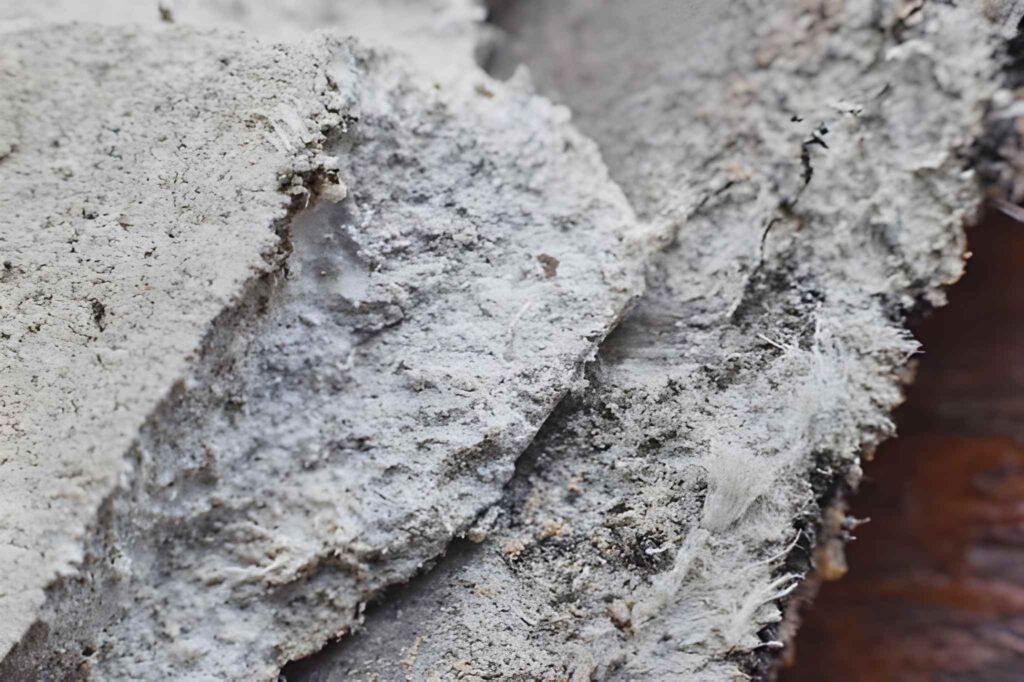
It’s worth knowing what raw, unprocessed asbestos actually looks like, mainly to understand why it’s so hard to spot once it’s been manufactured into something else. In its natural mineral form, asbestos-bearing rock can have a distinctly “hairy” surface, with visible bundles of fine fibers running through it.
Once separated out, a mass of raw asbestos fiber resembles loose cotton wool or fluffy candy floss, though the individual fibers that actually pose a health risk are far too small and thin to see without magnification.
Almost none of this raw texture survives once the fibers are blended into cement, vinyl, plaster, or paint, which is exactly why the finished product can look like almost anything.
What Color Is Asbestos?
Raw, unprocessed asbestos fiber does have some characteristic colors tied to its mineral type. The EPA recognizes six regulated fiber types, divided into two mineral families.
Chrysotile, the only serpentine type and the most commonly used in the U.S., is typically white to gray or slightly greenish.
The five amphibole types include amosite, which is brown, gray, or greenish, and crocidolite, which is blue. This is part of why people still refer to these as white, brown, and blue asbestos.
The problem is that once these fibers are mixed into a manufactured product, like pipe insulation, floor tile, or joint compound, that raw fiber color mostly disappears into whatever color the product itself was made or dyed.
Asbestos floor tile, for example, came in cream, beige, tan, gray, green, blue, brown, and marbled combinations of all of these, none of which reflects the color of the asbestos fiber inside it.
In a handful of cases, like some 1960s vinyl floor tiles, small green or other colored flecks visible in the tile’s speckled pattern were literally colored asbestos fibers used decoratively, but this is the exception, not something you can rely on to spot asbestos in general. In practice, the color of a finished product tells you almost nothing reliable about whether it contains asbestos.
What Does Asbestos Insulation Look Like?
Insulation is one of the more variable categories, since asbestos was used in several distinct product types.
Pipe wrap. The most recognizable form is a white or light gray corrugated, ridged wrapping, sometimes described as looking like cardboard or paper, often covered in a canvas or fabric layer for a more finished appearance. It commonly shows a honeycomb-like pattern underneath if the outer layer is damaged. This is frequently confused with fiberglass pipe insulation, which can also have a white or gray paper-like outer wrap. The difference is what’s underneath: fiberglass is pink or yellow and distinctly fluffy, while asbestos wrap is dense, layered, and more paper-like all the way through. You should never try to check this yourself by cutting or peeling back the covering.
Hard lagging at joints and fittings. At pipe elbows, valves, and other irregular fittings where the corrugated wrap couldn’t be shaped to fit, installers often applied a wet asbestos-cement paste by hand that dried into a hard, plaster-like coating. This tends to be white, gray, or slightly brownish, and with age it commonly develops a web-like pattern of hairline cracks.
Block and sectional insulation. Larger pipes, boilers, and tanks sometimes used rigid, pre-formed blocks or sections held on with wire or metal bands, occasionally with a canvas or paper covering. This material is often gray, white, or tan and can feel chalky or crumbly, especially if it’s aged or been exposed to moisture.
Vermiculite attic insulation. This is one of the more visually distinctive types. It looks like small, lightweight, pebble-like granules poured loosely across an attic floor, typically gray-brown, silver-gold, or tan in color, sometimes with a shiny, accordion-like or flaky texture. Vermiculite itself isn’t always asbestos-containing, but the EPA has confirmed that a mine near Libby, Montana, which once supplied roughly 80 percent of the world’s vermiculite, was contaminated with asbestos, and vermiculite insulation made from that ore remains in millions of homes across the country, so this type of insulation should be treated as a strong candidate for testing.
Loose-fill fibrous insulation. Distinct from vermiculite, some older buildings used a loose, fluffy, fibrous asbestos insulation packed into wall cavities, under floorboards, or across attic spaces. It tends to appear blue-gray or whitish and can resemble cotton wool or candy floss. This form is considered especially hazardous, since its loose, fluffy structure releases fibers readily with even minor disturbance.
Spray-applied fireproofing and acoustic coatings. Found on structural steel, ceilings, and sometimes walls, this material has a rough, somewhat spongy, fibrous texture, usually gray or off-white. It’s considered especially hazardous because it’s highly friable, meaning it crumbles and releases fibers easily even without much disturbance.
What Does Asbestos Tile Look Like?
Asbestos-containing floor tile, sometimes called vinyl asbestos tile or VAT, came in a genuinely wide range of appearances, which is exactly why size and installation date end up being more useful clues than color.
Speckled or flecked patterns, small chips of contrasting color set into a solid base, were also common, particularly in kitchens built in the 1950s through 1970s.
The tiles themselves are typically thin, often around 1/8 inch, noticeably thinner than modern luxury vinyl plank flooring, and they tend to feel rigid and dense rather than flexible.
Asbestos-containing ceiling tiles are a separate category worth knowing about too. Many have a distinctive surface pattern of small, irregular pinhole-like perforations, used for sound absorption, along with a somewhat rough or fissured texture.
How Can You Tell If Asbestos Floor Tiles Are Present?
Since color and pattern vary so widely, the strongest visual indicator for floor tile isn’t its appearance at all. It’s the size. Vinyl floor tiles measuring exactly 9 inches by 9 inches are strongly associated with asbestos content, since this was the dominant format used by manufacturers during the decades asbestos tile was produced.
Some 12-inch by 12-inch tiles from before the mid-1970s also contain asbestos, though that size is less consistently associated with it. If you measure your tile and it comes out to 9×9 inches in a home built or renovated before the 1980s, it’s reasonable to treat it as a strong candidate for asbestos regardless of its color.
A few other practical points matter here.
The black, brown, or tan adhesive, sometimes called mastic or cutback adhesive, used to install these tiles frequently contains asbestos itself, even in cases where the tile on top tests negative, a distinction significant enough that the EPA maintains specific guidance on how its regulations apply separately to floor tile and the mastic underneath it.
What Does Asbestos Cement Look Like?
Asbestos cement, sometimes called transite, is cement reinforced with chrysotile fibers, forming a hard, rigid gray material that’s easy to overlook because it just looks like ordinary cement or modern fiber-cement board.
It was widely used for corrugated roofing panels and siding shingles, wall cladding, gutters and downpipes, chimney flues, and some water and sewer pipes.
Because it’s dense and solid rather than soft or crumbly, asbestos cement is generally lower risk than insulation or spray coatings as long as it stays intact.
OSHA draws exactly this distinction using the term friable, meaning a material that can be crumbled by hand pressure and readily releases fibers, versus non-friable materials like asbestos cement or vinyl floor tile, which generally don’t emit airborne fibers unless they’re sanded, sawed, or otherwise aggressively disturbed.
What Other Common Materials Might Contain Asbestos?
Beyond insulation and flooring, OSHA and the EPA both list textured “popcorn” ceilings, joint compound and plaster, roofing shingles and felt, exterior siding shingles, and older textured paints among the range of other building materials that commonly contained asbestos in homes built before the 1980s.
As with insulation and tile, appearance alone can’t confirm or rule out asbestos in any of these materials.
What Should You Do If You Think You’ve Found Asbestos?
If a material in your home matches these descriptions, the safest first step is to leave it alone.
Do not attempt to test the material yourself. In New York, testing and abatement must be performed by state-certified inspectors and licensed contractors, and the New York State Department of Health maintains the training and certification requirements these professionals must follow.
If you’re planning any renovation or demolition on a building constructed before the mid-1980s, an asbestos survey by a certified inspector should happen before work begins, not after something is already disturbed.
Why Does Visual Identification Matter for a Legal Claim?
Knowing what asbestos-containing materials commonly looked like matters beyond just home safety.
In a personal injury or exposure claim, being able to describe specific materials, their appearance, location, and condition, can help establish exactly what someone was exposed to and where, which is often central to connecting a current diagnosis back to a specific building, job site, or product decades later.
What Are the Legal Deadlines for an Asbestos Claim in New York?
Because asbestos diseases can take decades to appear, New York starts the filing clock from the date of diagnosis, not the date of exposure.
Claim Type | Deadline | Legal Basis |
|---|---|---|
Personal injury (mesothelioma, lung cancer, asbestosis) | 3 years from the date the disease is discovered, or reasonably should have been discovered | CPLR § 214-c |
Wrongful death from an asbestos-related disease | 2 years from the date of death | EPTL § 5-4.1 |
Summing It Up
Asbestos can look like almost anything, white or gray corrugated pipe wrap, pebble-like attic insulation, a 9×9 inch floor tile in any number of colors, or a rough, spongy spray coating on ceiling beams.
Knowing these common appearances helps you recognize what’s worth taking seriously, but appearance alone can never confirm or rule out asbestos. Only professional testing can do that.
Porter Law Group represents New York families and individuals affected by asbestos exposure in homes, workplaces, and buildings across the state.
If you’ve been diagnosed with an asbestos-related disease and you’re trying to piece together where the exposure actually happened, we can help you connect the specific materials and locations you remember to a legal claim.
If you or someone you love has been diagnosed with mesothelioma, lung cancer, or another asbestos-related disease, we can review your history and explain your options.
Frequently Asked Questions
What color is asbestos insulation usually?
It varies by product. Pipe wrap and hard lagging are typically white or gray, sometimes slightly tan or brown. Vermiculite attic insulation is usually gray-brown, silver-gold, or tan and pebble-like. None of these colors alone confirms asbestos content, since non-asbestos insulation can share similar coloring.
How can I tell the difference between asbestos pipe insulation and fiberglass?
The outer wrap can look similar, both are sometimes white or gray and paper-like on the surface. The real difference is underneath: fiberglass insulation is pink or yellow and distinctly fluffy, while asbestos insulation is dense and layered throughout. You should never try to check this yourself by cutting into the material, since doing so can release fibers if it does contain asbestos.
Do all 9×9 inch floor tiles contain asbestos?
No, not all of them, but the 9×9 inch size is strongly associated with asbestos content because it was the dominant format used by manufacturers while asbestos tile was produced. If your home was built before the 1980s and has 9×9 inch tiles, it’s reasonable to treat them as a strong candidate for asbestos until a lab test confirms or rules it out.
Can asbestos floor tile and regular vinyl tile look exactly the same?
Yes, and this is one of the most important things to understand. Asbestos-containing tile and ordinary vinyl tile from the same era can be visually identical in color, pattern, and size. There’s no reliable way to distinguish them by appearance alone, which is exactly why testing matters more than visual inspection for flooring decisions.
If I find something that looks like asbestos, is it safe to touch it to look closer?
No. Undisturbed, intact material that contains asbestos generally poses minimal risk, but touching, scraping, or otherwise disturbing it can release fibers into the air. If you suspect a material might contain asbestos, the safest move is to leave it exactly as it is and contact a certified inspector rather than investigating it yourself.
Prior results do not guarantee a similar outcome.
Contact Porter Law Group Phone: 833-PORTER9 Email: info@porterlawteam.com