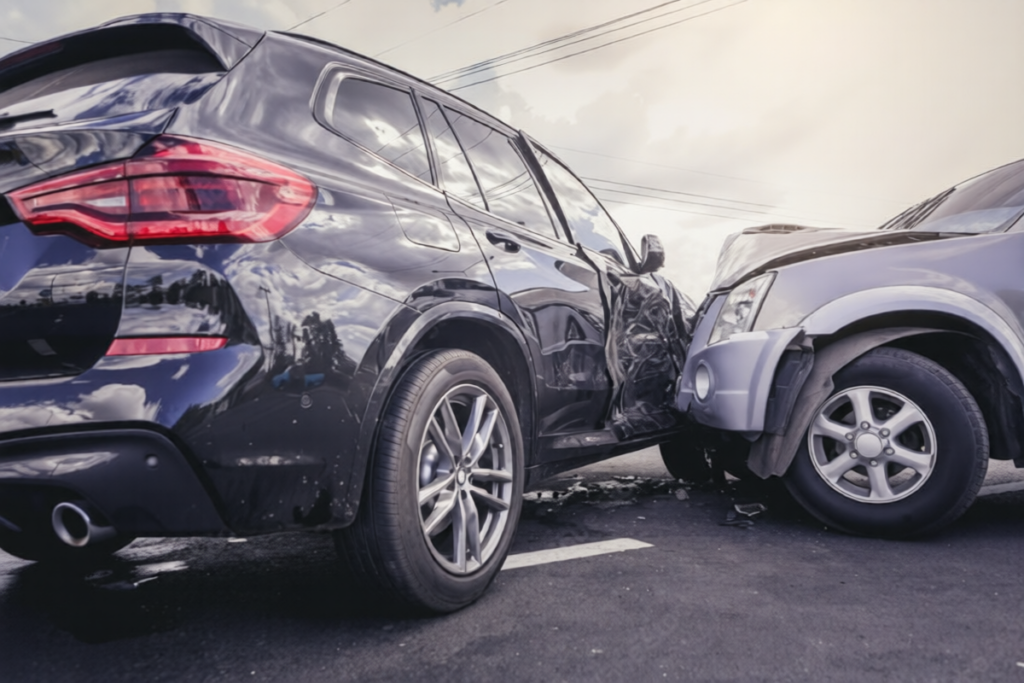

An Uber crash isn’t just a car accident with an app attached. Four distinct legal complications stack on top of each other in these cases, tiered insurance coverage, New York’s no-fault threshold, a brand-new fault rule that can bar recovery entirely, and a genuine, currently unresolved legal fight over whether Uber drivers are even employees or independent contractors.
Understanding how these pieces interact is the difference between a claim that gets undervalued and one that’s built correctly from the start.
Prior results do not guarantee a similar outcome.
Why Does Coverage Depend on the Driver’s App Status?
New York sets three distinct insurance tiers for rideshare drivers under Vehicle and Traffic Law Section 1693, and proving which one applied at the moment of your crash is often the first real fight in these cases.
App Status | Required Coverage |
|---|---|
App off | Only the driver’s personal policy, often excluded for commercial use |
App on, waiting for a request | At least $75,000 per person / $150,000 per accident |
Active trip, en route or transporting a passenger | At least $1,250,000 per occurrence |
The practical problem is that the data proving which tier applied, exact login timestamps, trip acceptance records, GPS status, generally exists only in Uber’s own systems.
You’re not just proving what happened in the crash. You’re proving what the app was doing, using records you don’t control and have to formally request.
How Does New York’s No-Fault System Change What You Can Recover?
Your own insurance covers your initial medical bills and lost wages regardless of fault, but to sue for pain and suffering beyond that, you need to meet the “serious injury” threshold under Insurance Law Section 5102(d).
This threshold got narrower in 2026: the category covering a non-permanent injury that prevented normal activities for 90 of the first 180 days was eliminated, closing off a path some claimants used to previously rely on.
Whatever category you’re pursuing now needs to be supported by real medical documentation from the outset.
What Changed With New York’s 2026 Fault Reform?
This is genuinely current, and it applies to rideshare cases with real force. For motor vehicle actions commenced on or after May 26, 2026, a new subsection added to CPLR 1411 bars recovery entirely if a claimant’s fault is greater than the combined fault of the people they’re suing.
Before this, New York reduced damages by your share of fault but never cut off recovery at any percentage.
What makes this particularly worth understanding in the rideshare context is that it doesn’t only affect the driver being sued.
A passenger or a pedestrian struck by a rideshare vehicle is also a claimant under a motor vehicle action, and if fault gets allocated in a way that puts more of it on them than on the defendants combined, even someone who wasn’t driving at all can be barred from recovering.
Is an Uber Driver an Employee or an Independent Contractor?
This is genuinely unsettled in New York right now, and it matters enormously because it determines whether Uber itself can be held responsible for a driver’s negligence, not just the driver personally.
Uber has long classified its drivers as independent contractors specifically to avoid this kind of vicarious liability.
That position was tested directly in Rawlins v. Myint, a Brooklyn case where a passenger was injured when the car she was riding in was struck by an Uber driver logged into the app.
After the driver himself was already found liable, the case went to a jury trial in June 2026 specifically on the question of whether Uber was also vicariously liable, which turned entirely on whether the driver was Uber’s employee or an independent contractor.
The court rejected Uber’s request for a directed verdict in its favor, holding that question belonged with the jury rather than being decided as a matter of law.
What this means practically is that identifying and preserving evidence of Uber’s actual control, its compliance enforcement, vehicle standards, and platform access conditions, can matter as much as the crash itself.
Does Uber’s Arbitration Clause Affect Your Case?
It can, and this is a detail almost no one thinks about until it’s already a problem. Uber’s Terms of Use include a mandatory arbitration clause and a class action waiver, meaning disputes are often required to go through private arbitration instead of a courtroom.
Whether that clause is actually enforceable has split federal courts. In Meyer v. Uber Technologies, the Second Circuit, whose rulings control in New York, upheld Uber’s arbitration clause, finding the app’s registration screen clean and readable enough to give users reasonable notice of what they were agreeing to.
The First Circuit reached the opposite conclusion in a separate case, Cullinane v. Uber Technologies, involving a different version of the app, finding the hyperlink to the terms too inconspicuous to count as real notice.
The outcome in both cases turned on granular details of app screen design at the moment of signup, which illustrates something important: whether you signed up for Uber years ago under an older app version, or more recently, can genuinely affect whether an arbitration clause applies to your situation at all.
What Should You Do to Protect Your Claim?
Given how many of these issues turn on data and records Uber controls, moving quickly matters more here than in an ordinary car accident case.
Request and preserve trip data, app screenshots, and driver information as early as possible.
Get a police report and document the scene the same way you would after any crash. And get medical treatment promptly and consistently, since the narrowed serious injury threshold gives insurers more room to argue a claim doesn’t qualify than it used to.
What Are the Key Deadlines in a New York Uber Accident Case?
Situation | Deadline | Rule |
|---|---|---|
Claim against the driver or Uber | 3 years from the date of the crash | |
No-fault claim for initial medical bills and lost wages | 30 days to file with your own insurer | Insurance Law Article 51 |
Notice of claim if a government vehicle was involved | 90 days |
Summing It Up
An Uber accident claim in New York carries four layers most ordinary car accident cases don’t: proving which insurance tier applied, meeting a narrowed serious injury threshold, navigating a fault rule that can now bar recovery entirely, and, in many cases, litigating whether Uber bears any responsibility at all for its driver’s conduct.
None of this makes these cases impossible, but it does mean the evidence gathered in the first days after a crash matters more than most people realize.
Porter Law Group has built its reputation on trial-tested representation for injured New Yorkers, and our attorneys work on a contingency fee basis, meaning you pay nothing unless we win.
If you’ve been hurt in an Uber accident, reach out to discuss what happened and what your legal options look like.
Call 833-PORTER9 or email info@porterlawteam.com to schedule a free consultation.
Prior results do not guarantee a similar outcome.
Frequently Asked Questions
Can Uber be held responsible for its driver’s negligence, or just the driver personally?
It depends on whether the driver is legally an employee or an independent contractor, a question New York courts are actively litigating right now. In Rawlins v. Myint, a Brooklyn court sent that exact question to a jury rather than accepting Uber’s independent contractor classification automatically.
Does Uber’s arbitration clause mean I can’t sue in court?
It might, depending on when and how you signed up. Federal courts are split on whether Uber’s arbitration clause is enforceable, and in New York, which follows the Second Circuit’s Meyer v. Uber decision, it has generally been upheld, though the outcome can depend on the specific app version and registration screen you encountered.
Did New York’s serious injury threshold change recently?
Yes. A May 2026 reform eliminated the category covering a non-permanent injury that prevented normal activities for 90 of the first 180 days, narrowing the paths available to sue for pain and suffering beyond your no-fault benefits.
Can I lose my case entirely if I was partly at fault?
Possibly, under New York’s 2026 comparative negligence reform. For motor vehicle cases commenced on or after May 26, 2026, being found more at fault than the people you’re suing, combined, can bar recovery entirely, and this can affect passengers and pedestrians, not just drivers.
How much does an Uber accident lawyer cost in New York?
Most plaintiff-side personal injury attorneys, including Porter Law Group, work on a contingency fee basis. You pay nothing upfront, and there is no fee unless the firm recovers compensation on your behalf.
This article is for informational purposes only and does not constitute legal advice. Attorney advertising. Prior results do not guarantee similar outcomes.