
In the high-risk environment of construction, certain hazards are not only common but consistently deadly. The Occupational Safety and Health Administration (OSHA) has identified four types of accidents that cause the majority of construction-related fatalities each year: falls, struck-by incidents, electrocutions, and caught-in/between accidents.
Prior results do not guarantee a similar outcome.
These incidents, known as the “Fatal Four,” account for nearly 60% of all construction worker deaths annually. Because of this, they are top priorities for safety regulations, training programs, and—when things go wrong—legal claims for injury and wrongful death.
Understanding these deadly hazards is essential for everyone connected to the construction industry, from workers, site supervisors, and safety officers to project managers and even company owners. Each of the Fatal Four presents its own unique dangers and requires specific safety protocols to prevent tragedy. Despite OSHA standards and ongoing efforts to improve workplace safety, these hazards continue to claim hundreds of lives and cause thousands of serious injuries every year.
This harsh reality makes prevention efforts critical—but when safety measures fail, injured workers and grieving families may have the right to seek legal compensation for negligence or violations of workplace safety laws. If your accident involved specific OSHA violations, you may have additional legal options — learn about suing when OSHA safety violations caused your accident.
Why Choose The Porter Law Group for Fatal Four Construction Accidents
When construction accidents occur due to the OSHA Fatal Four hazards, the resulting injuries are often catastrophic or fatal, leaving victims and families facing overwhelming medical, financial, and emotional challenges. The Porter Law Group brings specialized expertise in New York construction accident law, with particular focus on cases involving falls, struck-by incidents, electrocutions, and caught-in/between accidents—the very hazards that OSHA identifies as most deadly.
What sets The Porter Law Group apart is our comprehensive understanding of the complex regulatory framework governing construction safety in New York, including OSHA regulations, New York Labor Law, and industry-specific safety standards. Our attorneys meticulously investigate Fatal Four accidents to identify all potentially liable parties, from general contractors and property owners to equipment manufacturers and subcontractors. We have secured substantial verdicts and settlements for construction workers injured by these deadly hazards, and we encourage you to view the results we’ve achieved for previous clients. Our commitment to injured construction workers extends beyond legal representation—we fight to ensure that victims receive full compensation while also advocating for improved safety standards to prevent future tragedies.
1. Falls: The Leading Cause of Construction Fatalities
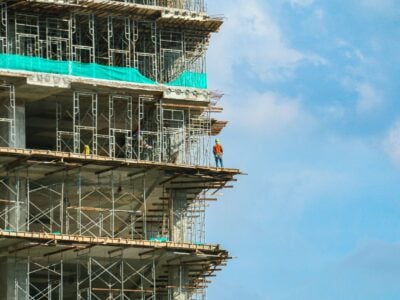
Falls continue to be the deadliest hazard in construction, accounting for 39.2% of all industry fatalities in 2023—a staggering 421 deaths. These fatal accidents often involve:
- Falls from heights: Working on scaffolding, rooftops, ladders, or other elevated platforms
- Falls through openings: Unprotected floor holes, skylights, or incomplete decking
- Falls from ladders or stairways: Due to improper placement, faulty equipment, or lack of training
- Falls from machinery or vehicles: When workers climb on or off construction equipment without proper access points
According to the 2023-2024 data, falls from heights between 6 and 30 feet caused 260 deaths, while portable ladders and stairs were involved in 109 fatalities. These numbers highlight how even relatively short falls can be fatal.
Recent Trends and Statistics
Falls remain the #1 most cited OSHA violation, with 6,557 citations and over $48 million in penalties issued in FY2024, Still, there has been some improvement: OSHA reported a 20% decline in fatal falls in FY2024 (189 deaths, down from 234 the previous year 2023). This reduction is attributed to increased enforcement and expanded use of fall protection systems.
Prevention Strategies
Under OSHA rules, fall protection is mandatory at elevations of 6 feet or higher in construction. Key prevention methods include:
- Guardrail systems: Physical barriers that block workers from falling off edges or through openings
- Safety net systems: Positioned below elevated work areas to catch falls
- Personal fall arrest systems: Harnesses, lanyards, and anchor points that stop falls or reduce fall distance
- Fall protection training: Instruction on how to properly use equipment and recognize fall hazards
States that invest in robust safety training programs have seen fall-related deaths drop by up to 15%, proving that education and enforcement save lives.
Legal Implications
New York’s “Scaffold Law” (Labor Law §240) offers strong legal protections for construction workers injured in gravity-related accidents. This law imposes absolute liability on contractors and property owners who fail to provide proper fall protection. That means injured workers may have a powerful legal claim in addition to workers’ compensation.
If you or a loved one has suffered a fall-related injury on a construction site in New York, the Porter Law Group can help. We understand the complex legal landscape surrounding falls, including both workers’ compensation and third-party liability claims under New York’s unique labor laws. Our expertise in fall-related construction accidents can make a crucial difference in securing the compensation you deserve.
2. Struck-By Incidents: Unexpected and Deadly Impacts
Struck-by incidents occur when a worker is hit by a moving object, piece of equipment, or vehicle, often with devastating results. In 2023, these accidents were responsible for approximately 8% of construction fatalities (around 86 worker deaths). Struck-by injuries are typically classified into four major categories:
- Struck by flying objects: Tools, debris, or materials propelled through the air
- Struck by falling objects: Items dropped from ladders, scaffolds, or structures above
- Struck by swinging objects: Loads shifting or swinging while being hoisted by cranes or mechanical lifts
- Struck by rolling or sliding objects: Construction vehicles, heavy machinery, or unsecured materials moving unexpectedly
Transportation-related incidents, which often involve struck-by vehicles, accounted for 22.3% of workplace fatalities across all industries in 2023.
Recent Trends and Statistics
In FY2024, OSHA issued 2,681 citations related to ladder safety violations, many linked to struck-by risks from falling ladders or workers carrying unsecured tools. However, there have been modest improvements: the adoption of high-visibility clothing and better rigging procedures has reduced incidents in highway and roadside construction zones. Still, these accidents remain a major concern across all job sites.
Prevention Strategies
Preventing struck-by injuries requires a combination of equipment protocols, visibility enhancements, and site controls. Key safety measures include:
- Protective barriers and fencing: To physically separate workers from active machinery or traffic
- High-visibility clothing: Ensuring workers can be seen clearly by vehicle and equipment operators
- Tool tethering: Securing hand tools when working at heights to prevent drops
- Proper storage and securing of materials: Preventing objects from tipping, rolling, or falling unexpectedly
- Backup alarms and human spotters: Assisting with safe movement of large machinery and vehicles
Legal Implications
Struck-by incidents often involve multiple responsible parties, such as equipment manufacturers, subcontractors, or third-party vendors operating on construction sites. Determining who is liable often requires a comprehensive investigation into site conditions, supervision, equipment safety, and communication protocols.
If you or someone close to you has been injured in a struck-by incident on a construction site, contact The Porter Law Group immediately. Our thorough investigative approach can identify all potentially liable parties, helping to secure maximum compensation for your injuries while holding all responsible parties accountable.
3. Electrocutions: Invisible but Deadly Hazards
Electrocutions are among the most silent yet fatal hazards in construction, accounting for about 8% of construction-related deaths in 2023—approximately 86 fatalities. These incidents are often sudden and can be caused by:
- Contact with overhead power lines: When equipment, ladders, or materials come into contact with energized wires
- Exposure to live electrical sources: Damaged wiring, malfunctioning tools, or open electrical panels
- Improper use of cords: Overloaded extension cords, frayed wiring, or inadequate grounding
- Lightning strikes: May occur during outdoor work in thunderstorms
- Lack of ground-fault protection: Missing or defective Ground Fault Circuit Interrupters (GFCIs)
Across all industries in 2023, electrocutions were part of a broader category—exposure to harmful substances and environments—which accounted for 18.6% of workplace fatalities (200 deaths).
Recent Trends and Statistics
The 2024 data shows promising progress: the use of GFCIs and improved lockout/tagout protocols led to a 12% reduction in electrocution incidents on utility-related construction projects. OSHA’s enforcement of double-insulated tools and proper clearance from overhead lines has also contributed to a decline in fatal electrical accidents.
Prevention Strategies
Reducing electrocution risk starts with rigorous safety protocols and site awareness. Key prevention measures include:
- Lockout/Tagout procedures: Ensuring all machinery and circuits are fully de-energized before repair or maintenance
- Ground-fault circuit interrupters (GFCIs): Devices that automatically shut off electrical power when a ground fault is detected
- Proper grounding: Verifying that all electrical systems and tools are properly grounded
- Safe distances from power lines: Keeping equipment and workers at least 10 feet away from live lines
- Insulated tools and protective gear: Using only rated tools and PPE to handle electrical components safely and minimize electrical risks
Legal Implications
Electrocution cases often involve complex liability questions. Depending on the circumstances, responsible parties may include:
- Electrical contractors
- General contractors
- Property owners
- Equipment manufacturers
- Utility companies
These cases frequently require expert testimony to determine exactly how the electrocution occurred and which safety violations contributed to the incident.
Have you or a family member suffered an electrical injury on a construction site? The Porter Law Group has the specialized knowledge needed to handle these technically complex cases, working with electrical engineering experts to identify code violations and establish liability while fighting for the full compensation you need for medical treatment, lost income, and pain and suffering.
4. Caught-In/Between Accidents: Crushing Dangers
Caught-in/between accidents occur when a worker is trapped, crushed, or compressed between objects or machinery. These incidents accounted for approximately 5% of all construction fatalities in 2023—resulting in 54 worker deaths. This category includes:
- Trench collapses: When unprotected trenches cave in, burying workers
- Equipment rollovers: Workers pinned under overturned vehicles or machinery
- Caught in rotating equipment: Clothing, hair, or body parts pulled into unguarded machinery
- Caught between moving and stationary objects: Workers crushed between equipment and structures such as a backing truck or a wall
- Cave-ins during excavation: Collapsing soil, rock, or debris falling onto workers
Trench collapses alone resulted in 15 fatalities in 2023, a decline from 39 deaths in 2022—showing progress, but not enough to eliminate the threat.
Recent Trends and Statistics
In 2024, data shows significant improvement in trench safety, with only 12 trench-related fatalities reported by November—a 70% drop since 2022. This decline is credited to OSHA’s “zero tolerance” enforcement policy, which led to:
- 1,200 trench inspections nationwide
- Multiple criminal referrals for companies violating trench safety regulations
These numbers reflect the life-saving impact of aggressive enforcement and increased awareness.
Prevention Strategies
Caught-in/between incidents can often be avoided with proactive safety systems, clear communication, and strict compliance. Key prevention strategies include:
- Trench protection systems: Use of sloping, shoring, or trench boxes for excavations deeper than 5 feet
- Machine guarding: Installing physical barriers around moving parts to prevent entanglement
- Equipment operator training: Ensuring that all heavy equipment operators are trained and certified
- Clear worksite communication: Confirming that all crew members are accounted for before starting or moving machinery
- Routine inspections: Checking equipment and excavation sites daily to catch potential hazards early
Legal Implications
Caught-in/between incidents often lead to catastrophic injuries or fatalities, and liability may extend beyond the employer. These cases frequently involve:
- OSHA violations, particularly in trenching, excavation, or machine guarding
- Multiple responsible parties, including subcontractors, site managers, or equipment manufacturers
- Opportunities for third-party liability claims, in addition to workers’ compensation
If someone you love has been injured or killed in a caught-in/between accident on a construction site, reach out to the Porter Law Group for compassionate, knowledgeable legal guidance. Our attorneys understand the devastating impact of these accidents and will fight relentlessly to secure the compensation your family needs while holding negligent parties accountable for safety failures.
Overall Fatality Trends and Industry Responses
In 2023, the construction industry recorded 1,075 worker fatalities, maintaining levels near a 12-year high despite progress in certain risk categories. Federal OSHA documented 826 deaths across all industries in FY2024—an 11% decrease from FY2023—indicating that targeted enforcement and safety education are beginning to yield results.
OSHA’s National Emphasis Programs (NEPs) on falls and trench safety have been especially impactful. In states with their own OSHA plans, these initiatives have led to an estimated 15% reduction in fatalities. Meanwhile, the top OSHA citations in 2024 closely mirrored the Fatal Four hazards:
- Fall protection (6,557 citations)
- Ladder safety (2,681 citations)
- Electrical wiring methods (1,890 citations)
Training remains a critical factor in reducing accidents. Companies that implemented the OSHA 30-Hour Certification program reported 34% fewer incidents compared to those without structured training.
Reach out to our experienced team for a free consultation and explore your options for compensation.
How The Porter Law Group Helps Fatal Four Accident Victims
At Porter Law Group, we offer comprehensive legal representation for workers and families affected by Fatal Four accidents, combining legal strategy, technical expertise, and compassionate support. Our services include:
- Thorough accident investigations: Gathering documentation, witness statements, and regulatory records to uncover all safety violations and responsible parties
- Expert witness coordination: Collaborating with safety engineers, medical specialists, and construction experts to build a strong, fact-based case
- Maximum compensation pursuit: Seeking damages for medical expenses, lost wages, pain and suffering, future care needs, and wrongful death claims
- Third-party liability claims: Identifying claims beyond workers’ compensation against property owners, contractors, and equipment manufacturers
- New York Labor Law expertise: Leveraging New York’s protective labor laws (especially §240 and §241) to secure additional compensation
Our team combines deep knowledge of OSHA regulations, New York labor laws, and construction site safety practices to aggressively advocate for those injured by preventable accidents. We not only fight for fair compensation, we help drive industry change by holding negligent parties accountable.
Contact A New York Construction Accident Lawyer
If you or a loved one has suffered injuries from one of the OSHA Fatal Four hazards on a construction site, The Porter Law Group is ready to fight for your rights. Construction accident cases involving falls, struck-by incidents, electrocutions, or caught-in/between accidents often involve complex liability questions and require specialized legal knowledge that general practice firms may lack.
The Porter Law Group works on a contingency fee basis, meaning there are no upfront costs to you, and we only collect fees if we win your case. This arrangement ensures that quality legal representation is accessible regardless of your financial circumstances, while aligning our interests with yours—securing the maximum possible recovery for your injuries.
Don’t face the aftermath of a construction accident alone. Contact The Porter Law Group today at 833-PORTER9, or email info@porterlawteam.com for a free consultation. Let our experienced team of construction accident attorneys help you navigate this difficult time and secure the compensation you deserve while holding negligent parties accountable for safety failures.