

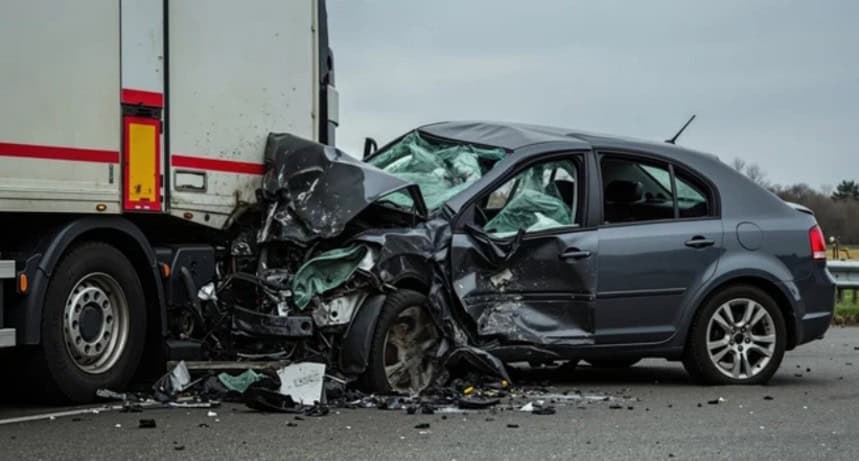
If you or a loved one was seriously injured in a collision with a semi-truck in New York, the road to recovery is harder than most people expect. Semi-truck accident settlements in New York can range from $100,000 for moderate injuries to over $5 million in catastrophic cases. These are not ordinary crashes. A semi-truck is made up of a cab connected to a large trailer, and that design creates dangers that smaller vehicles simply do not have. On wet or icy roads, the trailer can swing outward and sweep across multiple lanes in seconds. Other drivers cannot avoid it. According to the Federal Motor Carrier Safety Administration (FMCSA), large trucks were involved in over 5,900 fatal crashes nationwide in a single recent year. The Insurance Institute for Highway Safety (IIHS) reports that in most semi-truck crash deaths, it is the occupants of passenger vehicles, not the truck, who are killed. If this happened to your family, you deserve to know your options.
Prior results do not guarantee a similar outcome.
Why Choose Porter Law Group for Your Semi-Truck Accident Case?
Semi-truck claims are more complicated than standard car accident cases. The chain of responsibility can extend from the driver to the trucking company, cargo shipper, freight broker, and vehicle manufacturer. Proving what went wrong requires building a case around federal safety compliance, electronic data, and corporate records that defense teams work to control from the moment a crash is reported.
Porter Law Group has recovered more than $500 million for injured clients since 2009, including a $5.7 million settlement in a commercial trucking case where driver logbook violations established the company’s negligence. Led by Harvard-educated attorney Michael S. Porter, a former U.S. Army JAG Corps Captain with over 20 years of trial experience, the firm has a track record of results far beyond initial insurance offers. All eight attorneys have been selected to Super Lawyers or Rising Stars, a distinction earned by fewer than 5% of New York attorneys.

REQUEST A NO-OBLIGATION CASE REVIEW
Why Are Semi-Truck Accidents So Much More Dangerous?
The size and design of semi-trucks create hazards that do not apply to regular cars or even smaller commercial vehicles. Understanding what went wrong in your crash is the first step toward building a strong case.
The trailer can jackknife. The connection between the cab and trailer allows both parts to pivot independently. If the driver brakes hard on slippery pavement, or if the cargo inside was not loaded evenly, the trailer can swing out at a sharp angle, crossing multiple lanes at once. Drivers around the truck have almost no time to react. On New York corridors like I-90, I-81, and I-87, this is especially common during winter months.
They need much more room to stop. A fully loaded semi-truck weighing 80,000 pounds needs roughly 525 feet to come to a full stop at 65 mph. A passenger car needs about 300 feet at the same speed. That difference matters enormously. A truck driver who is tailgating, distracted, or fatigued even for a second or two may have no physical ability to stop in time.
Uneven cargo causes rollovers. When cargo is not loaded or secured properly, it can shift while the truck is moving. This throws off the vehicle’s balance and greatly increases the chance of a rollover, particularly on highway curves and exit ramps. When this happens, responsibility may not fall only on the driver. The company that loaded the cargo may share the blame.
Underride crashes are often fatal. When a smaller car slides under the side or rear of a trailer, the roof of the car is often sheared off completely. These crashes almost always cause catastrophic head and neck injuries, or death. Rear underride guards are required by federal safety rules, but side guards remain voluntary despite causing a significant share of these fatalities.
Who Can Be Held Responsible for a Semi-Truck Accident?
One of the biggest differences between a semi-truck crash and a regular car accident is that multiple parties can share legal responsibility. That matters because each responsible party typically carries separate insurance coverage, and commercial truck policies in New York range from $750,000 to $5 million or more. Identifying all of them can significantly increase the total compensation available to you.
| Who May Be Liable | Why They May Be Responsible | Key Evidence |
| The truck driver | Fatigued, distracted, or reckless driving | Trip data recorder, drug/alcohol test, phone records |
| The trucking company | Poorly trained driver, skipped inspections, pressure to exceed drive time | Hiring records, maintenance logs, scheduling records |
| The cargo loader or shipper | Improperly loaded or unsecured cargo | Loading records, weight documents |
| The freight broker | Selected a carrier with a known safety record problem | Carrier contract, safety history |
| The trailer or parts manufacturer | Defective brakes, coupling, or underride guard | Product defect records, recall history |
| A government entity | Dangerous road conditions or missing signage | Prior complaints, government records (90-day notice deadline applies) |
In New York, fault is divided among all responsible parties based on their share of responsibility. You can still recover compensation even if you were partially at fault, though your amount is reduced by your percentage.
Learn more about third-party liability in truck accidents.
What Compensation Can You Recover After a Semi-Truck Accident?
After a semi-truck accident, you may be entitled to two main categories of compensation:
Economic damages cover your real financial losses: emergency room treatment, surgery, physical therapy, follow-up care, and any ongoing medical needs. If you missed work during recovery, or if your injuries prevent you from returning to the same job or earning the same income, those losses are included too. Catastrophic injuries are common in semi-truck crashes. Spinal cord injuries can require lifetime care that runs into the millions. Severe brain injuries and serious burns are similarly devastating financially.
Non-economic damages cover the human impact of your injuries beyond the bills. This includes physical pain and suffering, emotional distress, permanent scarring or disfigurement, and the loss of ability to enjoy life the way you once did. New York places no cap on these damages in personal injury cases, which means compensation can reflect what you actually went through, not an arbitrary limit.
Wrongful death claims apply when someone is killed in a semi-truck crash. Surviving family members can seek compensation for lost future income, loss of guidance and companionship, and funeral expenses. These settlements typically range from $1 million to $10 million or more depending on the circumstances.
In cases where a trucking company knowingly violated safety rules, falsified driver records, or pressured drivers to stay on the road past safe limits, punitive damages may also be on the table.
FIND OUT WHAT YOUR SEMI-TRUCK ACCIDENT CASE IS WORTH →
Why Choose Porter Law Group for Your Semi-Truck Accident Case?
Case Results
$5,700,000 Settlement: A 52-year-old man suffered a leg amputation in a commercial trucking accident. Porter Law Group established liability through driver logbook violations and secured a settlement covering lifetime prosthetic costs and lost earning capacity.
$3,400,000 Jury Verdict: A 40-year-old man sustained a traumatic brain injury in a truck collision. The insurer offered $100,000 before trial. Porter Law Group secured $3.4 million, 34 times the pre-trial offer.
Porter Law Group’s published results include more than 50 cases at or above $1 million, anchored by a $17.8 million settlement and a $13.5 million jury verdict.
Every case is different. Past results do not guarantee future outcomes.
How Long Do You Have to File a Claim in New York?
Most injured victims have three years from the date of the accident to file a lawsuit in New York. But in semi-truck cases, waiting is risky because critical evidence disappears long before that deadline arrives.
The truck’s electronic data recorder can be overwritten within 30 days. The trucking company may repair or scrap the vehicle. Dispatch logs and internal communications may be deleted during routine data purges. If a road defect or malfunctioning traffic signal contributed to the crash, a formal notice must be submitted to the relevant government entity within 90 days, or you may lose the right to pursue that part of your claim. Wrongful death claims have a two-year deadline from the date of death.
Acting quickly is not just a good idea. It can be the difference between a strong case and no case at all.
Learn more about truck accident evidence and how it is preserved.
Semi-truck crashes leave you facing serious injuries, mounting bills, and a trucking company already working against you.
What to Do After a Semi-Truck Accident in New York
1. Call 911 and record the truck’s identifying information. Ask the responding officer to document the driver’s commercial license number, the trucking company’s name, and the federal ID numbers displayed on the truck cab door. Also ask them to note any visible problems such as unsecured cargo, damaged tires, or leaking fluids.
2. Photograph everything at the scene. Capture the truck’s company name and ID numbers, the license plates on both the cab and trailer, the damage to both vehicles, skid marks, road conditions, and any spilled or shifted cargo.
3. Get medical attention within 24 hours. Serious injuries from truck collisions, including internal bleeding and brain trauma, do not always show up immediately. Getting evaluated the same day also creates a medical record that ties your injuries directly to the crash.
4. Do not give a statement to the trucking company. Trucking companies often send representatives to the crash scene or hospital within hours. They may seem cooperative, but their goal is to protect the company. Do not sign anything or answer detailed questions without speaking to a lawyer first.
5. Contact a semi-truck accident lawyer as soon as possible. An attorney can send formal legal notices requiring the trucking company to preserve all records right away, before anything is erased, overwritten, or destroyed.
GET A FREE CASE REVIEW: CALL (833) PORTER-9 →
Semi-Truck Accident Lawyer Near You in New York
Porter Law Group represents semi-truck accident victims throughout New York State, from high-volume freight routes on I-81, I-90, and I-87 to commercial corridors across the five boroughs. Headquartered in Syracuse with a statewide practice, the firm handles semi-truck accident claims in every county and jurisdiction in New York.
Semi-Truck Accident Lawyer in New York City, Syracuse, Buffalo, Rochester, Albany, Yonkers, White Plains, Utica, Binghamton, Long Island
Call (833) PORTER-9 to speak with an experienced semi-truck accident attorney who understands the local courts, trucking routes, and safety regulations that apply to your case.
Frequently Asked Questions About Semi-Truck Accidents in New York
How much is a semi-truck accident settlement worth in New York?
It depends on the severity of your injuries, your medical costs, lost income, and how many parties are at fault. Settlements for moderate injuries often start around $100,000. Cases involving catastrophic injuries such as spinal cord damage or traumatic brain injuries can reach several million dollars, and wrongful death claims regularly exceed $2 million. Your compensation may be reduced if you are found to have contributed to the crash, but it is not eliminated.
Can I sue the trucking company directly?
Yes. Trucking companies are legally responsible for their drivers’ actions while on the job. They can also face direct blame for things like failing to properly train a driver, ignoring required vehicle inspections, or pushing drivers to stay on the road past safe driving limits.
What causes most semi-truck accidents in New York?
Driver fatigue, distracted driving, brake failure, improper cargo loading, and speeding are the most common causes. Fatigued driving plays a role in a significant number of large truck crashes nationwide. Brake problems are the most frequently cited mechanical issue. Improperly loaded cargo creates instability that leads to jackknife and rollover events, especially in wet or icy conditions common across New York State.
What evidence matters most in a semi-truck accident case?
The truck’s electronic trip data, the driver’s qualification and work history file, vehicle maintenance records, and internal company communications are among the most important. This data can be overwritten or deleted within weeks of a crash, which is why reaching out to a lawyer quickly is so important. Read more about black box and electronic trip data in truck accident cases.
What is the difference between a semi-truck and an 18-wheeler?
The terms are often used interchangeably. A semi-truck refers to the cab and trailer combination, while “18-wheeler” refers to the number of wheels on the vehicle. For legal and insurance purposes, both are treated the same way. The important factor is the vehicle’s weight, which determines which federal safety rules apply and who can be held responsible.
What Clients Say About Porter Law Group
Meet the Attorney

Michael S. Porter, J.D.
Michael S. Porter, J.D. Founder and managing partner of Porter Law Group. Harvard University (B.A., 1994), Syracuse University College of Law (J.D., 1997). Former U.S. Army JAG Corps Captain, Airborne Training School graduate. Super Lawyers recognition for 14 consecutive years, 10.0 rating on Avvo, Distinguished rating from Martindale-Hubbell. Over 20 years of trial experience and $500 million in recoveries for injured clients throughout New York.
Reviewed by Michael S. Porter, J.D. | Last updated: [April, 2026]
Contact Porter Law Group Today
Semi-truck crashes cause life-changing injuries, and key evidence like electronic trip data and dashcam footage can be permanently lost within days. Contact Porter Law Group at (833) PORTER-9 for a free, no-obligation consultation. We work on a contingency-fee basis, so you pay nothing unless you win.
Phone: +1 833-767-8379
Email: info@porterlawteam.com
Monday to Friday: 8 AM to 5 PM | Saturday and Sunday: Closed