
Improperly loaded cargo truck accident settlements in New York typically range from $100,000 to over $5 million depending on injury severity, with wrongful death claims regularly exceeding $2 million. Federal cargo securement standards under 49 CFR Part 393, Subpart I require that all cargo on commercial vehicles be secured to prevent shifting, falling, or spilling during transit. When cargo shifts inside a trailer, it changes the truck's center of gravity mid-drive, causing rollovers, jackknife events, and loss of vehicle control. When cargo falls off the truck, it creates road debris hazards that cause multi-vehicle pileups. New York's pure comparative negligence law (CPLR §1411) allows injured victims to recover compensation from the truck driver, carrier, cargo shipper, and loading company.
Settlement
Jury Verdict
Settlement
Settlement
Improper loading claims require knowledge of federal cargo securement standards that most personal injury attorneys do not possess. Porter Law Group has recovered more than $500 million for injured clients since 2009, with published jury verdicts showing 20x to 34x multipliers over pre-trial offers. Led by Harvard-educated attorney Michael S. Porter, a former U.S. Army JAG Corps Captain with over 20 years of trial experience, the firm retains engineers who analyze cargo weight distribution, securement device specifications, tie-down working load limits, and post-crash cargo position to prove exactly how the improper loading caused the accident. Seven of eight attorneys are recognized by Super Lawyers, a distinction earned by fewer than 5% of New York attorneys.
"Improper loading cases are about what happened at the loading dock, not what happened on the highway. The crash is the consequence. The negligence occurred hours or days earlier when someone stacked the cargo too high, skipped the tie-downs, or loaded all the weight on one side of the trailer. We trace the chain of custody from the loading facility to the crash scene, and every party that touched that cargo is a potential defendant." Michael S. Porter, J.D., Porter Law Group

REQUEST A NO-OBLIGATION CASE REVIEW
These two violations are related but legally distinct. A truck can be within the 80,000-pound federal weight limit and still have improperly loaded cargo that causes a crash.
| Factor | Overloaded Truck | Improperly Loaded Cargo |
| The violation | Total weight exceeds 80,000 lb federal limit or axle weight limits | Cargo is unsecured, unevenly distributed, stacked too high, or improperly tied down |
| Federal regulation | 23 U.S.C. §127, 49 CFR Part 658 | 49 CFR Part 393, Subpart I (securement standards) |
| Can occur at legal weight? | No (by definition, weight exceeds the limit) | Yes (a 60,000-lb load can be improperly distributed or unsecured) |
| Primary crash risk | Increased stopping distance, tire failure, brake fade | Cargo shift causing rollover, jackknife, or road debris |
| Key evidence | Weight tickets, weigh station records, bills of lading | Cargo securement inspection reports, tie-down specs, post-crash cargo position photos |
| Primary liable party | Shipper (determined load weight) | Loader (physically placed and secured cargo on trailer) |
Learn more about overloaded truck accidents.
Cargo shift during turns and braking is the most common consequence. When cargo is not properly secured with chains, straps, or blocking/bracing, it slides to one side of the trailer during a curve or moves forward during braking. This sudden weight transfer changes the truck's center of gravity and pulls the vehicle in the direction of the shifted load, causing rollover accidents on curves and jackknife events during sudden braking.
Cargo falling from the truck creates road debris that causes chain-reaction crashes. Lumber, steel, gravel, construction materials, and consumer goods that fall from flatbed trucks, dump trucks, and open trailers strike following vehicles or force drivers to swerve into adjacent lanes. 49 CFR §393.100 requires that all cargo be contained, immobilized, or secured so it cannot leak, spill, blow off, fall from, or shift upon the vehicle.
Top-heavy stacking raises the center of gravity. Loading heavy items on top of lighter items, or stacking pallets above the trailer's sidewall height, moves the truck's center of gravity upward and makes the vehicle unstable during routine maneuvers. Tanker trucks face a related problem: partially filled tanks allow liquid cargo to slosh and surge during turns, creating the same center-of-gravity shift that solid cargo stacking produces.
Uneven side-to-side weight distribution creates unequal braking forces. When 70% of the cargo weight sits on the left side of the trailer and only 30% on the right, the left-side tires carry more load, the left-side brakes work harder, and the truck pulls to the left during braking. On a highway curve, this imbalance can tip the truck toward the heavy side.
The cargo loader bears primary liability for securement failures. The person or company that physically placed cargo on the trailer and secured it with tie-downs, chains, straps, or blocking is responsible for ensuring compliance with 49 CFR Part 393, Subpart I. This includes selecting securement devices with adequate working load limits, applying the correct number of tie-downs for the cargo type and weight, and distributing weight evenly across the trailer. Third-party warehouses and loading docks that load trucks bear independent liability separate from the carrier.
The cargo shipper shares liability for packaging and load planning. The company that packed the cargo and created the loading plan is responsible for ensuring the cargo can be safely transported. A shipper that packs fragile items without adequate bracing, that specifies a loading configuration that places heavy items on top, or that fails to communicate the cargo's weight distribution requirements to the loader bears independent negligence. Learn more about third-party liability.
The trucking company bears liability for inspection failures. CDL drivers are required to conduct pre-trip inspections that include verifying cargo securement under 49 CFR §392.9. The carrier is responsible for training drivers on cargo inspection and for maintaining securement equipment (straps, chains, binders). A carrier that pressures drivers to skip pre-trip inspections or that provides worn or defective securement equipment is directly negligent. Learn more about trucking company negligence. | Learn more about trucking company liability.
The truck driver shares fault for failing to verify securement. Federal regulations require drivers to inspect cargo securement within the first 50 miles of the trip and every 150 miles or 3 hours thereafter (49 CFR §392.9). A driver who accepted an improperly loaded trailer without checking, or who noticed shifted cargo and continued driving, has breached this duty. New York's comparative negligence system (CPLR §1411) assigns fault to each party based on their share of responsibility.
Economic damages cover medical expenses, lost wages, loss of earning capacity, and vehicle replacement. Cargo-related crashes produce catastrophic injuries because the cargo itself becomes a secondary projectile. Traumatic brain injuries from falling debris generate lifetime care costs exceeding $2 million. Spinal cord injuries from rollover crush impacts range from $1.2 million to $5.1 million. Burn injuries from hazmat cargo spills exceed $500,000 in treatment costs.
Non-economic damages cover pain and suffering, emotional distress, disfigurement, and loss of enjoyment of life. New York places no cap on non-economic damages. Wrongful death claims under EPTL §5-4.1 typically settle between $1 million and $10 million. Punitive damages may apply when the carrier knowingly dispatched a truck with unsecured cargo, when the loader routinely skipped securement procedures, or when the shipper ignored documented complaints about loading practices.
FIND OUT WHAT YOUR IMPROPERLY LOADED CARGO CASE IS WORTH →
Porter Law Group's published results include 53 cases at or above $1 million, anchored by a $17.8 million settlement and a $13.5 million jury verdict.
$5,700,000 Settlement: 52-year-old man suffered a lower extremity amputation in a commercial trucking accident. Porter Law Group established liability through driver logbook violations and secured a settlement covering lifetime prosthetic costs and lost earning capacity.
$3,400,000 Jury Verdict: 40-year-old man sustained a traumatic brain injury in a vehicle collision. The insurer offered $100,000. Porter Law Group secured $3.4 million, a 34x increase over the pre-trial offer.
Every case is different. Past results do not guarantee future outcomes.
Standard deadline: 3 years. Most improperly loaded cargo claims must be filed within 3 years under CPLR §214. However, the cargo itself, the securement devices (straps, chains, binders), and the loading facility's inspection records must be preserved immediately. Carriers may scrap damaged tie-downs and shippers may discard loading documentation within weeks.
Government entities: 90 days. If a road defect caused the cargo to shift (a pothole, uneven pavement, or sudden grade change), a Notice of Claim must be filed within 90 days under General Municipal Law §50-e.
Wrongful death: 2 years. The estate has 2 years from the date of death under EPTL §5-4.1. Minors' claims are tolled until age 18.

Looking for Medical Compensation after a Dog Attack?
Let us help. Our clients don't have to pay anything unless we win.
1. Call 911 and stay at the scene. If cargo spilled or fell from the truck, do not attempt to move it. The position of fallen cargo is evidence of how it was loaded and secured. Ask the responding officer to document the type of cargo, the securement devices (or lack of them), and the position of cargo on and around the truck.
2. Photograph the cargo, securement devices, and truck. Capture images of loose or fallen cargo, broken straps or chains, empty tie-down anchor points on the trailer, the cargo position inside the trailer (if visible), the truck's DOT number, carrier name, and any spill patterns on the road.
3. Seek medical attention within 24 hours. Cargo-related crashes produce traumatic brain injuries from falling debris, crush injuries from rollover events, and chemical burns from hazmat spills, all of which may present delayed symptoms.
4. Do not give a recorded statement to the trucking company. The carrier, shipper, and loader will each attempt to blame the other parties in the loading chain. Direct all communication to your attorney.
5. Contact a truck accident lawyer immediately. An attorney can send spoliation letters demanding preservation of cargo securement inspection reports, loading manifests, tie-down specifications, and the truck's pre-trip inspection logs. Porter Law Group offers free consultations on a contingency-fee basis.
GET A FREE CASE REVIEW: CALL (833) PORTER-9 →
Porter Law Group represents improperly loaded cargo accident victims throughout New York State. Headquartered in Syracuse with a statewide practice, the firm handles claims in every county and jurisdiction in New York, including Syracuse, New York City, Buffalo, Rochester, Albany, Yonkers, White Plains, Utica, Binghamton, and Long Island.
Call (833) PORTER-9 to speak with an experienced truck accident attorney who handles cargo loading cases in your area.
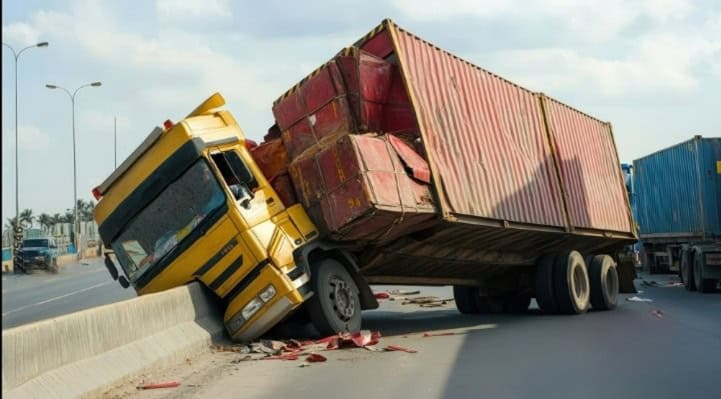
Improperly loaded cargo truck accident settlements in New York typically range from $100,000 for moderate injuries to over $5 million for catastrophic cases, with wrongful death claims regularly exceeding $2 million. These cases often produce higher total recoveries because the loader, shipper, carrier, and driver each bear independent liability with separate insurance coverage. The more defendants with provable negligence, the larger the available compensation pool.
Overloading means the total cargo weight exceeds the 80,000-pound federal limit. Improper loading means the cargo is unsecured, unevenly distributed, stacked too high, or loaded with inadequate tie-downs, regardless of total weight. A truck can carry 60,000 pounds and still be improperly loaded if all the weight sits on one side of the trailer or the cargo is not secured with chains and straps meeting 49 CFR Part 393 standards. Both violations create independent negligence claims. Learn more about overloaded truck accidents.
The cargo loader, shipper, trucking company, and truck driver all share legal responsibility for ensuring cargo is properly secured before the truck leaves the loading facility. The loader physically places and secures the cargo. The shipper determines how the cargo is packaged and provides loading instructions. The carrier trains drivers on inspection procedures. The driver must verify securement within the first 50 miles and every 150 miles thereafter under 49 CFR §392.9. Each party bears independent liability.
49 CFR Part 393, Subpart I establishes the federal cargo securement standards that apply to all commercial vehicles operating in interstate commerce. These regulations specify working load limits for tie-downs, the minimum number of tie-downs required based on cargo length and weight, specific securement methods for different cargo types (lumber, metal coils, concrete, heavy machinery), and the requirement that all cargo be contained, immobilized, or secured to prevent shifting, leaking, or falling. Violations create per se evidence of negligence. Learn more about FMCSA violations.
Improperly loaded cargo most commonly causes rollover accidents (from cargo shift raising the center of gravity), jackknife events (from uneven braking forces), road debris crashes (from cargo falling off the truck), and rear-end collisions (from sudden loss of vehicle control). Liquid cargo in partially filled tanker trucks creates a specific hazard called liquid surge, where the fluid shifts during turns and braking, amplifying lateral forces. Each crash type has its own distinct injury pattern and liability analysis.
Post-crash photographs of the cargo position, the condition of securement devices (broken straps, missing chains, empty anchor points), the loading manifest, and the driver's pre-trip inspection log are the most critical evidence. The cargo's position after the crash shows how it shifted and which securement failure allowed the movement. The loading manifest shows what was supposed to be on the truck and how it was supposed to be arranged. The pre-trip inspection log proves whether the driver checked securement before departing. Learn more about black box and ELD evidence.
The standard deadline is 3 years under CPLR §214, but physical evidence like broken securement devices and the cargo position must be preserved immediately. Carriers may scrap damaged straps and chains within days. Loading facilities may discard inspection records during routine purges. Government entity claims require a 90-day Notice of Claim under General Municipal Law §50-e. Wrongful death claims carry a 2-year deadline under EPTL §5-4.1.
Porter Law Group works on a contingency-fee basis, meaning you pay nothing unless the firm recovers compensation for you. There are no upfront costs, retainers, or hourly fees. The firm covers all expenses for cargo securement analysis, loading facility discovery, engineering experts, and litigation against multiple defendants. If the case does not result in a recovery, you owe nothing.

Founder and managing partner of Porter Law Group. Harvard University (B.A., 1994), Syracuse University College of Law (J.D., 1997). Former U.S. Army JAG Corps Captain, Airborne Training School graduate. Super Lawyers 14 consecutive years, 10.0 Superb on Avvo, Distinguished rating from Martindale-Hubbell. Over 20 years of trial experience and $500 million in recoveries.
Reviewed by Michael S. Porter, J.D. | Last updated: [April, 2026]
Improperly loaded cargo causes rollovers, jackknife events, and road debris crashes that devastate families. The securement devices and loading records that prove the negligence can be discarded within days. Contact Porter Law Group at (833) PORTER-9 for a free, no-obligation consultation. We work on a contingency-fee basis, so you pay nothing unless you win.
Phone: +1 833-767-8379
Email: info@porterlawteam.com
Monday to Friday: 8 AM to 5 PM | Saturday and Sunday: Closed

Avoid sharing confidential information via contact form, text, or voicemail as they are not secure. Please be aware that using any of these communication methods does not establish an attorney-client relationship. *By appointment only.
The information contained on this site is proprietary and protected. Any unauthorized or illegal use, copying, or dissemination will be prosecuted to the fullest extent of the law. All content on this site is provided for informational purposes only. It is not, nor should it be taken as medical or legal advice. None of the content on this site is intended to substitute for medical advice, diagnosis, or treatment. Attorney Advertising.
We serve clients in every city and county in New York State. These include places like: The Adirondacks, Albany, Alexandria Bay, Amsterdam, Astoria, Auburn, Ballston Spa, Batavia, Beacon, Binghamton, Brooklyn, Buffalo, Canandaigua, Carthage, Cattaraugus, Catskill, Cayuga Lake, Cazenovia, Chelsea, Clayton, Clifton Park, Cobleskill, Colonie, Cooperstown, Corning, Cortland, Delhi, Delmar, Dunkirk, East Aurora, East Hampton, Elmira, Fayetteville, Finger Lakes, Flushing, Fredonia, Fulton, Garden City, Geneva, Glen Cove, Glens Falls, Gloversville, Gouverneur, Great Neck, Greenwich Village, Hamilton, Hammondsport, Harlem, Haverstraw, Hempstead, Herkimer, Hornell, Hudson, Huntington, Ilion, Ithaca, Jamaica, Jamestown, Johnstown, Kingston, Lake George, Lake Placid, Lewiston, Little Falls, Liverpool, Lockport, Long Island City, Lowville, Malone, Manhattan, Manlius, Massena, Medina, Middletown, Monticello, Montauk, Mount Vernon, New Paltz, New Rochelle, Newburgh, Niagara Falls, North Tonawanda, Norwich, Nyack, Ogdensburg, Old Forge, Olean, Oneida, Oneonta, Ossining, Oswego, Penn Yan, Peekskill, Plattsburgh, Port Chester, Potsdam, Poughkeepsie, Queens, Rhinebeck, Riverhead, Rochester, Rome, Rye, Sag Harbor, Saranac Lake, Saratoga Springs, Schenectady, Seneca Falls, Seneca Lake, Skaneateles, SoHo, Southampton, Spring Valley, Staten Island, Stony Brook, Suffern, Syracuse, Tarrytown, The Bronx, Thousand Islands, Ticonderoga, Troy, Tupper Lake, Utica, Warsaw, Waterloo, Watertown, Watkins Glen, Wellsville, White Plains, Williamsburg, Woodstock, Yonkers, and many more communities throughout New York State.
Copyright © 2026, Porter Law Group. Personal Injury Lawyers
Made with 💛 by Gold Penguin


