
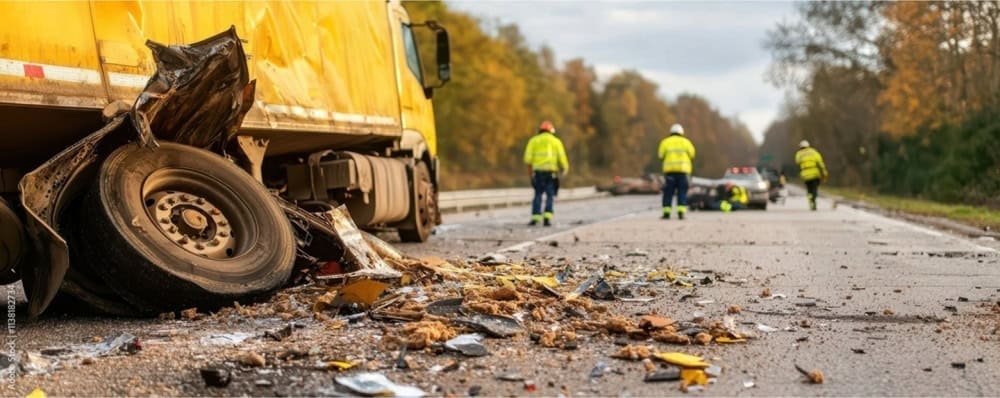
A collision involving a tractor-trailer, delivery truck, or other commercial vehicle usually involves more than just the driver. Liability can extend to the trucking company, the truck’s owner, a maintenance contractor, a cargo loader, or another business entirely, and each of those parties may control different pieces of evidence.
Commercial trucks are also required to carry electronic logging devices, and many carry event data recorders similar to a car’s “black box.” These systems can show speed, braking, and hours driven leading up to the crash, but the data is not preserved indefinitely.
Once a truck goes back into service or a logbook cycles over, key proof can disappear.
New York’s general personal injury deadline still applies to truck cases (three years from the date of the crash under CPLR 214), but waiting to act can quietly cost you the evidence you need long before that deadline arrives.
This is the main reason attorneys with real trucking experience tend to move faster and more deliberately than a generalist would in the same case.
Prior results do not guarantee a similar outcome.
What Makes a Truck Case Harder to Prove Than a Car Accident Claim?
A basic auto accident claim often comes down to two drivers, two insurance policies, and a police report. A truck accident claim usually involves more layers, and a lawyer needs to know how to work through each one.
- Multiple potentially responsible parties. The driver, the motor carrier, a freight broker, a cargo loading company, and a maintenance contractor may each bear some responsibility.
- Federal trucking regulations. Rules governing driver hours of service, vehicle inspections, and cargo securement can become central to proving negligence.
- Commercial insurance policies. Trucking companies typically carry much larger policies than personal auto insurance, and their insurers tend to defend claims more aggressively as a result.
- Technical evidence. Electronic logging device records, black box data, and maintenance logs often require someone who knows how to request, preserve, and interpret them.
- Corporate defense tactics. Large carriers often have investigators or legal counsel on scene within hours of a serious crash, working to protect the company’s position before the injured person has even left the hospital.
What Should You Look for in a Truck Accident Lawyer?
Because these cases involve so many moving parts, the lawyer’s specific experience with commercial trucking claims matters more here than it does in most personal injury cases.
- Direct experience with truck accident litigation, not just general personal injury or car accident cases. Truck cases involve regulatory knowledge that a generalist may not have.
- A track record of taking cases to trial. Insurers negotiate differently with firms that are known to prepare every case as though it may go before a jury.
- Familiarity with evidence preservation. Ask specifically how the attorney handles requests for logbooks, black box data, dashcam footage, and maintenance records, and how quickly those requests go out after being retained.
- Access to the right experts. Serious truck cases often require accident reconstruction specialists, medical experts, and sometimes vocational or economic experts to fully value a claim.
- Direct attorney involvement. Ask who will personally be handling your file day to day, rather than assuming it stays with the attorney you first spoke with.
What Questions Should You Ask During a Consultation?
| Question | Why It Matters |
| How many truck accident cases have you handled in New York? | Trucking claims require regulatory and technical knowledge that general injury cases don’t |
| Have you taken truck accident cases to verdict? | Insurers often negotiate harder against firms with limited trial experience |
| Who will personally manage my file? | Some firms hand cases off after signing; you want to know who to expect to hear from |
| How do you preserve black box, dashcam, logbook, and maintenance evidence? | This evidence can disappear quickly if it isn’t requested early |
| What experts do you typically use? | Reconstruction and medical experts are often necessary to prove liability and damages |
| How do contingency fees and litigation costs work? | Fee and expense structures can vary between firms and should be explained clearly upfront |
What Red Flags Should You Watch for When Hiring a Lawyer?
A few warning signs tend to separate firms that are genuinely equipped to handle a commercial trucking case from those that are not.
- Inability to name any actual truck accident cases the attorney has personally handled
- Vague or dismissive answers about how evidence like black box data or driver logs gets preserved
- Guarantees about what your case is “worth” before any investigation has taken place
- Treating your case like a routine fender-bender without discussing the trucking company, driver logs, or maintenance history
- Pressure to sign representation paperwork immediately, before you’ve had the chance to ask questions
What Are the Key Deadlines in a New York Truck Accident Case?
New York’s legal deadlines are strict, and missing one can end your right to compensation no matter how strong your case is otherwise.
| Deadline | Rule | What It Means |
| 3 years | CPLR 214 | General statute of limitations for a personal injury lawsuit in New York |
| 2 years | EPTL 5-4.1 | Statute of limitations for a wrongful death claim following a fatal truck crash |
| 90 days | General Municipal Law 50-e | Notice of claim deadline if a government or municipal vehicle was involved |
| Pauses until age 18 | CPLR 208 | The clock stops for injury victims who were minors at the time of the crash, resuming once they turn 18 |
New York also follows pure comparative negligence under CPLR 1411, meaning you can still recover damages even if you were partly at fault for the crash, with your award reduced by your share of fault.
Trucking companies and their insurers frequently try to shift blame onto the injured driver, which is exactly why preserved evidence and an attorney comfortable proving fault matter so much.
What Kinds of Truck Accident Cases Require This Level of Experience?
Not every commercial vehicle crash looks the same, and the right lawyer should be comfortable handling the specific type of case you’re dealing with.
Porter Law Group’s truck accident practice covers a wide range of vehicle types, including 18-wheeler accidents, semi-truck accidents, delivery truck accidents, dump truck accidents, tanker truck accidents, and tow truck accidents, among others.
The same is true when the underlying cause involves distracted driving or overloaded cargo, where proving the underlying FMCSA violation or instance of trucking company negligence often becomes central to the case.
Summing It Up
Choosing the right truck accident lawyer in New York comes down to finding someone who treats your case like the commercial trucking claim it actually is, not like an ordinary fender-bender. Evidence disappears quickly, multiple parties are often involved, and insurers defend these cases aggressively from the very beginning.
Porter Law Group has built its reputation on trial-tested representation for injured New Yorkers, and the firm’s attorneys work on a contingency fee basis, meaning you pay nothing unless we win.
If you or a loved one has been hurt in a truck accident, reach out to discuss what happened and what your legal options look like.
Call 833-PORTER9 or email info@porterlawteam.com to schedule a free consultation.
Prior results do not guarantee a similar outcome.
Frequently Asked Questions
How long do I have to file a truck accident lawsuit in New York?
Generally three years from the date of the crash, under CPLR 214. If the crash involved a government or municipal vehicle, a Notice of Claim is generally required within 90 days under General Municipal Law 50-e.
Who can be held liable in a New York truck accident besides the driver?
Depending on the facts, liability can extend to the motor carrier, a freight broker, a cargo loading company, a maintenance contractor, or the manufacturer of a defective part. A lawyer familiar with commercial trucking claims will investigate each of these parties rather than stopping at the driver.
Can I still recover damages if I was partly at fault for the crash?
Yes. New York follows pure comparative negligence under CPLR 1411, meaning your compensation is reduced by your percentage of fault rather than eliminated entirely.
Why does evidence disappear so quickly in truck accident cases?
Electronic logging device data, black box records, and dashcam footage are not preserved indefinitely, and a truck can be repaired or returned to service within days of a crash. A preservation letter sent early in the case is often what keeps this evidence available.
How much does a truck accident lawyer cost in New York?
Most plaintiff-side personal injury attorneys, including Porter Law Group, work on a contingency fee basis. You pay nothing upfront, and there is no fee unless the firm recovers compensation on your behalf.
This article is for informational purposes only and does not constitute legal advice. Attorney advertising. Prior results do not guarantee similar outcomes.